The future of work in America
September 4, 2012
Technology and the Web are destroying far more jobs than they create. We will need to develop a “Third Way” based on community rather than the Market or the State to adapt to this reality, novelist and economic commentator Charles Hugh Smith writes on Business Insider.
“The Internet is destroying vast income streams that once supported tens of thousands of jobs in industries from finance to music. Craigslist has gutted the once-immense income stream from newspapers, and web-based marketing has shredded print-media advert page counts. Global competition and pressure to maintain profits and margins relenetlessly drives enterprises to slash payrolls.
“As a society, we need to admit that ‘free-market’ capitalism is not going to bring back these lost jobs. Thanks to technology, society is capable of meeting basic human needs (food, clothing, shelter, transportation) with far fewer workers percentage-wise than were needed in the past. But as a society, we also need to admit that socialistic solutions won’t work either.
“I see community as the only viable way forward. Many aspects of human life cannot be turned into a ‘market opportunity,’ nor can they be taken over by the insolvent central-planning Central State. Paying people to stay home and rot is not a solution, but neither is paying people more than they produce in competitive markets.
“There is a ‘Third Way,’ but we’ve lost the skills and infrastructure required. Of the three elements of civil society, the Market and the State have crowded out Community. We either re-discover the labor-value of community or we devolve further into a potentially “death spiral” social and financial instability.”


Comments (108)
by roger l
I am an old man, think that my life is about over, but i would like to see the human race last a few more years. We should not teach robots emotions and they should be controlled or in time they will have control. I am not talking about the near time, but over long, I hope, long, time, depends upon how we program them. Again, watch emotion is robots, they do not need them for a long time. We have the knowledge to give AI the full range of emotions over time, and robots will soon have the things that make us think we are humans and cannot be replaced.
Roger
by Alison B Lowndes
Totally agree with @Mark Petereit thats its about progress and adaptability. I’m of just-above-average intelligence but certainly no genius. I was taught (or was genetically equipped) with creativity. Especially without privilege, you can teach a child anything! The “McDonalds” generation, especially those really bleeding welfare system’s in UK/US simply weren’t given the education and robots will never replace good teachers. Start there. Community will always exist even in mega-cities but its not the way forward.
by Khannea Suntzu
I didn’t envision “posthuman” in terms of dignity and income. But it looks like economy itself is becoming posthuman. We are inheriting a Terminator economy, run by Romney/Gekko Skynets who are dead set on getting rid of the flesh components in the production cycle.
by Editor
So the “posthuman economy” (a felicitous phrase, that) is a good thing, then, right? No more human slavery in robotic jobs! Once we have artificial food, 3D-printed houses, molecular computers, infinite life extension, and infinite energy from space: universal virtual wealth beyond our wildest dreams! Or am I missing something? :)
by Stephen Willemse
Your not missing anything…….. That is what we are working toward is it not ?
by hal
amazing to know how many do not see the compounding interest of the industrial revolution augmented by the information age. Whatever the magic potion of brain and brawn that created elongated versions of the Pharaoh-Emperor-King-Sheik-Czar leisure class in the past will represent the non-working class in the future. Through the natural attrition of death and man made additon of violence and war i suspect this future makeup likely to spring forth from the Tycoon-Entrepreneur group with hall passes for certain skill sets (although soon enough many of us of mortal salts (like editors) will be able to augment up to the elites. Yippee-skipee!
by Bri
I’m not able to follow your line of reasoning. Your speaking in sweeping generalities. The most specific thing you mention is the job of editor. I don’t see how that trade will be immune to job loss and somehow end up at the top of the heap. I’ve asked before for anyone to profer up a job that would be immune to AI robotics taking it over, so unfortunately I’ll use it ad an example. Watson I’d very close to understanding the meaning of questions. In some respects it’s already superior. Before the best humans could hit the button it had an answer. Not just your average human. These contestants are really smart and have extremely diverse knowledge bases. It won’t be long before they will be able to read a research article and write a commentary about it. ( it will take longer for movie reviews because it’s visual information and so it’s more dense with processing) even if Amara was equally as fast, which is impossible because biological circuitry is way too slow, it is far more cost effective to have the box of circuits than to have a flesh and blood editor. She has to eat, sleep, vacation, etc. In the real world the AI editor will happen way before the implants. Before she could type a single word the article would be posted without spelling errors. That’s the real world. It will take out all jobs on all levels. Ray says that by 2045 computers will be so powerful that they will be able to think every thought by every living person for the last 10,000 years in micro seconds. He’s not talking about one computer. Because of robotic automation there could be billions of them. Each and everyone of them so inexpensive that they would be cheaper than a days pay. It is impossible to compete with them. End of story. So if our financial system stays the same, the only ones making any money would be those that have too much already. The ones who own the companies. I think capitalism is doomed way before 2045 so that’s less than thirty years from now. With the state of regenerative medicine advancing at the rate it is there won’t be as big a die off as your thinking. Wars are another issue. Unfortunately some people will rebel. Maybe I should say a lot of people will try to rebel. The laws of the land will intercede and crush that rebellion faster than it can organize. The AI programs will spot aggressive behavior before you can grab your gun. If you don’t obey and marshal law has been declared. You’ll be dead. Have a cup of coffee, I mean green tea and wake up. This is for real. It is happening. You in reality don’t even really own your house. The one percent do!!!!
by Editor
>profer up a job that would be immune to AI robotics taking it over
Robot counselor, robot overseer, robot-human mediator, robot-human communication specialist, robot assistant, various unknown government positions (assuming there is a government), entertainer (making robots laugh at human stupidity, etc. — typical show: Stupid Human Tricks), robot-human planning commission member, editor (wishful thinking), anti-Skynet mercenary (temporary job, pre-Singularity).
by Jan Parker
Well, economicly the only thing I buy new is food. It’s either ebay or dhgate.com. I buy directly from the manufacturer in foreign countries at a discount, and I am not at all ashamed of it. In the case of clothes they are tailor made for me. There is a tailor down the street from me and I tried to walk in and was dismissed at the door. So there are many reasons why I don’t buy local, and if I could get good food that way I would. I can’t wait until we can print our own food so I don’t have to go to the damn grocery store and face the broken lives of the people working there. The economy has changed, may as well get retrained now, cause the manufacturing jobs are not coming back, and we are learning to delete the wal-marts of this world too.
by William McGaughey
The following solution will not work politically but it work economically:
The federal government could initiate a shorter workweek simply by amending the Fair Labor Standards Act. This would create a financial incentive for employers to limit weekly hours per employee and, if they can’t meet their operational needs, hire more workers. Wages would float according to the supply and demand for labor. (Shorter hours means a reduced supply of labor so that wages would tend to rise.)
These are proposed changes to FLSA:
1. Reduce the standard workweek from 40 to 32 hours.
2. Raise the overtime premium from time-and-a-half to double-time (if additional disincentive for overtime is needed).
3. Shrink or eliminate the exempt category.
This would be an appropriate response to the challenge of robot labor but, of course, neither Democrat nor Republican would consider it because they want the flow of taxable incomes to continue unabated.
by chrisflondon
As technology advances, two distinct things will happen :
As AI grows in sophistication, the cost of human labor will plummet. At some point in the future, it’ll cost a dollar to purchase the combined brainpower of a 1000 Einsteins or the craftsmanship of 1000 Michelangelos (all emulated in software of course). The value of anything that these AIs can possibly produce will fall vanishingly close to zero once you subtract the cost of raw materials.
Simultaneously, the cost of energy and those raw materials will fall. The amount of solar available to us is effectively limitless, as is the amount of matter that we’ll be able to harness (even if it means reaching into space). Hence these costs ultimately fall to zero also.
Both these changes are inevitable. The interesting question is, which one will happen first ? I believe this will determine how the next few decades unfold. “A” followed by “B” is a frightening prospect; imagine living in a world where your labor is effectively worthless yet physical goods are limited in number and out of the reach of most. On the other hand, A then B seems more palatable; our incomes may fall, but the costs of physical goods and materials falls faster.
Unfortunately, current evidence suggests that we are heading down the first path…
by John M.
We all shall have our answers the day unemployment will reach 40-50%
The sad fact is that the political class is useless at best, when not nefarious.
There is no hope for a gentle solution to stop the building of a class warl in a country that has managed to give a label of respectabilty to corruption by calling it “lobbyism” , this has open the gates of hell since a long time, so , folks, be ready, the solution might well start with an Insurrection, since lobbyism has already killed democracy, and it’s political mechanisms are jammed.
by Giulio Prisco
@Khannea re Ayn Rand: Note that modern big capitalism is protected by the state and indistinguishable from state control. I am not sure how Rand would react.
Today, big capital knows that bribing politicians, expensive as it may be, is still much cheaper than R&D, quality assurance/control, and customer service. So instead of offering good products and services they buy politicians to kill competitors and new entrants with regulations.
by Khannea Suntzu
http://www.batr.org/negotium/090512.html
by Editor
http://www.batr.org/negotium/090512.html
Excellent. A must-read.
by Rick
What is described in the article is already happening. Buying Local is the means of creating community. Less trips to WalMart for junk is a means of creating community. We just have to realize that there is this inherent dipole of behavior in humans: 1) is inquisitive, inclusive, future thinking; and the other 2) is reactionary, selfish, exploitive and believes in a zero-sum game. Both have had survival value; however, when one moves to far in either direction the results are unsustainable. This is our current condition.
I for one will not buy an iPad because: 1) Apple is not as innovative as they pretend to be; 2) it is made by sweatshop labor in China; 3) the profits of Apple are possible based on the relative disadvantage of the Chinese people; 4) instead of investing in revolutionizing manufacturing in this country Apple employs 19th century models; and 5) I don’t really need it.
by Gabor
I don’t know. How about an iPhone? You are using a smartphone, aren’t you? I don’t buy Apple either for my own reasons but I do have a Samsung smartphone, which is also not a “local community” product. Buying stuff at home with your computer does not count “buying in the community”. Even when you buy something in your local “mom pop grocery”, half (or more) of the products are not local. Also I don’t think that your two types of humans are mutually exclusive at all. We all have those behaviors, some of us just more willing to recognize them than others.
by tim the realist
Why do we still have a 40 hour base workweek? Fewer hours of work per person each week will allow more people to be productive and free up some time for the overworked top performers.
by Rick
This is a Keynsian notion. John Maynard Keynes proposed that the increased productivity of the industrial revolution would ultimately lead to much more leisure time. Hasn’t happened yet. I recall a line from Star Trek the Next Generation. Richer explained that members of his civilization lived to improve themselves. Such a world is possible.
by cosmowrench
Maybe employer ownership is the solution? I know of some projects going on in my country where the employees of a company are the only shareholders of that company. And from what i hear its working out quite good.
by Paul TREHIN
Sorry for typos and other errors in my previous message. Here it is with corrected errors:
Indeed Khannea Suntzu.
Teaching high level skills to people who had low level and higly specialized training will be almost impossible.
That’s why I advocated for a high level general education, the kind that enables one to be learning even when technologies or methodologies change rapidly. and further mor to enjoy learning.
Such general education is necesary also in manual jobs:
See Matthew Crawford’s book : ” Shop Class As Soulcraft: An Inquiry into the Value of Work.”
Where the author insists on the need of shopclass education as a basis for intellectual education, and vice-versa.
A friend a mine, Plumber by trade, told me that he had no problem finding youngsters who knew about soldering or plying and glueing pipes but his problem was finding young employees who knew “when to ply, solder or glue pipes”
Note that craft jobs directly in relation with customers are difficult to “offshore” and so far, in the present state of technology, also difficult to replace by automated machines.
Paul
by TM May
Most folks here seem to think data-internet-related work provides food, water, and shelter.
It does not. Farmers do.
We have already overbred far too much.
But food and water are real ‘necessities’.
We should probably be alot nicer to our land, our animals,
and our farmers.
If we want to eat.
by daveb
The most important part of your argument is to simply stop eating animals, then try sourcing your vegetables and fruits locally when possible.
by Mike Clayton
As soon as automation finishes off Wall Street (should be easy to automate the bond and stock trader’s jobs, and the financial services employees) we should be able to put those guys back to work in the health care industry, managing organ transplants for the rich and famous, right? Few jobs are really hard to automate if they are broken down into sub tasks and workflows with conditions, and the physical side of the work all done by robots, leaving a very small number of interventionists that are given the power to decide the undecidable. Those would be the REAL 1%…not the richest 1% but still leaving the 99% to “vote” for their favorite deciders…since money will be eliminated, and property ownership will be decided by community rules. Glad I am really old already.
by Khannea Suntzu
This topic discussed on KurzweilAi, a site that only recently glamorized the ideals of Ayn Rand. I live in truly surreal times!
by Editor
Then you’ll love the Part 2 movie teaser video tomorrow…. stay tuned :)
by Khannea Suntzu
http://medic343.wordpress.com/tag/anton-lavey/
by Editor
http://www.kurzweilai.net/atlas-shrugged-part-ii
Happy now?
by Khannea Suntzu
If I was a straw figure I wouldn’t feel attacked right now. I’d feel raped.
by hal
rand was on point regarding some aspects but missed the curve for women’s right by half a decade-1957 to mid 60′s. and such a hero worshiper for all the hoopla about individual effort. it is 700 pages of looking for someone to worship ala justin bieber, lady gaga, or steve jobs. look inside yourself and breath….that’s it. the future and past don’t exist just now, and if one is commenting on this piece they are not likely starving or short on Maslowe’s hierarchy of needs. well….maybe they are not loved…..hmmmmm.
by GFreemanPHD
Currently the 1% needs the 99% to: a) provide labor for the production of goods and services and; b) provide wealth for the 1% to extract. Because the 99% has the power to vote the 1% has an interest and need to influence and control their political thought.
Current trends: a) more and more goods and services are being produced with intelligent automation replacing human labor; b)Wealth and income are moving to the higher income levels; c) political rhetoric and influence is being controlled by the very rich and; d) the 1% are reducing the political power of the 99% by suppressing their vote.
Future trends:
1. Government of the people, by the people, for the people is being replaced with government of the corporation, by the corporation, for the corporation. [Corporations are people too my friend- Mitt Romney]. The 99% will eventually have little or no political power.
2. Labor costs will continue to be reduced with the 99% moving to serfdom.
3. Unemployment will increase as human labor becomes more and more obsolete and is replaced with intelligent automation.
When most of the income and assets is in the hands of the 1%, the economy will depend only on the spending of the 1%. Walmart and other stores that cater to the masses will rapidly disappear.
With no need for labor by corporations, welfare support of any type (food, clothing, shelter, education and health care) will be an unnecessary burden on the 1% as they will be paying for it with no return on their investment.
by Bri
Exactly! That’s the eventuality of it. As the consumer base is eroded to the point of having no money, the one percent won’t be able to stop the trend. Without sheep to be fleeced the economy will come to a halt. Even the corporations themselves will be run by robots. Then money has absolutely no value. Being rich will be meaningless. A billion dollars is a thousand dollars a day for two thousand seven hundred and thirty nine years! You can’t spend it on day to day needs. No matter how jacked up your house can be, you still can’t spend it! It just sits in a bank where they lend it out to make more money than they can spend. If instead anybody could go to a bank, take money out and spend it, where do you think it will end up? In a bank. The business will prosper put it’s profits into a bank for other people to spend, if we all have access. If you spent money like a drunken sailor it just makes more money for other people to spend.
by HHHoppe
This is the same rhetoric main stream economist and Luddites have been saying since the industrial revolution. The fact is, as production cost fall, the total quantity of goods increase, there by making consumer goods cheaper for everyone. This is why the standard of living in the industrialized nations has continued to increase over the last 150 years of increasing technological automation.
by Alex
Hmm… this seems like a waterbed effect, where humans will simply have to pull finger and adapt. If menial jobs get replaced by robots, then in order for us humans to stay on top of the food chain, we need to develop skill sets that are simply beyond the ability of machines. The problem is machines will inevitably catch up and overtake. Even skills like accounting, economics, actuarial science, engineering are all eventually going to be displaced by some super clever machine. The only, and in my opinion ONLY solution to not being totally dominated by our machine counterparts is to simply merge man and machine, so that a harmonized symbiotic relationship forms at the outset before there is a ‘them and us’ scenario. Anyway just some random thoughts on what could be unfolding.
by Gabriel
I totally agree….it’s why I don’t think their be an “Artilect War” like Hugo de Garis thinks — their is not going to be an “Us vs Them”…their is only going to be an “Us”.
We are a people that is very intimate with our technology; we always have been…when we enter the realm of Strong AI, that will be even more so…and when that Strong AI is billions of times smarter then the un-augmented, it will be even more so….and when the lines are so blurred, what makes one think that it will be any easier for an AI to notice the differences between AI’s and human beings anymore?
The same way people don’t see computers and technologies as a “them” in today’s day (well, except maybe Luddites and radicals), I believe it will remain that way in the future….their will be no great war, or rift between man and machine because we will not allow one to happen.
It’s not a foolproof strategy, but it certainly puts the odds in our favor.
by Raeganne
Let’s start focusing on getting out of low Earth orbit and colonizing…that should diffuse the disparity between jobs and labor a bit with small colonies
by tim
Thats the real deal
We are 10 times more more likley to be killed in an end of civilisation event (yellowstone eruption-asteroid) than in a plane crash.
So come on 1% get us out of the cradle Mars and the Moon
by Guy Clinch
What does “re-discover the labor-value of community” even mean? What kind of jobs come from such a rediscovery? I have no idea what this guy is talking about. Can someone explain it to me?
by Guy Clinch
What does “re-discover the labor-value of community” mean in practical terms? How do we do that? What kind of jobs does that create?
by Jon
Perhaps a return to a more agrarian society? Relearning the love of growing, cultivating, harvesting your own food within the a social network defined by family and community?
Learning to do things for ourselves, and being dependent on each other, all over again?
by Charlie
…so you mean basically poor as shit coal miner’s daughter lifestyle. A return to being crazy poor farmers stuck in a Malthusian trap is purely insane. A romantic notion only because there’s a song about it. That is just laughable.
by cosmowrench
Farming is no exception when it comes to automation. GPS controlled machines can cultivate land with very little human labor.
by Khannea Suntzu
/me envisions a world with beautiful national lush parks everywhere. With mini gun equipped robots patrolling the barbed wire fences and Mitt Romney playing golf in a course the size of Tanzania.
And here and there a few contained Gaza-style internment compounds with hundreds of millions of “the economically unviable” fed dole yeast and made to feel grateful with an endless barrage of “XFactor” blaring from huge billboards.
by MrFriendly
A lot of jobs will be outsourced via telepresence robots.
I may have to move to India to find work.
by angelchrist
does India have job?
by Khannea Suntzu
Oh yah for a while.
by Cassini
I think that for every job lost due to automation should be created a new position in scientific research. The number of scientists will never be excessive. Thus, the gains from automation would be used to produce more innovation.
Likewise, if systems like IBM’s Watson “take the job 80% of the doctors,” this large contingent of qualified individuals should be directed toward medical research.
A laboratory of course involves not only jobs for scientists. There are auxiliary positions that would be filled by those with no interest or aptitude for research.
I think something like that would be more interesting than simply distribute money via welfare. The controversial side of this is that taxes would fund it.
If the U.S. manages to do something like that the influence of the West (including the idea that it is desirable to use technology to change for better the condition of people individually considered) will be extended. Otherwise, the population advantage and China’s investments in the production of science and technology will surpass the U.S.. With the advancement of automation in China, that country will have a number of engineers and scientists far greater than the U.S.. And a government able to do things quickly. History has shown that the maximum of Francis Bacon (“Knowledge is power”) is quite accurate.
by Tim Coulter
Virtually any proactive solution is preferable to “simply distributing money via welfare”.
However, although your suggestion takes an optimistic view of how we might productively use our redundant skilled labor, it fails to acknowledge the negative consequences. if we assume that all this extra effort spent on medical research is likely to yield some significant health benefits, we can also assume that there will be a further increase in life expectancy, which will simply add to over-population and aging-population problems that we currently have.
Whichever way we choose to solve this problem, we need to pay attention to the side effects that are likely to come as part of the package.
by Bernard Denis
Well this article does touch a nerve, and gets a lot of coments, we are in a transitional period. But what I see is that most people view the future with the current conditions. But the future will be with future conditions, many ethical problems will be solved, longer life and possibility to opt out by comitting a happy “going away forever” swith friendss may become the norm.
Also then, most commentators refer to social welfare and rotting home as obligatory non desirable consequences of a completely robot manual work world. But thinking it differently, if world society pays a real salary to all that are born, and gives a bonus to those who WANT to better their community through manual labor, as art, friendly service or anything else, then it becomes a different story.
Many people would WANT to stay home, and do what pleases them. Many people are miserable at work but forced to do it to sustain health. If you can think of a meaningful life reading and doing as you please, then you do not see that as negative. Most people reading this newsletter are educated individual, hard working is a way of life and nonchalance is absolute nonsense. Most of that is inherited through culture.
This transition may take 200 years, or less, but in the end, I believe capitalism will leave its place for a mixture of social capitalism, which will later totally disappear in a world where equilibrium has reached it’s full potential.
The planet is not lacking food to feed its inhabitans, nor money to pay them, the biggest problem is distribution. But even that is starting to be addressed.
This comment is a much reduced version of what is needed to accomplish, to see this positive continuation in turmoil times. But the world shows signs of marching towards it.
by Khannea Suntzu
You want fries with that Biogenetic research?
by Carl Brooks
Its simple rationality that shows us things have to change.
if more than 50% of a democratic population of a country becomes unemployed, that is a tipping point. The unemployed being in the majority would force change to happen. Any politician going against what the majority wants, will be voted out of power and if they do not relinquish that power, they will be forced to relinquish it. It wont quite be the french revolution, people wont be decapitated or anything like that but things will change, of that there is no doubt.
What will this “change” be?
I have no idea…. that would be speculation at this point.
Speculating a hope of what it would be, I hope for everyone to be able live happily and peacefully however they see fit.
What i hope it wont be, i hope it wont lead to any form of population control. That would be absolutely disastrous for every single person in that population be it the controller or the controlee of said population (i doubt this will happen tho, we’re better than that)
by Joe Atiyah
China has already used population control.
It would have been disastrous if they hadn’t.
As it is China will have 50% of its population over retirement age by around 2050. Big problems.
by Matt
Why shouldn’t humanity’s progress at eliminating the need for
labor simply/naturally result in humanity not needing to exert
as much labor for basic subsistence ?
I’m certainly not saying that people should be “given”
the basics, especially not at tremendous cost to others. Why
should one have to pay $100000 to support 100 people at $1000
each (analogous to a corporatist/statist welfare economy), when they could support themselves at $10 each in a freed market economy where the prices naturally reflect both demand and cost of production ?
In short, I guess I’m proposing that application of natural/freed market forces would turn decreased demand for labor into correspondingly decreased cost of a basic-subsistence standard of living, which in turn decreases the need for people to work as much/hard for that standard of living.
by grettir76
I totally agree that tech is destroying more jobs then creating right now, our biggest problem right now is dumbwitted economists that are extremely narrow minded and cannot open their eyes to the great transformations that are really going on.
http://www.businessinsider.com/why-the-american-jobs-market-is-in-such-horrible-shape-2012-9
But never say never, maybe things will get better with time and we will see all these new 20million net woth of jobs that will be needed in the next decade or so in the US alone, I just find it highly unlikely but its hard to dismiss history, tech has always created more or an equal amount of jobs then it has destroyed in the past, but keep in mind there is no law about a special balance here, there is nothing to say this will continue forever.
by Bri
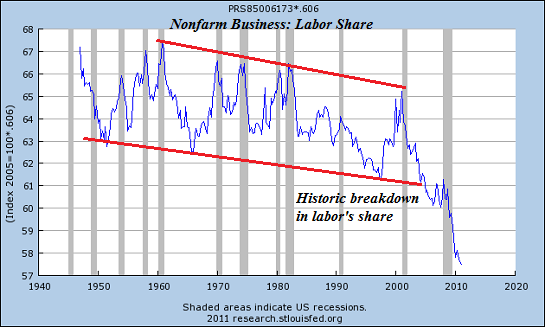
If you think that chart looks bad, just wait till the robots are autonomous and can think like a human. That’s when I say it will all go down the drain. There is no way you’ll be able to learn as fast as them or adapt. About ten years out it will really kick in.
by vspyder
The sad thing is that even the lowly paid Chinese workers are not immune. Currently in China, the workers are replaced by robots\machines when their wage demands make them economically unviable. It’s the way of the world unfortunately.
by GFreeman
Foxcom the manufacture of Apple products has announced that they will be replacing 1,000,000 workers with robots over the next three years.
by roger l
Has the Apple executives thought about what they will do with people who are released because of athomation or AI.
by GFreemanPHD
Foxcom the manufacture of Apple products has announced that they will replace 1,000.000 workers with robots over the next three years.
by GFreeman
Robots are already autonomous, Goggle’s self driven car as an example. Robots that and think like a human is neither praticable nor desirable, thiink of all the insane robots there would be. Instead robots will think defferently and be more intelegent than humans. Think intelegent automation that can easily adapt to any task. Humans as workers will be obsole. Thomas Paine’s garanteed minium income for all is the only answer.
by GFreemanPHD
Robots are already autonomous, think Goggle self driven car. Human thinking can lead to insanity. Do we really want millions of insane robots running around the country. Insead thing of intelegent automation where robotic devices and instantiously adapt to new tasks and situations. Exept for human to human interaction, human workers will be obsolete. Thomas Pane’s idea of guaranteed minium ilncome for all people is one answer.
by Ralph Elliott
I agree that we have a severe problem. There are, however, a couple of points that I believe are being overlooked:
1. Most people will never be able to perform any of the high tech jobs that will be left regardless of how hard you try to train them. People graduate and can’t do basic percentages.
2. The Free Market only really works at a local level. Where people know the owner of the company and the company is actually at risk if a neighborhood begins to spurn its products. The customer must also be able to judge the quality of the products (full disclosure of the contents would be a start). When you have a multinational with a turnover greater than the GDP of most countries, they aren’t too concerned about a few hundred or a few thousand consumers.
3. When the majority of a county’s wealth is controlled by a minuscule percentage of the people, this minority can to a large degree control the government and shape the laws to suit themselves (see the tax laws).
I think there are many possible constructions that could be viable but I see none that can actually be implemented given the current circumstances and vested interests. See the polarized and paralyzed state of US politics.
by Hoss
It doesn’t matter what your profession is, in a purely hyper-competitive, unregulated free market if you are the second best, you will eventually be destroyed. The rise of tech is a product of Capitalism’s obsession with efficiency and employees with salaries and benefits are the most inefficient feature of any industry eventually. The solution will be political whether we like it or not. We must set up a safety net that is able to absorb all employees who will lose their jobs to machines and algorithms…so we can wear togas and debate philosophy all day with a virtual Plato, or work on our gardening. Life doesn’t have to be hard and stressful and competitive. The Singularity is a comin and it’s no friend of Capitalism.
by Ante
I’m sorry but it seems like you have a false concept of Singularity (which goes for most commenters here – a surprising fact considering that we are all on KurzweilAI). Singularity is the product of competition. Whether we call it evolution or capitalism or anything else.
It is undeniable that competition is the basis of progress. But competition does not necessarily require capitalism. The traditional model of capitalism involves large corporations attracting capital and hiring workers for producing products. It used to be an amazing paradigm which enabled building things like railways across countries, coordinating thousands of workers, accumulating capital from hundreds of individuals.
Today, this is a dying paradigm. According to management theory, large corporations exist because internal transaction costs are lower than external transaction costs. It means it’s easier, faster and cheaper telling people what to do in a factory in order to get a shoe in the end than running around alone and trying to find someone who sells leather in order for you to make a pair of shoe and then sell it some other person. But this was a paradigm that was built in an age of slow information.
Today, we’re nearing an age of ubiquitous and fast moving information, fast transport and growing cultural understanding. It is getting very, very easy to find the man with leather and the guy to sell the shoe to. The question we have to ask from ourself: how long are we going to need large private and public corporations for production and wealth distribution?
Yes, traditional capitalism favors the elite but the solution is not that we rely on large public entities (the state) to tax them. First, because they are just as corrupt and abusive as private corporations (and also, inefficient and incompetent). Second, while corporations operate globally, this form of civil control follows political borders. You can’t tax Microsoft in France too much because it simply moves investments to another country.
The solution is empowerment. With all that information available we don’t need large, complex, corrupt structures any more. Traditional structures are breaking down to make way for little, agile teams of entrepreneurs who may be the avant-guard of the next paradigm. They are more transparent, can operate via flexible, virtual platforms and can make valuable products fast and efficiently BECAUSE of tools available due to automation.
And they enable a more democratic distribution of income if we apply models where team members are shareholders at the same time. The elimination of physical and administrative workforce – which everyone seem to dread so much – can actually make everyone a boss and make way for more creative jobs.
by Brett McLaughliun
Ante, that might work for a society’s super achievers, but I don’t think that an average person can find ways to operate transparent, flexible and virtual platforms to create products fast and efficiently.
Indeed, I think that you’re *right* that these opportunities will present themselves, but only to the exceedingly gifted and/or lucky — which is pretty much the way it is now: A few billionaires, a million or so people trying to start the next new thing, and then the huddled masses.
by aus
Hoss, I think your post is the most prescient one here. Capitalism is doomed thanks to Adam Smith’s invisible hand itself. As workers are replaced by robots, the firms that use the robots will lose customers. Basic income will be necessary lest the unemployed masses rise up and destroy the establishment.
I also envision America as a futuristic techno-Athens with robots playing the role of slaves.
by Foye Lowe
Here’s a post-Labor Day rant for you:
There is hardly any gentle way of conveying a hard, harsh reality. Some folks, accustomed to the usual circumstances at least in this country, will not see the reality, and, indeed will proclaim the reality to be otherwise. Let them at least consider the matter, and understand the point.
Here is one reality: Humans are social animals.
Well, of course. That sounds nice and uncontroversial. As in, “they gather for afternoon teas and and soirees and debutante balls.” No. I mean as in “they gather for lynchings and riots and gang fights. As well as the slightly less gory but often physically brutal sports contests and somewhat more gory purges and wars and genocides.”
In the circumstances of lethal struggle between gangs or nations or human groups of one sort or another, in-group cooperation continues at least to some extent, but inter-group competition becomes, well, deadly. At those times, the hopeful rights to “life, liberty, and the pursuit of happiness” are minimal, or nonexistent.
Let me emphasize that point: the notion of some divinely-provided right to even life, much less private property, is whimsical when civilization disappears.
So we get to the hard, harsh reality: What you think of as yours – your life, your private property, your family, your home, your little or large homesite, your whatever – is yours ONLY while there is civil order, or while you can prevail against those who do not recognize your claim. Your rights are entirely or almost entirely dependent on a general consensus that what is yours, is yours, and that the group will have in place and maintain mechanisms to preserve your thus-created rights to what is yours. You can have what you regard as yours, or some portion thereof, ONLY by the sufferance and forbearance of a sufficiency of the group. Even those in the stone castle surrounded by the moat, or in the gated communities with access to private jets, are subject to the physics of this reality: Everything can be taken from you by a strong enough mob.
Where am I going with this rant? To the subject of taxes, to the distribution of wealth among the populace, to the cash flow which acts like the circulation of blood in the body. You may not like taxes, but who does? You may deplore the slipshod, inefficient, and sometimes corrupt manner in which taxes are used, and the purposes for which they are used. But without the bribe (as it were) of taxes to provide an adequate amount of social stability, your “rights” to life, liberty, pursuit of happiness, and to private property – all such rights – will disappear, along with the thin veneer of rules of behavior and respect for order that are civilization.
The barbarians and savages are not only at the gates. They are among us. At the present time, we call them “criminals”. Without taxes (and without a say-so in their use), the same group expands widely and becomes not criminals but revolutionaries. Folks want more than cake. Billionaires, take note.
by Tom Bellinson
Spot on! Our society has almost finished coalescing into lenders and borrowers. Either you have capital to use for profit making, or you must borrow money to subsist. We assume as the number of people with capital shrinks and the other group grows, we will somehow find answers within civilized society. Greed being what it is, revolution may be the only alternative to fixing a broken system.
by Daniel
Foye, you are writing your rant under the incorrect assumption that only the State can uphold social stability and that without a State our civilization would crash into oblivion. The truth is the State does a very poor job of protecting your rights and your property, and is possibly the biggest cause of social instability in the history of mankind. Another fact that adds to this is the States goal of having a monopoly of violence, where the State requires you to give up your own rights to self defense by restricting gun ownership etc.
You are right that the “criminals” are among us, but I would propose that the real savages are the people that run the Governments of the world. They are running protection rackets to survive, and if you don’t pay up the “bribes” they send out their armed thugs (the police) to take your property from you using force and throw you in jail. If you resist you’ll likely end up with a bullet in your head.
Regarding what you call criminals, a lot of them are largely a product of Government intervention into the free market in the first place. Governments create criminals, and then they steal from you to protect you from those criminals. Now that’s a nice business model isn’t it?
by Brett McLaughliun
Daniel, can you cite an example of an effective society that operates without a government? Like, even a single one?
Also, calling taxes “bribes” is a sh*tty thing to say, and highly inaccurate. The government provides a pretty impressive array of services: roads, fire and police services, defense, social security, medicare. To be sure, there’s inefficiencies (and too much spent upon defense, if you ask me), but that’s NOT to say it’s just a big shakedown.
by Gorden Russell
“lynchings and riots” sounds good to me. Every so often we need to hang a banker to encourage all the others. Was it Voltaire who said that?
You made a really great point, Foye, when you said, “… the notion of some divinely-provided right to even life, much less private property, is whimsical when civilization disappears.”
When unemployment benefits run out on 50% of the population, a lot of people will stop voting Republican. Instead they will pick up their guns and march on the Hamptons, Belaire, and Palm Beach. The people at ALEC will curse the day they wrote the model legislation for the Stand-Your-Ground laws. The people we used to call “gun-nuts” will be called liberators when they start passing their assault rifles and riot shotguns out to the neighbors. Then the guys at ALEC will wish that they’d voted for the taxes to pay for unemployment benefits to last until age 65. Taxes will have to be levied upon the robots and computers and even on the very algorithms that replace people.
by David Taylor
Look at the chart. It clearly shows more goods for less labor. That is called “improved standard of living”. Yes, we get more goods for less labor. What do you think happened with the agricultural revolution where the percentage of the population growing our food went from nearly 100% three or four hundred years ago to 50% a hundred years ago to 2% today. Two hundred years ago the poor were hungry. Today, the poor (at least in the US), have IPhones and color TV’s. Today, menial labor is either out sourced to China or automated in the advanced countries. Great! Your “third way” is socialism (or communism) and will lead poverty and oppression. I traveled in Russia while it was still communist. It is inconceivable to most Americans that people lived in such poverty. To say nothing of the oppression. Remember, freedom is the free exercise of choices, including where to spend your money. Letting your government tell you where to spend your money is oppression.
by Paul TREHIN
For more information on this subject, one should read Martin Ford’s book “The lights in the Tunnel” dowloadable for free via a simple Google search.
For French readers, Pierre Larrouturou’s boon “pour éviter le krach ultime” (to avoid the final Krach) also tels the same story.
More than progress leading to ever highr labour productivity, henc reduced requirement for work, it is the failure to share equitably the productivity gains between capital (machines) and labour (workers)
who both participated to labour productivity gains, as had been done during the twentieth century when doubling work productivity had resulted in lower work hours while increasing workers income and life standards, especially in the USA.
Actually I believe that it is a similar phenomenon that brought down Soviet economies: increased productivity that was captured by an elite who had lived a good life while basic workers starved and lived in crammed and cold appartment.
I’ll stop here but I have a lot more detailed analysis and hypothesis about this subject.
by Gorden Russell
Say, Paul, are you writing from Britain? Is it true that the unemployment benefits don’t run out there?
by Paul TREHIN
Hi Gorden,
I’m writing from France, I don’t know much about UK unemployment benefits.
The proble we are facing is however far larger than any country policy could tackle, even a country the size of the USA, even China is starting to experiment job losses. With job automation, even chinese salaries have become too high to competes as a result Chinese unemployment is on the rise
As often mentionned, job losses through “off shoring” is far less important than job loses via job automation, and now with technological progress in digital economy all job levels are concerned from blue collar to high level white collars. Note that this started in agriculture about a century ago when land productivity increased by a ten fold through mechanisation, with the enormous rural to town migration that thie evoluton entailled. Manufactiring jobs wipped part of the problem. For a while white collar jobs in service industry, trades, banking an insurance in turn also provides jobs to replace the job losses that industrial automation had entailled.
But now even service oriented jobs tend to disapearAt supermarkets cashiers disapear too.
The only service jobs that keep growing are those of high level consulting wich are accessible to highly educated/ experienced people. These aren’t going to provide jobs for the millions who have lost or wil loose their jobs because aof a more and mora automated economy.
What will coutries leaders of group of countries leaders do to avoid the predictable turmoil that a jobles economy will create.
The problem in Greece Spain and many coutries under the Rating agencies fire, is not related to financial public or private deficit it is linked to the high level of unemployment which in turn increases the private and public defficit.
Unemployment is not the result of the economic crisis, it is the cause of economic crisis.
Paul
by Jonathan Cole
Peak Capitalism, like Peak Oil, is now on the horizon and heading toward us. The central mechanism which the 1% use to increase their cash holdings is to gain temporary control of an object (property, corporation, government, etc) and then attach debt to that object, pocket most of the value of that debt as cash into their account, then release control of the object. The end result of this is that every object on the planet becomes burdened with debt beyond its value. All objects, even the most unexpected, eventually become available to this mechanism through ‘programs’, such as programs to allow unqualified properties to get a mortgage, or programs to get unqualified nations an international loan. As long as huge numbers of new consumers arrive into the economy each year, the (false) pretenses of this mechanism are still believeable to the players. But with a period of zero growth in the developed world upon us, the facade is melting.
by John Smith
None of the posts explain why capitalism and free markets won’t work. They most certainly will. Sure, they have to be regulated in a minimal way to ensure fairness, but free market systems have adapted most effectively to previous disruptive technologies like the loom, the tractor, etc… Individuals will always find new and effective ways to spend their time creating new wealth by identifying new ways of meeting the desires of others. Markets and capitalism fail when the State and its elites try to manage or control entrepeneurs too much. That leads to corruption, cronyism, and boondoggles that no one wants or needs. Just get out of the way and let individuals create and succeed.
by Tom Bellinson
This is a very naive position. It assumes that because something worked in the past, it will continue to work in the future. Themes often repeat in history, but the details are very different.
Last time vast numbers of people in the U.S. were displaced from their jobs, the rich folk lost their money too (most of them). The effect of this could be seen by the income distribution this country had in the ’60′s when income distribution was about as equalized as it has been since the dawn of the industrial revolution. This time, our corrupt government paid out almost a trillion dollars to make sure that the rich stayed rich. If you call fixing that at “minimal regulation” then good luck getting the very people the system protects to pass the regulation.
by Laura C.
+1. A free market system is a complex system, self-organizing, self-optimizing (absent interference by “central planners” – um, one could do worse than read Hayek on this stuff). There are always temporary disruptions on the way to more progress. This article points to those who’ve lost jobs in advanced economies, but actually there has always been un-/under-employed labor on a huge scale that has been sad both for the individuals and for society (think subsistence farmers, the impoverished of Indian cities…). Now we have a chance to bring so many of these into an opportunity economy through ubiquitous smart-phones, online education, crowd-sourcing + the cloud (think of those from poor African countries who signed up for the Thrun AI course). Yes, more people will have to invent their jobs rather than find their jobs, but this is good – great – for advancing prosperity. I believe the figure was 500,000 entirely new jobs that have been created by the advent of smart-phone apps. Technology, and more and more technology, is a good thing (ah – why else are you reading this blog?!).
by SyntaxHD
In the past economist argued that new automation and technology will open up new markets and therefore jobs (for expl: new economy, service sector)
But thats not true anymore…
With narrow artificial intelligence just as Watson and High Frequencies Trading Bots and highly sophisticated programming scripts many of these “white colour” jobs will disapear too.
Why?
Because the main economic law underlying all of these is “cost efficiency”
Employees will allways hire a more cheap way of producing goods and services then hold up to old traditions. This is one aspect why capitalism is so versatile and persistent.
We have to acknowledge that there is no future for market capitalism as we know it where everybody stricly works 8 hours a day to get there money. In the past we have witnessed two extremes one is the communistic idea (a more altruistic philosophy of working to build up a greater society) and the other one, unlimited free market capitalism where everybody is looking for there own good and raping every profit opportunity no matter of social/environmental costs.
We have to think out of the box and consider a totally new understanding of society, “work” as we know it is outdated.
by Old Prof
The relatively larger percentage of unmarried women to men and the impact of stagflation during the ’70′s drove many women into the workplace. Technology now requires a smaller workforce, but families have become dependent upon two incomes. Perhaps a community solution is to reduce the number of jobs pay holders of those jobs better, and provide incentives for mom (or Dad) to stay home a reassume the traditional parental responsibilities, e.g. Be a Pack Parent. Might conduce to stronger families and a stronger economy.,,
by Bri
We are a market based economy. If everyone owns every business, the money you take out to spend goes right back in your pocket. It closes the loop. It didn’t work before because of greed and lack of transparency..
by sauliooz
Such system is great but doesnt work if there is some structures capable of creating free money.. It destroys the “loop”
by GFreemanPHD
“It closes the loop”. That’s the problem, we don’t live in a closed ecconomic society anymore. There is Globalizatiion where American’s don’t control the Chinese ecconomy.
by Giulio Prisco
K, I also think the only solution is BIG (Basic Income Guarantee) for all, no question asked, sufficient for a modest but decent life (those who want more, can try to find paid gigs).
But since you mention taxes, I am sure you realize that most of taxpayers’ money is stolen or wasted by corrupted or incompetent (or both) politicians and admins much before reaching its intended destination.
Capitalism is broken, but centralized statism is broken as well. This is what Third Way means. I want to pay taxes to help others in need, not to enrich those who already have more than enough.
by Matthew
Does this 3rd way include health insurance? Should the community pay the price of HIV medication when it was caused by reckless behavior? The USA is very rich and can afford subsidized health care if the rich were willing to give. But they won’t as they are not morally obligated. Sure, most worked very hard, but they also told themselves lies, and lied to others to get to their positions of authority. In a competitive market economy, their are few who are very honest because it is too expensive.
I do appreciate the ideal, but its too much like a painting.
by Renzo Canepari
Giulio,
When this society allowed me to vote for the first time in 1972, an honest method minister proposed this, and ran for the presidency against a rel crook. the cook won!!! Con Tanti Auguri Canepari Renzo
by GFreemanPHD
Guaranted minium income was proposed by Thomas Pane during the American Revolution.
by Khannea Suntzu
Yah and I hear Nixon was in favor of BI as well.
by Gary Ehlenberger
Reducing the work week to 4 days or less will help. We must move to steady-state-green-capitalism.
see:
http://faculty.salisbury.edu/~mllewis/ENVR%20460%20Horton/New%20Scientist%20the%20folly%20of%20growth.pdf
by Khannea Suntzu
When I hear in this context we should have a “third way” I become extremely suspicious. It’s like saying “sure I realize that this isn’t working, but I don’t want higher taxes!!”. What it comes down to is the simple fact that a LOT of money evaporated from the system (in “developed” countries) in precisely the above manner. This has been going on for some time now, while at the same time the benefactors of this mechanism have had ample opportunity to funnel a lot of their ILL GOTTEN GAINS in to the political process, buying politicians.
This has escalated beyond acceptable and it is dead set to get even worse.
The only solution I see here is a Basic Income, and not just a fairly low one, but actually a pretty decent one. For everyone, even Bill Cheney. Let the basic income be enough to have a decent life by default and then allow everyone to generate some additional money on the side.
Because if this escalates I go on the record by stating that violent revolution, of the kind that involves the modern equivalency Guillotines, is a perfectly acceptable solution.
Guess what, the US and EU have gotten this memo and have started preparing. I mean, there has to be a reason US security forces are buying hundreds of millions of rounds of ammo. That’s small caliber ammo, the kind that doesn’t last for a decade. These people think their have a need of over a billion rounds of ammo well within in the next decade.
It should be of concern for everyone.
by Rob B
“The Internet is destroying vast income streams that once supported tens of thousands of jobs in industries from finance to music”
Thats nonsense.The income streams are still present, they are just much more widely distributed and less hierarchical. Also it ignores the vast increase in service now available both to the producer and the consumer of such services.
by Barbara Duck
Agree jobs are moving away and we have an economy in the US that is being built too heavy on the values of algorithms where we lose track of how we need to produce tangibles as a country. In order to regain balance and use algorithmic technology for the better and create jobs we need balance so we don’t make the business of selling data so lucrative as if Walgreens in 2010 made short of $800 million selling data only, think of how much is out there to tax, that’s a part of the solution here.
Think of what banks, hight frequency traders, Facebook and more are making just mining the web so there’s no incentive for companies to build factories and create jobs if they can hire a few geeks, set up the algorithms to mine and query the web and go to town with big profits with little overhead. Think about it as licensing and taxing this business will allow tangible businesses an option to come back if the fields are leveled out and consumers need a federal website of all these folks listing what kind of data they sell and who they sell too.
This is part of what I call the Attack of the Killer Algorithms and yes technology is not going away and can help the tangible producing companies as well but not until we make it less lucrative to mine and sell data and make billions in profit for little overhead. You can read more here..
http://ducknetweb.blogspot.com/2012/04/devaluate-algorithm-and-tax-data.html
by Flipnash
“I see community as the only viable way forward.”
forward in what way? what makes the community different in labor value than what we have today if its not a community?
by MMear
Thank you. Sounds like a glossing over using fancy new syntax.
by Mark Petereit
It’s not “the internet” or capitalism that is destroying those jobs. It’s the same problem workers have dealt with since the invention of the wheel — PROGRESS. The way to deal with progress as a society is to quit teaching tomorrow’s workers yesterday’s job skills. If the CORE curriculum TODAY isn’t math, science, techology, robotics, nano-biology, micro-biology, and human-computer interfaces, and if every student in every classroom doesn’t ALREADY have an iPad, then kick back and watch the rest of the world pass you by.
by Paul TREHIN
The only way to teach tomorrow’s workers the skills they will need tommorow, is to teach students how to learn faster and even more to teach them that learning is a fabulous experience.
Tommorrow’s workers will need to learn all along their working life: progress will not stop when thei will enter their working lives. In addition it is ludicrous to think that schools can teach skills for technologies that have not been invented yet and will appear before the end of school/colledge/university studies for these students.
Hence my recommendation to teach youngsters good learning skills, that is general scientific disciplines as well as general humanities. This of course pursuing excellence , as the level of education will increase. Such yopungsters will have the skills to learn any new technology or methodology that will crop up in the fuure and far bette, they will have the skills to invent new ones themselves.
by Anthony
Yes, exactly!
Learning how to learn is the meta-skill that we all need.
Digital games facilitate this learning more than any textbook.
by GatorALLin
reply to Mark P. and Paul T. Well said… the world is changing thanks to technology…. to complain about it is basically to be left behind and or not understand the values and challenges that come with it. It should continue at an ever increasing rate. Students will have to learn how to learn…. and use technology…. to expect change… and adapt faster than ever before… (agreed). I like that craigslist has taken over the newspaper business.. I hated paying so much to run a small adv. to sell my washing machine… so there was always a need there and now technology has changed that business model. Did that money get destroyed in lost jobs…? Maybe that money just went into the pockets of those selling and buying…so the distribution of that has changed for sure…. Now how you see that change has more to do with perception and where you are standing in relation to how you like and value change and technology. (what if there are no facts..only the perception of those events?)
by Gorden Russell
This week our paper, the Syracuse Post-Standard, went on a three-day-a-week publishing schedule. I think it was just last week that the New Orleans Times-Picayune did the same thing. Can we blame Craig’s list for all of this?
by CWDK
I’m in the Syracuse, NY area as well and have watched with mild interest as the Post-Standard thrashes about to avoid obsolescence….perhaps vainly, perhaps not. However, in reading through all the above comments only a few have hit at the central issue that “this process (technological advancement) is unstoppable”. All this “green, no meat, it–takes-a-village, anti-(anything technologically sophisticated)…today it’s Apple, what-the-heck-am-I-going-to-do-in-this-Brave-New-World” whining is merely blather in the face of a tsunami….better learn to surf quick….or you’re going to drown.
by Matthew
Because their is automation, then their would be an oversupply of skilled labor. Perfect for the managers, awful for the middle class.
This has happened before and will again, only worse. But it will take time. It will be a very long time before robots can do all that humans can do, maybe a century or more. And until then, those with the skills in a changing, dynamic economy will see themselves making more money because they have a niche ability to work with robots and software! But, those that are not needed, and there will be lots, will not have a job because they didn’t beat out the job competitors. How could it be any other way, except through welfare?
by Carl Brooks
it’s probably not going to be as long as a century before robots are as subtle and versatile as a humans. Its going to be more like 20-30 years, maybe even earlier.
by Cassini
I think that for every job lost due to automation should be created a new position in scientific research. The number of scientists will never be excessive. Thus, the gains from automation would be used to produce more innovation.
Likewise, if systems like IBM’s Watson “take the job 80% of the doctors,” this large contingent of qualified individuals should be directed toward medical research.
I think something like that would be more interesting than simply distribute money via welfare. The controversial side of this is that taxes would fund it.
As society can automate certain activities, it can direct the saved resources to bigger problems and that, for now, can not be automated. But I have difficulty in seeing how a neoliberal model could implement something like this. I think it would be necessary some kind of “New Deal”.
by beppe
This is a great idea and brings to the question: how much do we allocate to so-called R&D and how much to profit? Big profits are on the rise, and the richest is becoming even richer. So the point is that the outcome of technological improvement is being unfairly allocated. With a less uneven distribution of the wealth-gain deriving from being able to produce more “things” with less labour, we could pay more people to “think”, in the sense of working on problems not related to an immediate revenue. Today most young people use gadgets but how many of them knows what’s inside or behind them?
by Khannea Suntzu
Yah well good luck teaching any of those to people working at McDonalds.
by Paul TREHIN
Indeed Khannea Suntzu.
Teaching high level skills to people who ha lo level and higly specialized training will be almost impossible.
Tha’ts why I advocated for a high level general education, the kind that enables one to be learning even when technologies or methodologies change rapidly.
Such general education is necesary also in manual jobs:
Sea Shop Class As Soulcraft: An Inquiry into the Value of Work
Where the author insists on the need of shopclas education as a basis for intellectual education, and vice-versa.
A friend a mine, Plumber told me that he had no problem finding youngsters who knew about soldering or plying and glueing pipes but his problem was finding young employees who knew “when to ply, solder or glue pipes”
Note that craft jobs directly in relation with customers are difficult to “offshore” and so far also difficult to replace by automated machines.
Paul
by Alison B Lowndes
Amen!