The more science you know, the less worried you are about climate
May 30, 2012 | Source: The Register

(Credit: iStockphoto)
Americans with higher levels of scientific and mathematical knowledge are more skeptical regarding the dangers of climate change than their more poorly educated fellow citizens, a U.S. National Science Foundation-funded study has found.
The results of the survey are especially remarkable as the researchers were doing so from the position that the “scientific consensus” (carbon-driven global warming is ongoing and extremely dangerous) is a settled fact, and the priority is now to find some way of getting U.S. voters to believe in the need for urgent, immediate and massive action to reduce CO2 emissions.
As scientific/tech knowledge and numeracy appears to be more common among what the study called “hierarchical individualists” than among “egalitarian communitarians,” this meant that in the sample as a whole, the effect of more scientific knowledge and numeracy was to increase skepticism.
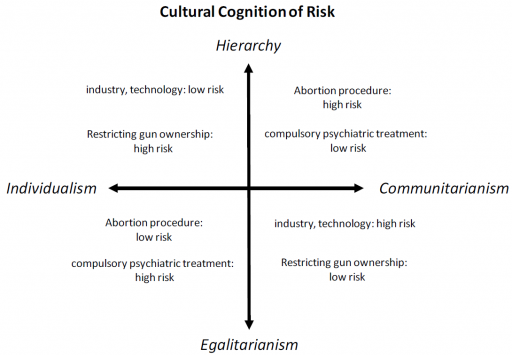
(Credit: D. Kahan et al./Nature Climate Change)
The researchers write:
This form of reasoning can have a highly negative impact on collective decision making … it is very harmful to collective welfare for individuals in aggregate to form beliefs this way.
One aim of science communication, we submit, should be to dispel this tragedy … A communication strategy that focuses only on transmission of sound scientific information, our results suggest, is unlikely to do that. As worthwhile as it would be, simply improving the clarity of scientific information will not dispel public conflict …
So, according to the assembled profs, the U.S. government should, in effect, seek to fund a communication strategy on climate change that is not focused on sound scientific information.
For all that, there’s no serious likelihood of the soft-studies profs genuinely managing to pump up climate fear successfully where legions of activists and climatologists before them have failed, so U.S. taxpayers of every political stripe might very well quarrel with the idea of spending their science budget with the aim of placing enormous political power in the hands of the trick-cyclist community.
Ref.: Dan M. Kahan et al., The polarizing impact of science literacy and numeracy on perceived climate change risks, Nature Climate Change, 2012, DOI: 10.1038/nclimate1547
Comments (31)
by Skeptic
The tree hugger alert was sounded, and the collectivists swarmed the comment thread of a page they rarely visit. Science is skepticism. Climate Changers and Religious Zealots, no difference between them.
by Duncan Work
This article appears to be more of an entertaining and opinionated editorial rather than a serious report of a scientific study. To make matters worse, the “scientific” study that is the subject of this article has incorporated some dubious assumptions in their methods and conclusions.
A measure of the scientific consensus about the realities and dangers of climate change should not depend on a survey of people who have studied a certain amount of science (which is what this particular study did), it should instead depend on a survey of people who are practicing *climate* scientists. Surveys of practicing climate scientists find that between 97% to 98% of climate experts support the consensus that humans are causing climate change (e.g.: Anderegg 2010: http://www.pnas.org/content/early/2010/06/04/1003187107.abstract).
Their assertion that most highly educated people are hierarchical individualists also appears completely unsupported. Where is the evidence of that?
by trakk
Hmmm……whereas in europe and the rest of the world…..its the opposite !!
by Peter Simmons
My conclusion is that the better educated are wealthier since they live in a meritocracy. The wealthy tend to ignore the threat of climate change since a) they have the money to relocate if necessary, buy expensive food as it gets scarce, and spend to protect themselves. Further, it is a fact that at present the poor are suffering more than the rich from climate change and will continue to do so. Go ask poor peasants in lowlying areas of the world already facing flooding, starvation and loss of everything if they believe it’s happening. Anyway, I dispute this pseudo-study and its assumptions. There are plenty of intelligent non-hierarchical individualists who are also egalitarian communitarians, I’m one. My experience is the opposite of these ‘findings’ those arguing vehemently against climate change being manmade are most often as thick as a plank, and can’t argue themselves outy of a paper bag. Some of them have only just discovered that plants absorb carbon dioxide.
by DrJDSJr
Insects and bacteria put 150 gegatons of CO2 into the atmosphere every year. Everything humanity does puts 5 gegatons into the atmosphere. Think about that.
by Editor
Source?
by Mr.x
“The results of the survey are especially remarkable as the researchers were doing so from the position that the “scientific consensus” (carbon-driven global warming is ongoing and extremely dangerous) is a settled fact,”
Surprise, surprise.Someone who learned to think in a certain way also dares to apply it to things which some people already ‘consensed’ to be a certain way.Appeal to authority is not ‘sound scientific’ information.If you fail to persuade educated people with good information, either your standards are fairly low concerning what you call ‘educated’ or you want to mask the fact that your so called ‘sound scientific’ information is not that conclusive. The use of scaremongering will only bias educated people in the opposite direction, e.g the mongers will meet more opposition.
Anyway people think too abstract. One is not just educated.He is good at specific things, where good is being gradual.Even more specific, one does sth good/smart (etc) at a given time (e.g during assesment of skill level).Therefore it is not surprising that people who “are” educated in some things/fields, believe very strange things in others or even the fields themselves, or as in this case, don’t believe in certain things.If they are self reportedly educated you can forget about the data since both educated and uneducated will proclaim themselves educated.People are like lenses (focus on things), without specific things (e.g mirrors) they can’t see their own ‘flaws’.Ok, strictly speaking lenses don’t see at all.
by Ryan
First and foremost, the study essentially found that those with higher scientific and numerical acumen are less concerned about global warming. That is NOT the same thing as saying that they are more skeptical of it. It could very well be that many of them aren’t worried about global warming for reasons similar to why we don’t worry about malaria. Whether or not malaria is a horrible and deadly disease is not really in doubt. The fact is that we have the technology today to treat it effectively and affordably. Due to this, the educated don’t see it as a major threat.
The biggest issue that I see today is that it is next to impossible to find an article about global warming, to some extent even in the scientific journals, that doesn’t wind up sounding like it was really about pushing a political agenda rather than scientific knowledge and understanding. The current article effectively states that there is a need to find a better way of getting the more educated republicans on board with the policies that the authors think need to be put into place to avert global warming.
My question is this. How many of us that are “greatly concerned” about global warming would discover that it “isn’t that bad” if the majority of the pieces about the sceientific evidence supporting the dangers of global warming were used to promote a republican agenda. For example, we could propose an end to welfare programs for the poor that allow them to pay reduced rates on their heating and electric bills. We could also call for a reduction in the regulatory hurdles that hinder the construction of nuclear fission power plants by driving up the cost of building them. In fact, we should call for an end of government subsidies to auto manufacturers, aerospace companies, steel companies, or any other blue collar job from an energy intensive industry. After all, saving the planet is more important that protecting the jobs of union workers, isn’t it?
By the way, I wasn’t seriously proposing that we should adopt the policies I just outlined. My point is simply that global warming has become a polical issue rather than a scientific one. I think we would make much more progress in actually accomplishing something to reduce our collective carbon footprint if truely bi-partisan solutions were proposed rather than thinking that the only acceptable solutions are those that also happen to conform with liberal ideology.
by Jeff
Daniel
let me know if you get funding to study combating funding of poorly conceived studies. I want to work for you!
by Logic
Perhaps the more you know, the more you realize a) our technological trajectory, b) our long track record of solving problems we have created, and c) the fact that living organisms (and Earth can certainly be thought of as a superorganism) tend to have self-regulatory system that make them adaptable to diverse situations.
Perhaps the more you know, the more you realize that we don’t have all the answers, so panicking about the climate is hardly rational.
by Peter Simmons
The more you know the more complacent perhaps. You appear to have a naive belief that we can always come up with solutions. Ignoring the climate, when it so self-evidently is changing rapidly and catastrophicly is hardly rational. But it is reassuring huh? There there, no worry. And you call yourself logic!
by Peter Simmons
The planet is certainly self-regulating, it’s just the timescale that’s a problem; if it will takes a thousand years for Earth to re-balance and return the ecosystem to ‘normal’ humans could still become extinct while waiting for that without enough food.
by devon
Read carefully and remember; this article doesnt sugest that more educated individuals are less likely to accepth that climate chage is a fact, or that it has been exacerbated by humans, but that climate change is dangerous. Afterall, the earth has been much warmer than it currently is at variouss periods in the planets history.
by daniel h pope
Ron, and others of similar persuasion, are in my opinion closest to my view as a scientist of 50 years. It is scary to think that using science and scientists to promote propaganda to ANYONE is the right approach. Certainly funding for basic science, so hard to get these days, is better spent “seeking the truth” than trying to convince even “better educated” people of ONE point of view. Also, the study as I read it did not consider the educational background (e.g., biology, physics, math, sociology) of those surveyed nor their political stripes to make sure that the “study” was well balanced and thus statistically defensible. It is surely true that not all “better educated” people do not agree. That is the fundamental aim and beauty of science. But look at the number of scientists whose work has been subverted to the interests of governments (e.g., Iran and North Korea) for power and control and industries for power and profit.
by Gorden Russell
This is one good reason to create carbon nanos that take carbon dioxide out of the air and weave it into carbon nanotubes and graphene. Nobody is ever going to do anything to directly fix the problem of climate change. Only when carbon nanos are used around the world to store carbon from the air in building materials will the problem be solved. When even the poorest of peasants have such nanos, they will cause their one-roomed huts to grow into large houses. This will take excess carbon out of the atmosphere and sequester it out of harms way.
by Peter Simmons
What are you on? I want some!
by Bri
Talk about an emotional issue! First, whatever the low or high end of temperature life wants to live at is irrelevant. The sun will heat the land mass to the point of deseartification. It’s only hope for life giving water is in the dew point temperature of the air traveling over it once enough water has precipitated out (around the coasts predominately), very little rain will fall in the interiors of continental land masses. Good bye to most life in the centers of the one quarter of available space on our planet. So despite having water on three quarters of our planet we will end up with tremendous droughts like we’re seeing today. The higher the temp the lower the available water in the interiors of continents. Without the snow melt waters and rivers , there would only be uninhabitable wasteland. But as Ray suggests carbon will be a major element to nano tech. Most of our stuff, like cars or buildings or machines will be built of carbon fiber, tube sheets, electronics, etc. Then the easiest place to get carbon from will be the air. Hey! It’s free , cheap and unregulated. Technology could give us th means to make this planet into a snowball. Right now it’s making our world change at an unprecedented rate. And if left unchecked would cause the biggest extintion event ever, and we are most definitely to blame. Anyone who doesn’t understand this is ignorant. It’s not that they aren’t smart. It’s that they are very selective of what information to base their opinions from. They ignore the deafening clarion call of information and selectively screen out what they don’t want to here. Technology will fix this easily with nano tech. The very selective nature of human reasoning is another matter. Most people are myopic , and what it will take to make them ‘see’ is base more on their cultural biases. We form paradimes based on ancient , superstitious beliefs, that don’t mesh well with emperical science. Listen to Rush limbough. He’s very intelligent, and uses his intelligence to actively distorte the facts. When the largest new oil descovory in years was found at the bottom of the gulf of Mexico , he he proclaimed that there is no end to peak oil in sight. His followers believe him and will recite it as fact. This is classic ignorance. If every drop of oil came out of that ‘ largest discovery in YEARS it would only power the U.S. for a few years. We passed peak oil a while ago. Now it’s just the really hard to find and get stuff left , yet peak demand is far off in the unknowable future. His listeners think that he’s telling them truthful info , but it has been crafted with an agenda. How does true science combat his cult of personality? Who will be its champion? Good luck trying to educate the educated. They’ve made up their minds and they don’t need to be bothered by the truth.
by Robecology
Great pic/artistic interp of the iceberg But I think the author has the wrong interpretation of the research. The “more science you know the less you’re worried” does NOT imply you’re skeptical about G.W.; it just implies you know the logical events likely, the likely consequences, and the best and worst case scenarios. You’re not being a “chicken little” and panicking….you’re just not worried. That’s not at all what “skeptical” implies, ie. doubting that it will occur or that the effects will be relatively not serious.
by Rob
Poor choice of words, combined with a lot of genius/mensa-bable….
Firstly; I wouldn’t say they’re more skeptical regarding the dangers of G.W.; they’re just more resolved to avoid panic and seek solutions.
Secondly; the following sentence is a clear example of “mensa-bable” or an attempt to make absurdly long, hard to understand sentences;
“For all that, there’s no serious likelihood of the soft-studies profs genuinely managing to pump up climate fear successfully where legions of activists and climatologists before them have failed, so U.S. taxpayers of every political stripe might very well quarrel with the idea of spending their science budget with the aim of placing enormous political power in the hands of the trick-cyclist community”.
Trick-cyclist community? huh? I wasn’t born yesterday…but someone’s throwing around words, here.
by Sara Peterson
http://www.metafilter.com/101924/The-Cultural-Cognition-Project-at-Yale
Talk about taking something out of context and then not identifying the parameters. I can’t find anything that says hierarchial individualists are anything other than Republicans.
Kahan grades people on two scales of cultural belief: individualists versus communitarians, based on the different importance people attach to the public good when balanced against individual rights; and hierarchists versus egalitarians, based on their views on the stratification of society. Republicans are more likely to be hierarchical-individualist, while Democrats are more often egalitarian-communitarian.
The alternative explanation can be referred to as the cultural cognition thesis (CCT). CCT posits that individuals, as a result of a complex of psychological mechanisms, tend to form perceptions of societal risks that cohere with values characteristic of groups with which they identify. Whereas SCT emphasizes a conflict between scientists and the public, CCT stresses one between different segments of the public, whose members are motivated to fit their interpretations of scientific evidence to their competing cultural philosophies.
http://www.nature.com/nclimate/journal/vaop/ncurrent/full/nclimate1547.html
All of the individuals who wrote articles, cherry picked the findings instead of reading the whole report.
For the ordinary individual, the most consequential effect of his beliefs about climate change is likely to be on his relations with his peers18. A hierarchical individualist who expresses anxiety about climate change might well be shunned by his co-workers at an oil refinery in Oklahoma City. A similar fate will probably befall the egalitarian communitarian English professor who reveals to colleagues in Boston that she thinks the scientific consensus on climate change is a hoax. At the same time, neither the beliefs an ordinary person forms about scientific evidence nor any actions he takes—as a consumer, say, or democratic voter—will by itself aggravate or mitigate the dangers of climate change. On his own, he is just not consequential enough to matter19. Given how much the ordinary individual depends on peers for support—material and emotional—and how little impact his beliefs have on the physical environment, he would probably be best off if he formed risk perceptions that minimized any danger of estrangement from his community.
by GamerFromJump
So let me get this straight; people who don’t buy the catastrophic AGW argument are either hillbilly morons, or they’re intelligent people that just need a different “sell.” When science gets mixed in with the vile sewer that is politics, Bad Things happen. The idea of researchers wanting to be better propagandists disturbs me, and should disturb any believer in the scientific method and it’s ability to tell us things about the world.
Also, they were doing this survey from a pre-determined position, and looking for support for it. No! Bad researcher! No biscuit!
Frankly, these results don’t surprise me. Knowledgable people are harder to lead around by the nose? It has always been thus. Why do you think the first move of every fascistic movement has been to attack the intellectual?
by Scott
Propaganda system failure…
System reboot…
Scientific Trojan horse detected…
Install propaganda program update…
by William Collins
Actually I rather agree with Daniel & Ron but have something to add. The study is missing the point, and the argument made by them is a misconception. Autodidactic and generally more educated people are not convinced and that is the symptom not the problem. The cure they seek is philosophy, she is the force for change and the answer to what is missing and which they cannot put their finger on. The problem is systemic and advertising fear is not the answer. Talk about reality to those who seek life and you will find functioning hears. WC
by anthony
Oh yeah, and did people self-report their scientific knowledge?
by anthony
Bein’ smart ain’t everything, apparently.
by Locke
I think there is an inherent scepticism against any politicised issue that ultimately has nothing to do with politics, but rather logic and fact.
Ironically the diagram above shows some of the other ones, like abortion and gun control.
Naturally more intelligent people are not going to just take what an untrained layman with a vested interest (politician) feeds them as fact, and rather try and find out the truth for themselves.
by Mortran
The climatologists’ claim that higher temperatures on earth are a threat contradicts any other branch of science including biology, geology, physics and chemistry. So of course more scientific knowledge leads to more skepticism towards global warming.
It contradicts any logic that higher temperatures during a rather cold geological period on a planet that is on the lower end of the temperature range suitable for life, would be a threat.
by AGreenhill
If they’re looking for a place to spend their money so as to be effective against climate change – I think the obvious candidate is profitability of green technology. The American sheeple will continue to believe what the big money wants them to believe… and if the big players can make big bucks on green tech then voila… problem solved.
by Ron
I find it sad that a scholar would conclude that we should not appeal to knowledge, but to communicate by advertizing a position. Skeptics are critical to the advancement of thought and the refinement of wisdom. They should also remember that science is not about having truth, it is about seeking truth.
by Daniel
This is hiliarious! The bozos didn’t get the results they were looking for so they want money to fund a study on what propaganda to use to scare the better educated into line with their crackpot theories!
by Max Osterhaus
Ha, exactly…this is absurd. Hard to even imagine that these people call themselves scientists and not propagandists; although if they were propogandists they wouldn’t be telling us their methods!
“we want government cash to spread “non-scientific information”"
Bah! hahaha…I hope this is a joke, but April 1st is long past.