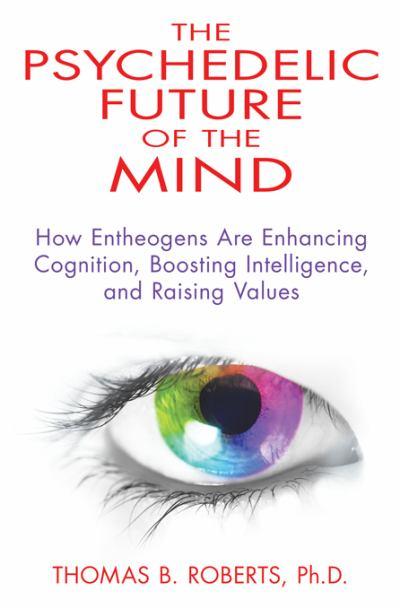
The Psychedelic Future of the Mind: How Entheogens Are Enhancing Cognition, Boosting Intelligence, and Raising Values
February 26, 2013
- Author:
- Thomas B. Roberts
- Publisher:
- Park Street Press (1/23/2013)
Explores scientific and medical research on the emerging uses of psychedelics to enrich mind, morals, spirituality, and creativity
• Outlines a future that embraces psychedelics as tools for cognitive development, personal growth, business, and an experience-based religious reformation
• Presents research on the use of psychedelics to enhance problem-solving, increase motivation, boost the immune system, and deepen ethical values
• Includes chapters by Roger N. Walsh, M.D., Ph.D., and Charles Grob, M.D., on their psychedelic research on religious experience and alleviating the fear of death
As psychedelic psychotherapy gains recognition through research at universities and medical establishments such as the Johns Hopkins Medical Institute and Bellevue Hospital, the other beneficial uses of psychedelics are beginning to be recognized and researched as well–from enhancing problem-solving and increasing motivation to boosting the immune system and deepening moral and ethical values.
Exploring the bright future of psychedelics, Thomas B. Roberts, Ph.D., reveals how new uses for entheogens will enrich individuals as well as society as a whole. With contributions from Charles Grob, M.D., and Roger N. Walsh, M.D., Ph.D., the book explains how psychedelics can raise individual and business attitudes away from self-centeredness, improve daily life with strengthened feelings of meaningfulness and spirituality, and help us understand and redesign the human mind, leading to the possibility of a neurosingularity–a time when future brains surpass our current ones. Roberts envisions a future where you will seek psychedelic therapy not only for psychological reasons but also for personal growth, creative problem solving, improved brain function, and heightened spiritual awareness.
Our psychedelic future is on the horizon–a future that harnesses the full potential of mind and spirit–and Thomas Roberts outlines a path to reach it.
Kindle version also available at this link
Comments (24)
by Bri
Yawn.
by Shauun
Out of site…
by Shauun
Out of mind.
by Gabriel
I will begin by saying that I’ve never read this book and have no idea at all what it contains beyond the little description here…..I just certainly hope that, even though I’m sure it raises reasons why the subject of the book, if the cover is anything to go by, are good things….that it doesn’t necessarily try to pitch the ideas to readers in an irresponsible way.
To make an example, I don’t drink alcohol, at all….Why? I just don’t – I have no religious reasons or any sort of conventional reason one might think for doing so…nor would i consider myself a teetotaler who is gonna abstain from the stuff for the rest of my life — I simply have never honestly had much interest or desire, and the few times where I have drank some had been less-then-desirable….perhaps I’ll be like most others and slowly start drinking the stuff more regularly as I gain more experience doing so, but the point is, I have very little experience or desire drinking any sort of alcohol, nor really care too.
This is in the face of the repeating evidence of the benefits of drinking alcohol moderately – that drinking a cup of red wine or two, gives you more health benefits then people who don’t drink alcohol at all. Suddenly, the idea of drinking has more merit….sounds tempting? Honestly, no….intellectually, perhaps the idea of drinking has more merit now that their repeatedly seems to be supposed health benefits to drinking a little…but, even so, I still cannot bring myself to really drink, nor do I honestly feel I should force myself too.
You shouldn’t abuse yourself or treat yourself as a commodity…perhaps there are rational health reasons to drink, but I feel I would be forcing and abusing myself if I tried simply for that, and it simply doesn’t sound wise to do so. Happily, Kurzweil and Grossman don’t suggest people who don’t drink should start in the book “Transcend”.
I just hope the author of this book, Dr.Roberts, does the same thing….that while he undoubtedly will go into the benefits of psychedelics, with good intentions and reason I’m sure, he doesn’t necessarily try to persuade people to try anything in any sort of irresponsible manner.
by Bri
It’s easy to misinterpret posts. Many people might think that I’m a druggy. If anything I’m far more like Gabriel. I have tried a handful of different drugs mainly in social settings. I don’t advocate drugs of any form. I do like to make informed decisions and so have allowed myself to experiment to a small degree with illegal drugs.
When I was growing up alcohol was commonly abused. My brother and his friend raided the family liquer cabinet at thirteen years old. Many of my peers started drinking at similar ages. I didn’t drink socially till I was in college. I rarely if ever drink now. I’ve never taken any pills of any form. During high school many of my friends sold them. Auspices were very popular. At times it seems that there is an almost endless array of drugs available today. I have no interest in trying them. My brother once said to me that hd had no fear of me becoming an addict of any kind, but he did fear that I would abuse LSD. It never happened. Three times in high school and three times in college. My yoga teacher during my high scoop years sold LSD. He never tried to get ke to try.
Being a long haired musician most people think I’m a druggy. I describe myself as an extroverted introvert. I’m mote of a straight laced geek. I’ve learned how to blend in with just about any social group. If you meet me in a bar you’ll see a drink in my hand but I don’t drink to excess. I don’t do shots with people. I’ll make up excuses like I’ve got to drive or, I’ve had too much, or crack a joke, maybe say no thanks but let me buy you one. I don’t like being out of control and I hate the way I feel the next day if I do drink too much.
If one examines the issue historically humans have used drugs since before recorded history. I’ve often said that alcohol was the reason civilization started. Once someone found out that leaving grain in water overnight and consuming that the next day made them drunk, they settled down to grow grain. Anthropologists seriously consider it a factor.
Psychedelics have recently gained a resurgence. It is now being researched quite a bit. It’s also being experimented with in a therapeutic manner. It has many unusual effectson perception. Further research will give a better understanding of what is happening and if it has any benefits. If you are a person with personality disorders it can have a very adverse affect. I strongly caution anyone to not abuse any substance and or behavior. As I’ve said before, I don’t advocate the use of drugs, I’m candid in my own personal experiences. It’s up to each individual as to what they should or shouldn’t do to themselves. Even exsersize can be hazardous to your health.
by Shauun
me me me…
by Shauun
http://www.youtube.com/watch?v=zyNyHark4xk
by Shawn
I’m fairly certain that you will find that the doctors who are doing research in the field of psychedelic therapy know a thing or two about both the benefits and the dangers of psychedelics, and that they are not street vendors trying to push drugs on a naieve youth.
I hope, for your sake, that in the future you will do a little more research before commenting.
by Shawn
Haha! Sorry, the last comment was supposed to be a response to Gabriel’s comment. Sigh…
by Shauun
You almost got yourself banned there.
by JasonN
I remember someone here commented (I lurk KAI long time):
“Drugs and hypnosis are essential to the creation and maintaining of civilizations.”
I believe unusually creative people like Da Vinci and Srinivasa Ramanujan were either drug users or self-hypnotizers. More drugs, indeed.
by Editor
Which might explain a few of the comments one sees …. OK, that’s a joke. I think.
by Dan
Or perhaps they were able to harness their mind’s eye in a hierarchical and purposeful way that allowed them to process complex multidimensional geometric concepts as readily as children access day dreams? This would take a rare combination of the right genetics and the accidental learning of the visualisation methods required (what a shame there is no school curriculum for that!), which could explain why such ability is so rare even though humans have been causing themselves to see things for so long, usually with nothing more than a hedonistic or ritualistic outcome.
The absence of large numbers of Leonardo like people living today is an intriguing puzzle, given the population is so much larger than it was 500 years ago and access to education and knowledge is so much better.
by Marcos Marin
I’m with you, between all the drawing, 3D modelling, music synthesis and composing, storytelling and occasional executable disassembling and reverse engineering, I would probably explode if I were to take drugs..
In fact, this is empirical evidence to suggest the opposite. An apophatic approach to intelligence, i.e. it’s not what you are missing to get to a “Leonardo” but what you have in excess, what you must drop, encumbering your path to enlightenment.
Your point on access to education makes this even more conspicuous, drugs may just be a way to induce people to let go more…
by Nelson Louis Johnson
No mention of doctor Timothy Leary? My gawd. We were experimenting at our own peril since 1960 so these a-holes can act like they ‘”discovered” it? Dr. Leary wrote ‘The Psychedelic Experience’ in 1962. We have suffered horribly to make it possible for “legitimate” researchers to now take credit for our work.
by Thomas Stück
There has been loads of more credible and respectable scientists working with psychedelics since the 60 than Leary. People are sick and tired of Leary, they view him as one of causes of the backlash against psychedelics in the first place, and rightfully so. Osmond, Grof, Janiger, Huxley and others were also there, way before Leary and the 60′s, doing amazing work that Leary helped put a stop to. These people today are not acting like they’ve discovered it either, but there is a massive amount of research going on right now, as has been picking up momentum since the 90′s, so it’s a little late in the game to still be dropping outdated cultural references about Leary and the hippies, which would only impede the progress of harnessing the miraculous power of psychedelics.
by Bri
So I guess the implications here are that we should be slipping some laced kool aid to all our politicians and business leaders. Far out mmmmaaannn!!!!
by Marcos Marin
Oh.. so that’s why it’s forbidden?!
Only Mount Olympus can have it.
by René Milan
A welcome development. However “beneficial uses of psychedelics are beginning to be recognized” is only half true. They were “beginning to be recognized” in the west about 50 years ago. That our research was (and largely still is) taking place outside of academic institutions and the law does not mean that it has no value.
by Marcos Marin
Worse, the law means it has even MORE value. Right on…
by Jackus
Keyword: Productivity maximization.
Some government groups and companies will use psychedelic drugs to get your employees “in-the-zone” during work.
by Marcos Marin
Exactly, maybe they will even work for fun! ;-)
by Thomas Stück
that’s not psychedelics, that’s caffeine, anti-depressants, sleep-aids, alcohol, sugar and nicotine. Psychedelics will make you seriously reconsider whether you really want to work in that fucked up environment any longer. :)
by Bri
You sound like you have experience. I’ve only done them about six times in my life. There is no way to tell people what it’s like.