Traffic intersections of the future will control autonomous vehicles
February 21, 2012
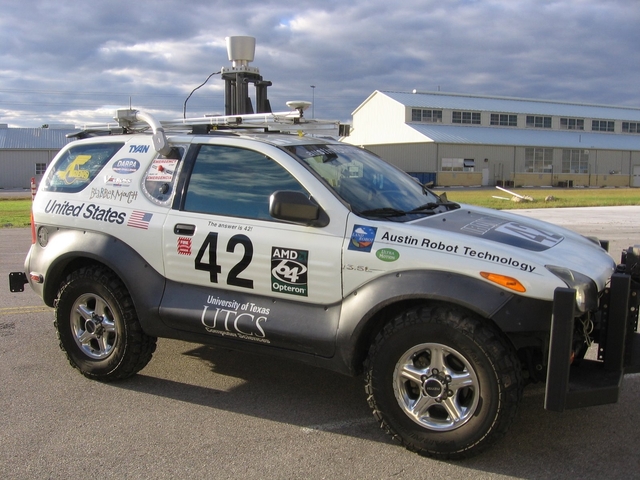
Marvin (credit: Peter Stone/Austin Robot Technology)
Intersections of the future won’t need stop lights or stop signs. They’ll look like a somewhat chaotic flow of driverless, autonomous cars slipping past one another as they are managed by a virtual traffic controller, says computer scientist Peter Stone, a professor of computer science at The University of Texas at Austin.
“A future where sitting in the backseat of the car reading our newspaper while it drives us effortlessly through city streets and intersections is not that far away,” he says.
“Computers can already fly a passenger jet much like a trained human pilot, but people still face the dangerous task of driving automobiles,” he says. “Vehicles are being developed that will be able to handle most of the driving tasks themselves. But once autonomous vehicles become popular, we need to coordinate those vehicles on the streets.”
Stone and his students, in cooperation with Austin Robot Technology, created an autonomous car named Marvin that competed in the 2007 DARPA Urban Challenge competition.
Automated intersection manager
In his newest system, AI driver agents (the autonomous vehicles) “call ahead” and reserve space and a time at an intersection. Then an arbiter agent, called an “intersection manager,” approves the request, and the vehicles move through. There is little stopped traffic.
For now, the action takes place mainly as a simulation on a computer, or with a single real car (for example, Marvin) interacting with many other simulated cars. But Stone says we’ll start seeing autonomous vehicles on the streets, and the benefits of controlling the cars — and traffic — will be realized.
Stone is presenting his research on autonomous intersection management at the American Association for the Advancement of Science (AAAS) annual meeting in Vancouver, British Columbia this week.