Ukrainian students develop gloves that translate sign language into speech
July 12, 2012 | Source: TechCrunch
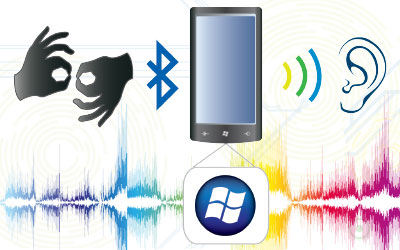
Using a gloves fitted with flex sensors, touch sensors, gyroscopes and accelerometers a Ukrainian team in a Microsoft competition has built a system called EnableTalk that can translate sign language into text and then into spoken words using a text-to-speech engine.
The whole system then connects to a smartphone over Bluetooth.
There are currently about 40 million deaf, mute and deaf-mute people. Many of them use sign language, which very few non-deaf people understand.
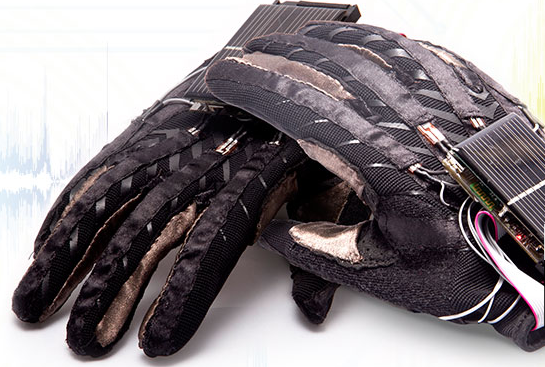
Sign language-translating glove (credit: EnableTalk)
The few existing projects that come close to what EnableTalk is proposing generally cost around $1,200 and usually have fewer sensors, use wired connections and don’t come with an integrated software solution. The EnableTalk team says that the hardware for its prototypes costs about $75 per device.
Users can teach the system new gestures and modify those that the team plans to ship in a library of standard gestures. Given the high degree of variation among sign languages, which also has regional dialects just like spoken language, this will be a welcome feature for users.
Windows Phone 7 doesn’t allow developers access to the Bluetooth stack, so the current version runs on Windows Mobile, the predecessor to Windows Phone.

Comments (11)
by Israa Lulu
Hi all , Do any one have an idea for developing a new project about sign language translation via mobile using image processing ,i need a help about this project ??
by Timothy M
If sign language can be translated into speech perhaps anyone who knows sign language (whether or not they are deaf or mute) could use the technology to communicate with anyone on earth using the appropriate spoken language.
by eldras
Should be possible to work this backwards ie get spoken words to convert into hand signs. Must be loads of times when gestures are better than speech eg underwater in space, non talking places
by Editor
Great idea. The same algorithms could presumably convert text (from speech-to-text, using Dragon software) into gestures (ideally, after the user edited the text).
by eldras
Utterly cool
by Phil Osborn
Surprised that this took so long. I recall watching Jaron Lannier (I think it was him) demonstrating a data glove back in the early ’90′s, and later at the Electronic Cafe, there were several people who had taken the Mattel (?) gaming glove and written software for it to function as a VR input device as well as for typing without a keyboard and playing music.
by Barrett Hoffarth
The low cost of the gloves will really make this accessible to the deaf and mute. I enjoy learning about how technology is making life better for humanity. It can actually be a relief from the highly biased and depressing stories produced by the standard news outlets. Keep it up Kurzweilai.com!!
by MatthewQ
(from the article)…There are currently about 40 million deaf, mute and deaf-mute people and many of them use sign language to communicate, but there are very few people who actually understand sign language…
This is a badly worded paragraph.
I’m just saying.
by Editor
Thanks, fixed
by MatthewQ
I was thinking about these gloves the whole day while I was at work. If if can really transcribe the sign language immediately to text- it would actually be quicker than typing. Admittedly, one would have to sit down and learn an entire language but that wouldn’t be any different than say committing to learn French. Once learned, you could just sign instead of using/needing a keyboard. Brilliant for writers or any stripe but also cool for just about anybody. Instead of being all hunched over a wee touch screen phone trying to use the miniscule keypad, just sign the whole word and a complete text message could be sent with just a few gestures. That would be really cool.
You could combine this with the google glasses and just go completely nuts with applications/implications.
by MatthewQ
Also, if you wore some sort of brain scanning cap and used sign language a dedicated computer program should be able to decipher which nerve impulse combinations equaled which words and the user would merely need to think about making the sign and the program would be able to effectively read the user’s mind (without the user actually needing to make the sign).
I think this might be qualitatively different than scanning the brain while someone thought about the words themselves because it would involve the motor cortex and since many signs involve both hands the scanner would be getting more information (from both sides of the brain) and thus have more to go on (maybe making it perhaps easier to decipher?). Maybe just a stupid idea but it would at least mean that a deaf/mute person wouldn’t even need to sign to a hearing person. They could just think the sign and the program would translate it into text or audible words for them- again, the google glasses being a great facilitator there…