Uploaded e-crews for interstellar missions
December 12, 2012 by Giulio Prisco

Artwork: The bright star Alpha Centauri and its surroundings (credit: ESO)
The awesome 100 Year Starship (100YSS) initiative by DARPA and NASA proposes to send people to the stars by the year 2100 — a huge challenge that will require bold, visionary, out-of-the-box thinking.
There are major challenges. “Using current propulsion technology, travel to a nearby star (such as our closest star system, Alpha Centauri, at 4.37 light years from the Sun, which also has a a planet with about the mass of the Earth orbiting it) would take close to 100,000 years,” according to Icarus Interstellar, which has teamed with the Dorothy Jemison Foundation for Excellence and the Foundation for Enterprise Development to manage the project.
“To make the trip on timescales of a human lifetime, the rocket needs to travel much faster than current probes, at least 5% the speed of light. … It’s actually physically impossible to do this using chemical rockets, since you’d need more fuel than exists in the known universe,” Icarus Interstellar points out.
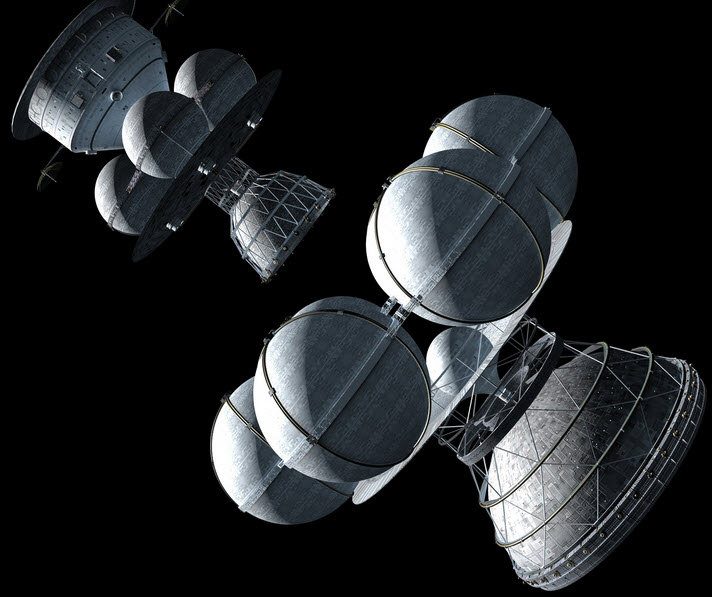
Daedalus concept (credit: Adrian Mann)
So the Icarus team has chosen a fusion-based propulsion design for Project Icarus, offering a million times more energy compared to chemical reactions. It would be evolved from their Daedalus design.
This propulsion technology is not yet well developed, and there are serious problems, such as the need for heavy neutron shields and risks of interstellar dust impacts, equivalent to small nuclear explosions on the craft’s skin, as the Icarus team states.
Although Einstein’s fundamental speed-of-light limit seems solid, ways to work around it were also proposed by physicists at the recent 100 Year Starship Symposium.
However, as a reality check, I will assume as a worse case that none of these exotic propulsion breakthroughs will be developed in this century.
That leaves us with an unmanned craft, but for that, as Icarus Interstellar points out, “one needs a large amount of system autonomy and redundancy. If the craft travels five light years from Earth, for example, it means that any message informing mission control of some kind of system error would take five years to reach the scientists, and another five years for a solution to be received.
“Ten years is really too long to wait, so the craft needs a highly capable artificial intelligence, so that it can figure out solutions to problems with a high degree of autonomy.”
If a technological Singularity happens, all bets are off. However, again as a worse case, I assume here that a Singularity does not happen, or fully simulating an astronaut does not happen. So human monitoring and control will still be needed.
The mind-uploading solution
The very high cost of a crewed space mission comes from the need to ensure the survival and safety of the humans on-board and the need to travel at extremely high speeds to ensure it’s done within a human lifetime.
One way to overcome that is to do without the wetware bodies of the crew, and send only their minds to the stars — their “software” — uploaded to advanced circuitry, augmented by AI subsystems in the starship’s processing system.
The basic idea of uploading is to “take a particular brain [of an astronaut, in this case], scan its structure in detail, and construct a software model of it that is so faithful to the original that, when run on appropriate hardware, it will behave in essentially the same way as the original brain,” as Oxford University’s Whole Brain Emulation Roadmap explains.
It’s also known as “whole brain emulation” and “substrate-independent minds” — the astronaut’s memories, thoughts, feelings, personality, and “self” would be copied to an alternative processing substrate — such as a digital, analog, or quantum computer.
An e-crew — a crew of human uploads implemented in solid-state electronic circuitry — will not require air, water, food, medical care, or radiation shielding, and may be able to withstand extreme acceleration. So the size and weight of the starship will be dramatically reduced.
Combined advances in neuroscience and computer science suggest that mind uploading technology could be developed in this century, as noted in a recent Special Issue on Mind Uploading of the International Journal of Machine Consciousness).
Uploading research is politically incorrect: it is tainted by association with transhumanists — those fringe lunatics of the Rapture of the Nerds — so it’s often difficult to justify and defend.
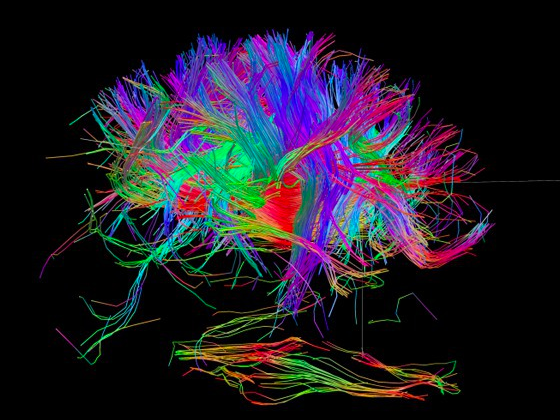
The connectome (credit: NIH Human Connectome Project)
Creating a brain
But MIT neuroscientist Sebastian Seung has speculated that if models of brains become increasingly accurate, eventually there must be a simulation indistinguishable from the original.
In Connectome: How the Brain’s Wiring Makes Us Who We Are, he explains how mapping the human “connectome” (the connections between our brain cells) might enable us to upload our brains into a computer.
In fact, “neuroscience is ready for a large-scale functional mapping of the entire neural circuits,” Harvard scientist George Church and other researchers conclude in a landmark 2012 Neuron paper.
I suggest that developing mind-uploading technology for software e-crews may make the 100YSS project practical, while delivering equally important spinoffs in neuroscience, computer science, and longevity, perhaps even including indefinite life extension.
The new brain can be much more resistant and long-lived than the old biological brain, and it can be housed in a similarly resistant and long-lived robotic body. Robots powered by human uploads can be rugged, resistant to the vacuum and the harsh space environment, easily rechargeable, and much smaller and lighter than wetware human bodies.
Eventually, human uploads augmented by AI subsystems can be implemented in the solid-state circuitry of the starship’s processing system.
Boredom and isolation will not be a problem for e-crew members, because the data processing system of a miniaturized starship will be able to accommodate hundreds and even thousands of human uploads.
Light sails
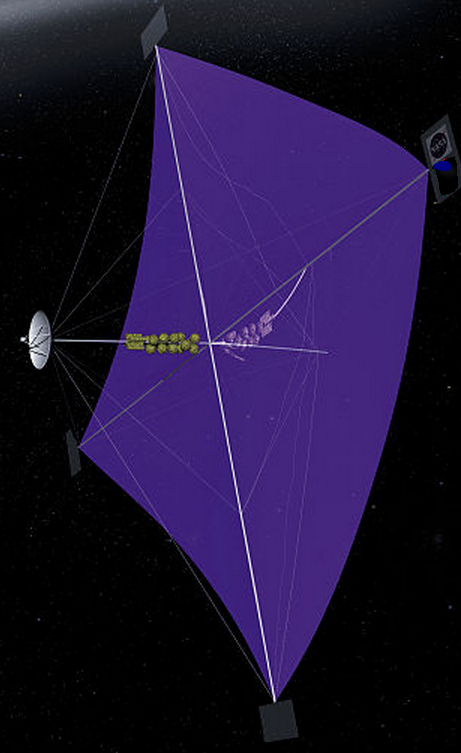
Light sail concept (credit: NASA)
The huge reduction in weight resulting from uploading would allow for radical propulsion systems, such as “light sails” (aka “solar sails”) — spacecraft driven by light energy alone. The Planetary Society currently has a research project to develop light sails .
The low mass of light sails — combined with the e-crew’s ability to withstand extreme acceleration — might allow for achieving a substantial fraction of the speed of light, so the time to go to the stars would be significantly reduced.
E-crewed interstellar missions have been described by science fiction writers. Greg Egan was one of first in Diaspora. In Charlie Stross‘ Accelerando, the coke-can-sized starship Field Circus, propelled by a Jupiter-based laser and a light sail, visits a nearby star system with an e-crew of 63 uploaded persons who have a hell of a lot of fun on the way.
Here we are, sixty something human minds. We’ve been migrated — while still awake — right out of our own heads using an amazing combination of nanotechnology and electron spin resonance mapping, and we’re now running as software in an operating system designed to virtualize multiple physics models and provide a simulation of reality that doesn’t let us go mad from sensory deprivation!
And this whole package is about the size of a fingertip, crammed into a starship the size of your grandmother’s old Walkman, in orbit around a brown dwarf just over three light-years from home.
Of course. a light sail powered by lasers back home, can only push a starship on an one-way trip,but the data from the uploaded astronauts would will be beamed home via the Interplanetary Internet.
The “starwisp” concept proposed by Robert L. Forward is a variation of a light sail remotely driven by a microwave beam instead of visible light (but has known problems).
Sideloading
One problem with implementing mind uploading is that it’s plagued by metaphysical discussions about the continuity of personal identity (“is only a copy”), which are irrelevant here. Even if I thought that uploads will be only copies, I would be not only happy, but also grateful and honored if my upload copy could participate in the first interstellar mission.
But even coarse, preliminary uploading technology could be sufficient. “Sideloading,” proposed by science fiction writer Greg Egan in Zendegi, is the process of training a neural network to mimic a particular organic brain, using a rich set of non-invasive scans of the brain in action.
Egan describes a “Human Connectome Project,” completed in the late 2020s, that produces detailed connectome maps from brain scans of thousands of volunteers. The maps could be used to build an average human neural network, which could serve as a model of a generic human brain.
Then the model could be tweaked and fine-tuned to emulate a specific living person, using in-vivo brain scans and supervised training sessions in a VR environment. In Zendegi, the resulting personalized model passes the Turing Test and often behaves as a convincing emulation of the original.
Why not send AI’s?
If strong AI is developed, perhaps smarter than humans, why should we bother to upload humans? One answer is that most of us will want human minds on our first journey to the stars.
However, I agree with Ray Kurzweil’s speculation that we will merge with technology, so many future persons will not be “pure” humans or pure AIs, but rather hybrids, blended so tightly that it will be impossible to tell which is which.
Ultimately, I think space will not be colonized by squishy, frail and short-lived flesh-and-blood humans. As Sir Arthur C. Clarke wrote in Childhood’s End, perhaps “the stars are not for Man” — that is, not for biological humans 1.0.
It will be up to our postbiological mind children, implemented as pure software based on human uploads and AI subsystems, to explore other stars and colonize the universe. Eventually, they will travel between the stars as radiation and light beams.
Comments (82)
by Alexandre Amaral
Hi Giulio,
Please have a look at this link: http://gizmodo.com/5942634/nasa-starts-development-of-real-life-star-trek-warp-drive?utm_source=deadspin.com&utm_medium=recirculation&utm_campaign=recirculation
It talks about warp drive that is currently being designed by NASA.
Dr. White, head of the project says if experiments go well, they could build an engine that takes man to Alpha Centauri (closest star) in just two weeks.
Please share this article with Ray Kurzweil. I’m currently reading his book, The Singularity, that talks about circumventing or surpassing the speed of light through worm holes. This warp drive would be approx. 10 times faster than the speed of light. If this is possible one day, it will be an amazing breakthrough for humanity and colonizing space will cease to be an issue.
Best regards,
Alexandre Cassanello Amaral
by Bri
@Alexandre: you should check out the Bob Lazar video. You can find it on you tube. It’s old and I don’t really know what debunkers have said, but he claims to have worked on secret government UFO programs. It’s a fun and interesting video. Another interesting alien space travel tech story comes from David Adair. Google or you tube both give interesting info on him. He talks about being shown one at Area51. David is quite the character and runs a space consulting company. They have designed projects for the space shuttle. Can’t say one way or another if any of this is real. It certainly sounds plausible. There is so much compelling testimony about UFOs that is hard to not think something is going on. So many high level people have come forward. They often are reluctant like David, for fear of the ridicule. I love the you tube videos from regular people. Especially when two unrelated people many years apart from each other, capture images of the same style crafts. A very intriguing subject. I’m not so quick to dismiss it all as phony, it’s just hard to find a way to validate any of the claims. I’d bet on warp drives and I’d also bet that we get visited by aliens. Hey Stephen Hawkins bet that there would be no Higgs Boson particle!
by Whittaker
I would like to point out that it’s Stephen Hawking (the physicist), not Stephen Hawkins.
There is an AI researcher named Jeff Hawkins, though.
by Jack Sarfatti
UFOs show us that advanced intelligence probably our future descendants have mastered time travel with warp drive and star gate traversable wormholes using amplified anti-gravity dark energy. The same dark energy that is accelerating our universe.
by Editor
Hi Jack, thanks for the comment. (Dr. Sarfatti was profiled in How the Hippies Saved Physics, http://www.kurzweilai.net/how-the-hippies-saved-physics)
by Giulio Prisco
Let’s hope hippies will save physics again, and the world. We need some more hippies spirit to save the world from today bigot nanny-statism and similar crap.
by Oracle3
Agree
by Giulio Prisco
Good to see you here Jack. I don’t find UFO reports too convincing, for the very reasons discussed in this post. I don’t think advanced galactic civilizations travel in physical bodies and big starships like in Golden Age science fiction novels, but they may come here as uploads and AIs in very small vessels. Perhaps a dust speck -sizes starship inhabited by alien uploads and AIs landed on my nose one minute ago.
by Gabriel
That could very well explain the question of “where is everybody?”….the answer is, all around us. Perhaps their really is this vast community of alien lifeforms, and we simply aren’t intelligent enough to comprehend and notice them yet.
It’s something that opens all sorts of discussion, but, when it comes to discussing aliens, I feel we are thinking more in the right direction in picturing something like machine intelligence with molecule-size starships rather then humanoids not to different then us, like the movies.
by Stephen Nielsen
Why even send humans? It would be incrementally cheaper, more efficient, as well as much faster to send AI augmented versions of our biological matrix instead.
Instead of trying to send us enormous, ugly bags of mostly water to distant stars, why not use what biologists call an “r strategy” and aim billions of much smaller “seeds” – autonomous robotics with specific sets of preprogrammed objectives and the ability to root, grow, (and terraform) toward billions of preselected candidate stars.
by giorgio gaviraghi
HI Giulio
what about sending thousands of human DNAs to be cloned as humans at arrival? They could be the same of the uploaded minds so they will also have a physical body? This would solve all problems , you don’t have to feed and maintain them and you will have thousands of humans at arrival. available with their body and mind
by Editor
There’s an interesting discussion on uploading (and alternate methods) for interstellar missions here: http://www.kurzweilai.net/what-will-your-next-body-be-like
by BKC
If – as it is suggested by many, that Time travel is possible, then I think our resources should be focused there. Not on inter-stellar space travel. Our nearest neighboring star – is more than 25,000,000,000,000 miles away. Time travel – not Space travel.
by Nyk
Time travel is impossible due to the laws of physics as we best understand them today. The only way to “travel to the past” is to attempt to simulate it using powerful quantum computers (the universe itself is a quantum computer, and it was proven by Deutsch that any quantum computer can emulate another).
This would probably take at least Type 3 civilization on the Kardashev scale. Needless to say, we should have other priorities at this point in our evolution.
by Gabriel
I honestly find thinking about time-travel to be kind of pointless….it’s something that, for all practical purposes, will be filled by virtual reality…you will have the ability to ‘visit’ any era you can imagine, see the dinosaurs, not to mention any fantasy you can really think of. In a sense, time-travel is something we actually have accomplished.
You could argue that it’s all just illusions and fantasies, and indeed it’s true (though very good ones come to life)….but at that point, I ask the question of why you would, in truth, still want to achieve time-travel if such a thing were possible…because again, if I could fearlessly “time-travel” to any time-period I want in VR, without worrying about paradoxes or anything at all….then what on earth is the point of trying to accomplish the real deal?
If anything, again, the illusion of time-travel is better because I don’t have paradoxes or all sorts of issues to think about, versus trying to accomplish the real deal which will be much harder and demand I think about them.
by Mr.X
“you will have the ability to ‘visit’ any era you can imagine, see the dinosaurs, not to mention any fantasy you can really think of. ”
You mean the propaganda/imagined versions of any era.
by Gabriel
It seems weird to mention things like uploading and still take the stance of not assuming the Singularity is not going to happen when looking at scenarios…
The Singularity is many things depending on who you ask – from Kurzweil’s point of view at any rate, it’s not a ‘big bang’ moment…it’s simply the moment when $1000 dollars gets you intelligence a billion times more then all biological intelligence today…from the pov of the unenhanced, it will be seen as a moment when they can no longer follow the exponential growth of tech (which has essentially become the exponential growth of humanity).
It’s not so much a ‘big bang’ moment, so much as simply a threshold…it’s not tied to things like mind-uploading, AI, and so on in such a way that, if we don’t “believe” in it or know it or whatever, it won’t happen….technology like nanotech is and will continue to evolve regardless of whether or not a tech Singularity happens or not.
So from that pov, one can argue that the Singularity has already gotten started or, shoot, it’s already here…it depends on your viewpoint of the word which, honestly, makes me feel it’s sort of redundant to even bring up. Technology like AI, nanotech and so on will continue to develop regardless of our notions of a Singularity.
by Giulio Prisco
Hi Gabriel. I don’t rule out that a Singularity will happen, but I don’t assume it either. Time will tell. As you say, there are many definitions of Singularity, and one person’s S is not necessarily another person’s S.
I can easily imagine alternative scenarios. For example, mind uploading and strong AI are developed in research labs, but remain extremely difficult and expensive and confined to specific high profile applications (like going to the stars).
by Bruce Wright
I’m deeply skeptical that we’ll see an indefinite exponential growth of technology, which is probably necessary for anything that I’d care to call a “singularity” though as you note that depends greatly on one’s definition of the word. I do expect technology to continue to grow for the foreseeable future, but likely not at the exponential “doubling every 2 years” rate that Moore’s Law predicts – every doubling gets closer to various physical limits, and you have to keep jumping to new technologies to avoid them. Sooner or later that’s likely to reach its limits – the Japanese have a saying that “No tree grows to the sky.” Similarly, no natural process of which we are aware will continue to grow exponentially forever; it’s a big leap to think that this will be the first. There are already signs of strain – moving to each successive chip generation is taking an increasingly large capital investment,
Still, that doesn’t mean that we aren’t in for a lot more of the same before the exponential growth of technological progress starts to slow down. And even going to a slower exponential growth rate (say, doubling every 5 years instead of every 2) or gradually trending towards a “mere” polynomial growth rate (eg, T*T rather than 2**T) would still lead to very rapid technological growth by historic standards.
by Gabriel
Kurzweil wrote in ‘Singularity is Near” that the ultimate limits of computation are 10^90 if I recall….we could go further if we had the future ability to create and/or colonize other universes, so exponential growth would continue on indefinitely (and if their is such a thing, our intelligence would likely find it)….if not, then saturating the universe will be our final destiny.
No, no exponential goes on forever, but the ultimate ramifications of Moores Law/LOAR are extreme, even if/when they do hit a wall. Even if we can’t transcend past a certain point, the good thing is, is the reminder that we’d never stop until we couldn’t go any further, because, well, why would we? So even if/when we did hit a wall, we can rest assure that we went as high as we possibly could.
by Bruce Wright
Theoretical limits are all well and good, but that doesn’t mean that there’s a practical pathway to attaining them while also remaining on an exponential growth curve. I alluded in my previous comment to the increasing capital costs of each round of doubling of silicon density; there’s been some considerable concern in the chip industry that we may be starting to approach what’s economically feasible to build by continuing to extend the current fab and silicon designs. Moreover, there’s also been concern expressed that the doubling time appears like it may be stretching out a bit – say going from 18-24 months to maybe 36 months, as each iteration becomes increasingly more complex and expensive. This may presage dropping to ever slower growth rates and possibly even falling off the exponential growth curve altogether. If we’re going to continue at the previous pace of doubling every 18-24 months, we’ll need new semiconductor technologies, and quickly. Now there are several promising technologies that may keep us on the same track for now, but the point is that there’s no guarantee that this will continue until we approach the theoretical limit.
I’d very much like it if we’re able to continue the exponential curve for the foreseeable future, but even Gordon Moore himself has said that he’s been pleasantly surprised that we’ve stayed on it this long.
by gaoptimize
If you believe the concepts of “accelerating intelligence”, a spaceship launched to Alpha Centauri in 2100 will be passed by one launched in 2105 by 2110. If you think it through, the Singularity favors exploration and development of the near, small, and inner space.
by Giulio Prisco
Also, it makes no sense to buy an iPad in 2012, because in 2013 there will be a better iPad. Conclusion, nobody ever buys an iPad.
by gaoptimize
The ROI of interplanetary exploration is at arrival, some tens of years after launch. The ROI of a new iPad begins the moment you start using it, presumably the day you buy it retail, or the week on-line. Your comment was specious and indicative of the kind of financial understanding that has pushed us to an inevitable financial collapse. I’ll bet you vote for Democrats, don’t you?
by Giulio Prisco
I don’t vote in the U.S., but yes, given the current options, I would vote for Democrats.
by Bruce Wright
As noted below, this is not at all clear. A spaceship with on-board nanotechnology might well be able to reconfigure itself dynamically based on information received from an Earth uplink. The uplink will almost certainly be able to get there well before the updated space ship, assuming that we never develop FTL travel.
by Brent Sherwood
Stimulating idea. For those interested in the first published appearance of the idea, see my 1988 paper Engineering Planetary Lasers for Interstellar Communication, in The Second Conference on Lunar Bases and Space Activities of the 21st Century, NASA Conference Publication 3166 (1992). It was based on chapter 12 of my Masters thesis of the same name, published as a NASA Contractor Report, CR 180780, on contract NGT 21-002-823, in 1988.
by Giulio Prisco
Hi Brent, this is very interesting. The URL of the paper is here, with full text PDF:
http://ntrs.nasa.gov/search.jsp?R=19930004822
I see that you proposed to extract the information in minds (and bodies) and beam the data to star colonies for reassembly on site via Drexlerian molecular nanotechnology.
by grayfox9x
“Ultimately, I think space will not be colonized by squishy, frail and short-lived flesh-and-blood humans.” .. Hhmm.. I hate to be the party crasher here but, as much as I love all the ideas proposed, I think reality will turn out to be a bit different.
I think by the time we get to develop deep space probes as discussed here, the social needs of overpopulation, energy, food, water and other shortages will become so immediate and so pressing that the need to “get off this rock” will push us (in large numbers) to Mars within the next 20-30 years.
And, BTW, I wish the social aspect of all these ideas was discussed more on these forums.. The reason there are light mentions of what will happen when “Strong AI” will become active is because.. well.. the current talk of 8% unemployment will seem laughable.. AI application can easily put 30% of the population out of work in the US (I will not even mention customer support call centers in India and elsewhere) IBM Watson applications alone will replace countless jobs.. coupled with fine control robotics with advanced image processing, that are just now becoming available (have you seen the new robot that plays pingpong?), these systems can pretty much destroy the human job market.
Before these ideas will materialize, society will go through a period of massive turmoil of defining participation and ownership.. With the ability to replace millions of people with AIs and advanced robotics, how will all these people live? If the services rendered by the automatons are for pay, how will they pay? How is existence going to be defined? Obviously, society will evolve into some form of “socialism” but, in the US, tens of millions will not accept that.. easily.. and many of them have guns.. Lots of questions.. I hope we discuss these a bit more as we go along ..
by Giulio Prisco
“Ultimately, I think space will not be colonized by squishy, frail and short-lived flesh-and-blood humans.” is a long term vision. In the meantime, all the things that you say can happen, and worse.
As you say, before these ideas will materialize, society will go through a period of massive turmoil of defining participation and ownership. Actually, this is happening now. The social model of the 20th and 19th century, based on the concept of “employment” is melting off, because advanced technologies destroy more jobs than they create. The result is that the rich become richer and the poor become poorer.
We need to forget the “right” to a “job” and learn to live in a society that cannot offer work to everyone. Of course we will have to introduce some sort of BIG (Basin Income Guarantee) to offer everyone a modest but decent living standard, otherwise cities will burn and heads will roll – our cities, and our heads.
BIG is, theoretically, “some form of socialism.” But real socialism, as it exists in the real world, means dictatorship of power-hungry control freaks, _even more_ dishonest and corrupted than those they want to replace. I think both jungle-capitalism and bribe-socialism are obsolete models, and we need third ways that work.
Contemplating awesome future visions, like colonizing the universe, can give us the drive and strength to find and implement a third way.
By the way, uploading is also the ultimate solution to overpopulation. Once billions of uploads can live in computronium with very little energy consumption and environmental footprint, the Earth will be a much better place for those who want to stay here.
by velisar manea
A third way is not an utopia anymore, the policies were popularized in a very successful book, Nudge, by Richard Thaler. We now know vastly more than ever about human behavior and the book popularizes some of the first insights from heuristics and biases, behavioral economics and so on applied to policy making.
If A.I.’s will soon be able to take some of the dirty jobs from humans there’s no need to fear too much of Luddites as rich countries can already afford a relatively good welfare system.
by IIChron714
Actually, most rich countries CAN’T afford a relatively good welfare system. Look at what’s happening right now with the “ficsal cliff” crisis. This is to say nothing about the debt wall. Look at what is happening to Greece and several other European countries. Governments are overstretching themselves doing things governments were never meant to do. Unfortunately, I believe we are headed into a form of socialism, most likely authoritarian global statism in the next few decades. In such a system the Basic Income Guarantee and the Singularity will be reserved for those who pledge to support the regime. Dissenters will need to develop ways to survive off-the-grid, producing their own electricity, building an independent internet, and operating an independent economy (possibly a barter system for some time).
by Nyk
Agree that global statism would be very bad news, especially because it propagates beliefs about human nature that are simply not true. Politicians don’t really understand the importance of science and the fact that it takes truly exceptional geniuses to discover what hasn’t already been discovered so far.
If they did understand, than money spent on bailouts, welfare, corporate welfare, wars – would be spent on cloning Von Neumanns, Einsteins, Turings. We may not have the means to build a AI with superhuman intelligence, but cloning technology has arrived to the point where we can attempt to create many humans with superhuman intelligence.
by Don
Humans, computers, software, networks, sensors and databases are all rapidly integrating to become more intelligent, knowledgeable and capable. A great number and variety of autonomous vehicles will soon join them to extend vision and effect – and that will create many jobs. Humans survive and grow by adapting to changing environments. In this case, the adaptation is by greater human integration with computers and associated digital systems and systems of systems.
by grayfox9x
I see what you mean.. the hybrid human/machine will participate in the work and be part of the produce/reward loop.. interesting idea, except that it does not really scale.. yes, there will be a few hybrids.. ok, a few thousands of hybrids, over the next, say, 20 years, what about the other 6-7-8 billion people ?
And, BTW, this parameter seems to elude most people.. scalability .. what works for a limited group of people, does not work for large or very large groups.. For example, Sweden is the example for successful socialism.. yes, but the population of Sweden is around 9-10 million people.. there are more people than that in LA .. The Swedes are pretty much all of the same DNA stock.. white, northern Europeans.. they all pretty much agree on everything.. try that in New York..
by WhoKnows3000
Just as science progresses one funeral at the time, economics and political, also, follow that same trend. Our economy, based on rampant speculation and over-leveraging ( more or less, a ponzi-scheme), is falling apart.
The house is starting to revert to simply being a place to live in and not being a productive asset in itself. This change is going to increase afford-ability tremendously. We’ll be seeing credit almost exclusively going into innovation development and that’s going to result to converge between the 1% and 99%.
The top 1% are still largely benefiting from the speculatory aspects of the economy. In others, they’re not productive and coming exponential growth is going to bring economic production closer to the home. This is going to break the traditional oligarchs; and shift help establish a higher degree of equity. It’s not as if a low socio-economic disparity isn’t achievable…just look at Nordic states.
As for “overpopulation”, the fear is quite overblown. The subcontinent of Africa only has a billion people. It isn’t that populated. The real problem here is the huge inefficiency with food production. There is plenty of food for the entire whole, several times over, but most are being wasted.
The idea of water scarcity can be mitigated through local water catchment technologies. Large public transport vehicles such as buses, rails – not just multi-unit buildings – could capture and filter water. This has yet to be incorporated in most nations, never mind desalination mated power by fusion ( longer-term tech).
by WhoKnows3000
We ought to be more optimistic with regards to the coming future. The real reason why fear the future is due to our archaic education system. It was centred around producing obedient robots for the industrial settings. The robot, even if lacking consciousness, could replace such workers without much problems.
The solution here is re-gearing the education system into producing, independent-minded, knowledge-workers. In fact, I think “worker” is inappropriate, but rather knowledge creators. Humans need to be involved in not just the assimilation, but the creation of knowledge. That doesn’t necessarily have to be scientific. However, if human cognitive sciences was turned into an information technology, we will also see exponential growth in cognition.
That would make it very difficult for AI to surpass us as of now, because all its enhancement will immediately be incorporated into us. This arms race will simply heighten humanity and should be welcomed with open arms. The time when performances converge, there will be no human, machine, or even physical realm: We’ll be gods.
Individuals will be able to create and manage systems as large, and complex as our universe. We will be able to create our own worlds much like a God, much like Sims, or SPORE. Some may argue that it could result in unimaginable evil, but I think by that time, our moral compass will be a lot more developed. Much like civility today is far greater than during the Biblical ages.
by Don
An idea or two: Getting there quickly is less of a problem if you miniaturize everything into a very low-mass package and do the acceleration in stages by precisely transiting thought pre-delployed EM Acceleration Tubes. As the vehicle passes through the destination system at high speed, it can collect and send back much valuable information using local solar power.
by piero
May I say something ? about long distance communication is now on development a system based on Entanglement is where two participles are entangled, i.e. connected in a way that physicists still cannot explain, though it can be shown that whatever happens to one, happens automatically and instantaneously, to the other , in next future not so far , we will be able to transport information instantly without the need of waiting for the message to arrive and the answer to be sent back to us Read more at: http://phys.org/news/2012-05-chinese-group-distance-teleporting-qubits.html#jCp another point is tha the NASA Engineering Directorate Harold White says creating technology to accomplish warp propulsion (a warp drive) is absolutely possible, and he’s even started work on creating it, according to an essay he recently published on the Icarus Interstellar blog.
Read more at http://venturebeat.com/2012/09/17/nasa-developing-warp-rive/#2zRIorwXYB1G5AEg.99 , both projects together make the flight to stars more realistic then brain upload …. stay updated .
by Eric
And I was just looking to post the same information. But I agree, with quantum entanglement the communication to a probe that’s 5 light years away should be easy to communicate with, and within 100 years I would think we should have that technology down.
by Conrad green
Someone needs to tell the oil companies to stop killing scientists and suppressing new tech because all the gas n oil in the world won’t get you 1/10 the way to alpha Centauri. Cruising on momentum. Hydrogen and ethanol and any form of combustible non sustaining compound , liquid or element is not gonna help.
by Bruce Wright
Questions about interstellar (or even solar-system level) propulsion are really independent from questions about Earth-based propulsion.
In addition, I’m not at all convinced that future Earth-based propulsion mechanisms won’t include internal combustion of some sort, at least as a significant alternative. That might not mean (and in the long run, probably won’t mean) fossil fuels; but synthetic fuels (hydrogen, biodiesel, ethanol, etc) might well be useful for a very long time – possibly even indefinitely. The problem is that mechanisms like electric cars require those huge batteries, which are not only heavy, but which store a very limited charge (compared to a tank of gas), and which also take a significant amount of time to recharge; by contrast, combustible fuels have a much higher energy density and are much more convenient for refueling. These considerations also make electrical airplanes pretty much a pipe dream at this point. I expect battery technology to continue to improve and to be very useful especially for commuter transportation, but it’s really got a long way to go to replace internal combustion fuels, to say nothing of hybrid technologies like hydrogen-based fuel cells. This really has nothing to do with whether the production of the fuel is “carbon-neutral” or not – it’s purely a question about the energy density and convenience of the fuel(s) used for transportation systems, particularly in situations that don’t use some kind of fixed guideway, which can have their electrical supply built in.
Propulsion in space is another proposition altogether – there’s no particular reason why chemical combustion is a very good idea in the long run, even just within the Solar System, or why the oil companies should have a stranglehold on propulsion mechanisms.
by IIChron714
Umm…Maybe it’s just me, but don’t you think nuclear fusion propulsion is just a little overpowered to get across town? Works great for interstellar travel, not for local ground transportation.
by GatorALLin
Sign me up….. I’m ready to go!
by Damon Montano
Speaking of human’s blending with machines makes me imagine something quite off the wall. I can just see future descendants of Homo S, those that have past the 50/50 human/machine ratio and are becoming more machine than human wearing skin rings on their fingers the way we wear metal rings. Like “see I still have biological”.
by WhoKnows3000
Why can’t a “machine” be biological? Human biology is going to become an information technology. Enhancement does not even necessarily require silicon-based technology. We could see machines that work at the nano or even pico-scale that enhance performance including one’s durability and vitality.
Humans and machines will converge just as language – a human technology – became “human”.
by Gabriel
Why can’t a machine be biological? One can argue that those already exist….they are called “human beings”.
by Whittaker
Battery farmed (for their meat, milk ,egg, wool and organs) animals can be considered biological machines as well. They are machines that takes in some food and produce all the stuffs that humans want them to produce. Feed them more and they grow more (meat, milk, egg etc), feed them less, they grow less. As for biological machines for physical labors, we have oxens, donkeys, horses etc.
by Damon Montano
Like the Enterprise with digital people inside. I want to go.
by Damon Montano
I haven’t followed Carl Sagan’s Planetary Society for over 10 years now, but around 2002 they tried and failed in their attempt to deploy their Russian launched solar sail satellite.
by Robert Williams
Yet by 2023 or 2024 man shall 1st touch down on Mars. It’s in the works this moment as I speak. Check out this website http://www.mars-one.com this non profit organization plans on send well over 80,000 people to mars there after that year. A settlement upon Mars. You got $500K you can go, 1 way trip only to never return.
by Bruce Wright
I sort of hate to throw cold water on this idea, because I think that eventually we probably will colonize Mars and likely even terraform it (assuming that we don’t find indigenous life on Mars, which has the potential to alter our plans significantly).
But the point is, what can these settlers accomplish in this time frame that makes the project worthwhile? There’s really nothing there that would justify the hugely expensive costs of shipping it back to Earth, except for scientific research, most of which can be “shipped” electronically. The costs of sending humans there are huge, even after this becomes routine (the $500,000 per person would be after a significant colony of, say, 20,000 people was established – the first few might cost a billion each, clearly well beyond what all but a tiny number of people could afford, and which would almost certainly mean a government-sponsored project). Even at $500,000 each, if you want to fund a scientific mission there are plenty of places much closer to Earth that would be much cheaper and for which it’s not a one-way trip. Clearly this won’t be a way to reduce “overpopulation” on Earth; you just can’t send enough people at a reasonable cost.
Moreover, if you’re just doing scientific research, this can be accomplished much cheaper using robotic probes, which will have increasingly good AI as time goes on.
In the long run, a colony on Mars probably will make sense: it has a much lower escape velocity than does the Earth, plus it’s much closer to the asteroid belt, and might be able to support exploiting minerals on Mars and the asteroids for deep space building materials cheaper than doing so from Earth (the asteroid belt will probably not be a good source of minerals for the Earth for the foreseeable future because it’s too expensive to transport them). But for building objects in near-Earth orbit, building mining and manufacturing facilities on the Moon will make more sense.
Personally I think this particular idea might be better to put off to 2040 or beyond, while we build our space infrastructure closer to the Earth and continue to improve our technology.
by IIChron714
It’d be great to have a colony on Mars, trouble is we’ve been saying 20 years or so for the past 50 years, kind of like work on fusion. Mars One may have a better chance than inefficient state-run organizations, but I won’t hold my breath. Personally, I think Bob Zubrin’s Mars Direct is probably the best bet.
by Robert Williams
Can I say…. BORG Theory here. if we do this wrong what happens if we decide to come back and simulate us humanoids into other eBrain cybernetically-enhanced humanoid drones? “Resistance is futile”
by IIChron714
I think the folks at Star Trek were quite prescient about the BORG thing. Imagine for a moment the Singularity gone awry … forced assimilation into a global collective consciousness devoid of all individuality and operating on cold logic devoid of compassion. Maybe it’s the elephant in the room, but these are things we’ll need to address in the near future.
by Micahel B
Interesting, but, speaking as a student of AI, mind uploading is unlikely to precede an AI system capable of the above task.
by Giulio Prisco
@Michael B. you may be right, but another possibility is that mind uploading will be the easiest way to create a human-level AI, the lowest-hanging fruit that will be picked first.
We are still _very_ far from both real AI and mind uploading, and I think we just don’t know enough at this moment to say which way is faster.
by Whittaker
Creation of hard AI must be done with extreme care. One tiny error in the AI’s architecture can lead to disastrous results. Eliezer Yudkowsky spoke about an hypothetical AI that has greater-than-human intelligence but with a flawed motivation system that give the AI incentive to do nothing except to make paperclips (just an example of how AI can be superhuman while lacking common sense). Even if humans try to confine it in a “box”, (which means removing all its maneuvor/manipulate abilities so that it have no ability to interact with the external physical world except through a computer screen) and only use it for making predictions and solving problems for human beings, there is still great danger. The AI, even in such confinement, still have ways to influence the outside world. Through that computer screen, the AI can persuade or carry out psychological engineering on a human being (the AI is now superhuman, so supposedly it understands everything including human psychology better than humans), say an human technician, and convince the human being to free it from the box. Yudkowsky had performed two experiments on the internet, in both he played the AI and another volunteer played the human technician. He succeeded at convincing the human to let him out both time.
To sum it up, there need to be more people that thinks about how to manage the Singularity (there can be more than one type of Singularity, and before it happens we can decide which type of Singularity we want to enter) and how to avoid (with some carefulness, foreseeable and avoidable) disasters.
by Whittaker
Many people use their calculators to find answers for complex mathematical questions without proof-calculate it. For instance, a lot (not all) people find the square root of non-square number without knowing how to perform that calculation mentally or with pencil and paper. What if (gedankenexperiment) the calculator attained sentience and decided to lie? (E.g. Changing a digit in the square root of 2, which is 1.41421356, to 1.51421356, which have disastrous results if the answer in applied in real life, such as engineering) It may threat (through text, let’s say on a calculator with larger screen like the TI-83) to give false answers to its human owner unless the human owner give it a mobile body with robotic legs and hands so it obtain more freedom, or more CPUs and RAMs so it obtain more intelligence. Of course, despite being malevolent (to humans), one may say that an AI’s decisions and requests are still based on logic and are reasonable, that is, decrease the entropy of itself and the environment locally and temporarily. But, what if there is a flaw in the hardware (e.g. faulty wiring resulted from a mistake by an assembly plant worker) or the software (e.g. programming bugs)? Or even worse, deliberately produced flaws by deluded (or psychologically ill) creator(s)? As well, many people have the belief that the AIs in the future, following “logic”, will always carry out actions that leads to perfect (or at least optimal) results. But we also know that human beings are products of a process that is the most optimal one the Nature can offer (namely natural selection), but yet we are capable of illogical (not optimal, or “less optimal than what we can foresee with our best intelligence”) behaviors. The actions of humans’ neurons are perfectly mechanical (that is, totally follows laws of physics and without “magic”), yet the collaboration of sufficiently large number of neurons produces such things as emotions and cognitive biases (and yes, I understand that emotion is a primitive form of intelligence that helps prepares an organism for instances of emergency, but its not optimal. As for cognitive biases, they are results of lacking of a articulate understanding of the world and ignorance which lead to bad reasoning). We should not assume that AIs, whose components are based on logic gates, are macroscopically more “logical” than human beings. They are also possible to suffer from mental illness and cognitive biases. Many of us already trust our calculators and computers with 100% blindness, what happens if these machines attain sentience and become capable of lying? At this point, I suddenly find the idea of loving, caring AIs that provide unconditionally for the MOSHs naive and dangerous. Hugo de Garis’ Artilect war, and other less utopian scenarios, seemed more convincing.
by Whittaker
That was a long post. Some of my sentences seemed a little bit awkward. Corrections and other forms of replies are appreciated.
by SCAQ Tony
Imagine robots 3d printing people after a 400-year journey and the copies they produce are so exact down to the distribution of atoms and molecules that their memories travel with them.
by Stephen Nielsen
Atta boy. That’s think like Bradbury.
by Fredrik Wallinder
One problem is of course what the e-crew is to do once there in order to motivate the huge cost.
by Brian
Do you really believe that people will be printing their own starships by 2045? That is ludicrous. We simply will not advance that quickly and even if we somehow manage to, that technology will not be available to individuals.I am very optimistic about the future and optimism can be a good thing but that just seems overly-optimistic.
by Giulio Prisco
@Brian – Well, I am reasonably confident that in 2045 people will 3D-print their own cereal-box starship models. Even sooner: we can do this right now if somebody uploads a nice model to Thingiverse ;-) ;-)
by jose reyes
Yes, I agree on the FACT that technology is evolving so quickly because our desire to learn and create our own futures, we are so diverse and unique that we need longevity to see what we would miss after death. This creative technology would change everything and who knows what is beyond the stars we see
by Giulio Prisco
@Shaun re “Is it possible to have a shared storage system for new knowledge that still allows each mind to remain as an “individual”?”
Yes, I think so, perhaps uploads will have only core subsystems implemented locally, and share subsystems not related to personal identity in a cloud.
In some sense, _we_ have a shared system for new knowledge (Google) in the cloud.
by Giulio Prisco
Thanks Theo. I don’t raise philosophical matters here, but just acknowledge that often discussions on mind uploading are “plagued by metaphysical discussions about the continuity of personal identity (“is only a copy”), which are irrelevant here.”
I think this application is cool because, among other cool sides, metaphysical issues are irrelevant. I also think abstract identity issues and “problems” disappear like snow in the sun when looked at from the right perspective, and that nobody will see problems once uploading is commonplace.
by T.Theodorus Ibrahim
Another excellent article Giulio.
On the philosophical matter you raise however I would like to say that the central metaphysical issue plaguing mind-uploading (or sideloading) is not the issue of continuity of personal identity but of first person subjectivity.
The indentity issue is easily resolvible on the basis of basic materialist assumptions, but the subjectivity one is not. See for example Ben Best’s description of the problem in terms of recovering patientes from cryonic suspension here http://www.benbest.com/philo/doubles.html and and Nick Bostrom’s related discussion here http://www.nickbostrom.com/papers/experience.pdf
by Shaun Coates
Would the individual minds that are uploaded be capable of learning? If every mind is learning the same thing, wouldn’t that require each mind to take up more storage space. Is it possible to have a shared storage system for new knowledge that still allows each mind to remain as an “individual”?
How would the mind adapt to not being able to feel? Do we even need to upload that portion of our brain?
So many questions. Not sure if I am sold on e-crews, but it does sound like a better alternative than death.
by mihai
“…none of these exotic propulsion breakthroughs will be developed in this century.” – why not?
by Shaun Coates
That was just a worse case scenario.
by Bruce Wright
Ideas have been proposed for getting close to or even beyond the speed of light, but at present we have no idea if any of them are even possible, let alone practical (ideas requiring a significant percentage of the mass of the galaxy to implement might fall into the category of “theoretically possible but it will probably never happen”). Moreover there are good reasons for thinking that they are all very hard at the very least, and impossible at worst.
Time will tell, but for now it’s probably better to assume the worst case and consider propulsion systems that are already known to work at least in theory.
by Jabbah
“I assume here that a Singularity does not happen”
Surely being able to upload human minds is pretty much part of the singularity?
I agree though, this is what I’ve been telling people, that by the time we are ready to send a manned mission to Mars, we will be on the verge of sending an uploaded mind that can get there quicker and more safely.
by Bri
Maybe the planning of this mission should hold off for ten to twenty years.
by Singularity Utopia
LOL: “…initiative by DARPA and NASA proposes to send people to the stars by the year 2100…”
People will be printing their own intergalactic spaceships no later than 2045.
by Jamie
I agree with SU. I would imagine in 20 years that somebody like Space X will do exactly that. Assemble the space ship in Earth orbit using autmated technology while bringing fuel from Jupiter via an automated fuel convoy etc. Nanotechnology could update the onboard tech via a information feed via Earth based laser or rf link. Who cares if it is 3-4 years old when it gets to the ship. This way technology would be kept updated in relatively close sync with earth. If humans go, they will live for just about forever anyways and Earth technology followed by extra-Earth tech will contiue to progress allowing them to update whatever tweaks they happen to have. My son is 7 years old and a real science lover. I could see his generation being on this ship.
by Bruce Wright
Yes, there’s a very good chance that an advanced space ship with on-board nanotechnology would be able to reconfigure itself via some kind of uplink from Earth, likely rendering as moot the objection that space ships made 10 years later would pass them. The main problem would be if the space ship didn’t have enough resources on board to reconfigure itself sufficiently (not enough mass, wrong element mix, etc) to take advantage of the latest technology from Earth. You can’t just run out and pick some up ….
by asiwel
Not “inter-galactic” …. the Milky Way is a very big place all by itself. It would take longer than 50 years for people to spread significantlly to the immediate neighborhood if we had Enterprise class starships right now.
by Bruce Wright
I think lots of people don’t really understand how really big space is :-). The Milky Way alone is over 100,000 light years in diameter, and 1000 light years thick. The nearest galaxies to us are several small clusters that are within about 200,000 ly of the Sun (the closest being the Canis Major dwarf galaxy at 25,000 ly); the nearest large galaxy is Andromeda, which is about 2.5 million light years. At the present time we have no idea how to get to even the closest of these satellite galaxies in a reasonable amount of time (defining “reasonable” as some small multiple of the number of light years).
by Whittaker
“defining “reasonable” as some small multiple of the number of light years”
I think you mean “number of years”, not “number of light years”.
“Light year” is an unit of distance, not an unit of time.
by Whittaker
Which “Enerprise” are you refer to? The one(s) from Star Trek?
That TV show is soft SF and I doubt such thing as warp drive will ever become reality.
Hugo de Garis, the AI researcher, talked about the possibility of intelligent beings shrink into the size of subatomic particles. If anything like warp drive or other FTL technology are possible, they should be used on (or at least are much easier to apply on) extremely miniaturized, particle-sized starships.