We Are the World: inviting everyone onboard the 100YSS is practical and will help to ensure its success
February 13, 2013 by Martine Rothblatt
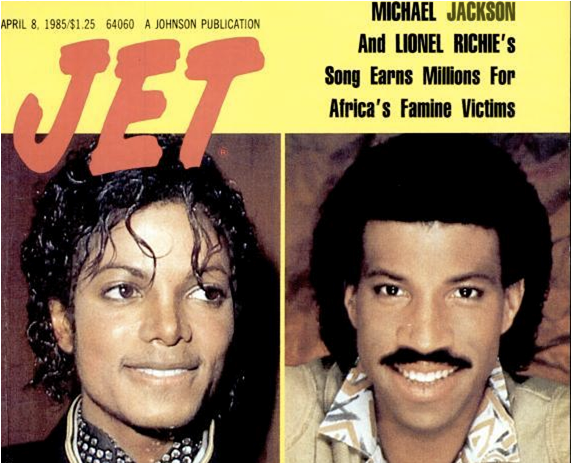
The song was written predominantly by Michael Jackson, with help from Lionel Ritchie, at the suggestion and with the production of Quincy Jones. The process began as an idea of Harry Belafonte. (Credit: JET)
Dr. Martine Rothblatt suggests inviting the entire world’s population on-board the 100YSS by uploading, at no cost, their mindfiles — a 1 TB (or less) digital file of an individual’s mannerisms, personality, recollections, feelings, beliefs, attitudes and values — into a central database that will be carried onboard the starship. Presented at the 100 Year Starship (100YSS) 2012 Public Symposium Sept. 13–16, 2012 in Houston.
In 1985 We Are the World, the first-ever multi-platinum single, got tens of millions of people singing “There is a choice we’re making; we’re saving our own lives.” [1]. These words may never apply to a project more meaningfully than to the 100 Year Starship (100YSS), intended to “make the capability of human travel beyond our solar system to another star a reality over the next 100 years.”.
Digital size of a person
Research from several groups show that a digital file of a person’s mannerisms, personality, recollections, feelings, beliefs, attitudes and values can be represented by less than one terabyte (1TB) of structured information [2] [3] [4] [5]. This is because a limited number, n, of human universals, m, yield millions of unique human combinations via (n!)/(m!*(n-m)!).
Add to this a few gigabytes of unique memories and you can account for the billions of diverse human mindsets, notwithstanding a very modest toolkit of building block characteristics.
For example, a megabyte of information about one’s daily experiences amounts to under 20 GB of information in 50 years. That daily megabyte is adequate to handle all of one’s tweets, texts and emails plus some compressed photos, audio and video. Combined with structured answers to personality inventories [5] and socio-cultural contextual information, a TB is ample space to provide a comprehensive digital reflection of your consciousness, known as a “mindfile.” The vast majority of information we store is redundant.
Websites exist that collect video streaming of an individual’s daily interactions. While such video streams can rapidly exceed many terabytes in volume, they far exceed the amount of information needed to accurately reflect a person’s mannerisms, personality, recollections, feelings, beliefs, attitudes and values. Advanced versions of pattern recognition software will be able to abstract from such continuous digital records such information as uniquely contributes to a mindfile. These pattern recognition based-abstracts are unlikely to require more than a TB of storage, especially when intelligently structured.
Digital size of all human mindfiles — the “Human Sapienome”
Digital memory of approximately 1022 bytes, the size of all human mindfiles in aggregate, what should be called the human “sapienome,” will be available within 20 years at less than 1% of the likely weight and cost of the 100 YSS. Ten billion people, times one trillion bytes, yields 1022 bytes.
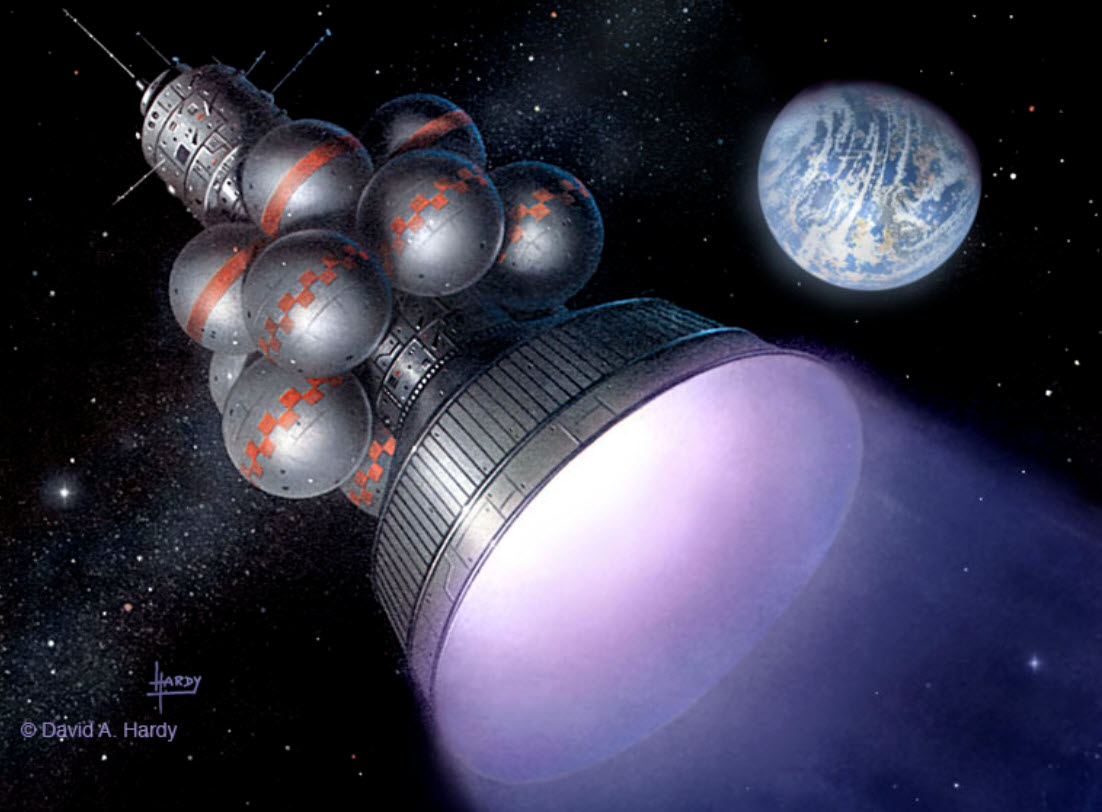
Daedalus starship (credit: David Hardy)
The Project Daedelus starship, either in its original British Interplanetary Society version or in subsequent self-replicating conceptualizations, had a payload mass of on the order of 500 tons [6]. Orion Starship designs of Freeman Dyson had estimated costs ranging from a tenth 10% to 100% of 1968 US GNP [7].
The past five decades of relatively steady, 18-month doubling rates in constant cost for digital memory is not expected to change over the coming decades, due to economic demand, competition and the availability of three-dimensional traditional and novel computing substrates [8].
Hence, by exponential growth, today’s terabyte of memory will become a giga-terabyte of memory in 45 years. Ten such memory modules would hold a ten billion person human sapienome at that time. Alternatively, a few thousand mega-terabyte modules could contain the human sapienome about 30 years from now.
A terabyte today costs around $100 and weighs about 0.5 kg. These numbers are not significantly different from lesser amounts of memory in years past, and are considered by Ray Kurzweil to remain constant or shrink with exponential growth [8]. Hence, 45 years from now, the mass and cost of the human sapienome on a 100YSS would be insignificant. Even 30 years from now, the mass would be a few thousand pounds and the cost about $1 million. This represents less than 1% of the mass and cost of the starship.
Lifenaut members (credit: LifeNaut)
Universal access to information technology needed to create a mindfile is at hand. Already three-fourths of the world’s population has a mobile phone, about one-fourth of which are smartphones capable of full mindfile creation capabilities.
Specialized websites to create mindfiles, such as LifeNaut.com and CyBeRev.org, as well as more generic websites that can also be used to create mindfiles, such as Google+ and Facebook, are free to the public.
Virtually every human being will be able to freely create a mindfile, as smartphone ownership becomes all-but universal over the next decade (with shared access to one for individuals in deep poverty). Hence, there are neither economic nor technological barriers to the creation of a human sapienome.
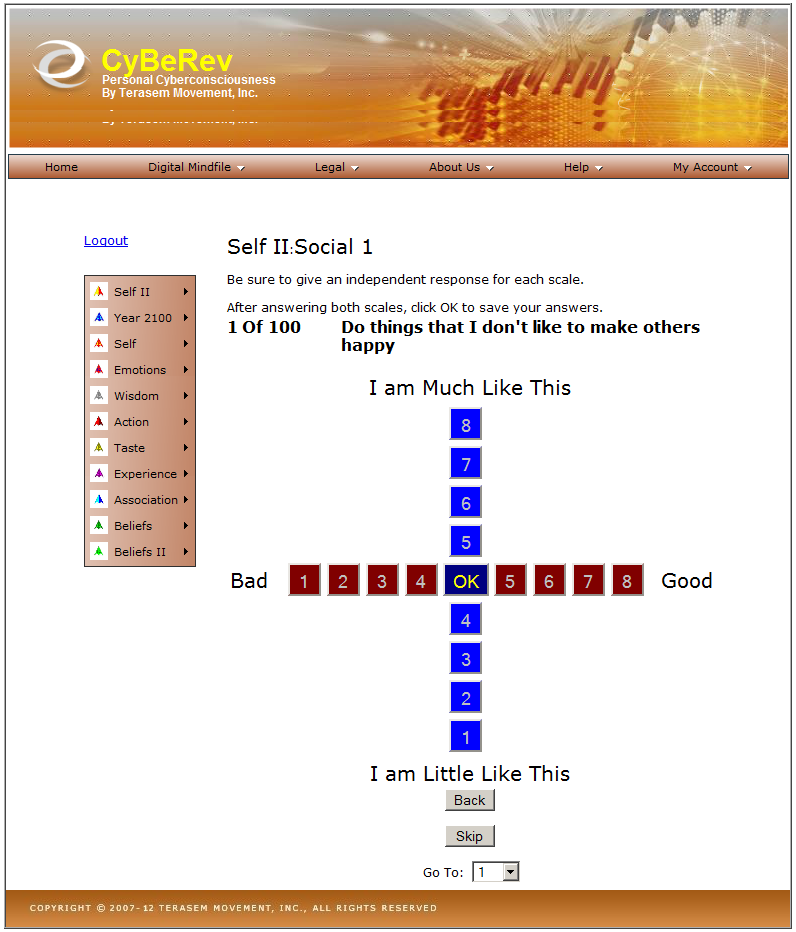
(Credit: CyBeRev.org)
Activation of mindfiles with consciousness operating system software, or “mindware”
It may well be feasible to activate the individual mindfiles within the sapienome with consciousness operating system software, known as “mindware.” This would enable all participating members of the human race to be digitally present, via software agent extensions of themselves, and interfaced with sensors upon arrival at the 100 YSS destination.
However, even if such mindware activation is not possible, the entire human race can still be conceptually — and in a sense spiritually and philosophically — “present” at the interstellar destination by virtue of their mindfiles being present onboard the starship.
As noted above, dozens (n) of mannerism, personality and feeling types (m) yield many thousands of unique human combinations via (n!)/(m!*(n-m)!).
Once you add to these thousands of personality and worldview templates differential recollections, beliefs, attitudes and values (within the terabyte of mindfile information), there are many billions of unique possible combinations of human psyches, one of which will be a best-match for digitally stored mindfiles of each 100YSS participating biological person.
Mindware best fits one of the “m” compound mannerisms, personality and feeling types to that analyzed from stored mindfiles, and then populates it with the recollections, beliefs, attitudes and values evident from that stored mindfile. These combinations and correlations can be accomplished with software that needs be nowhere near the complexity of synaptic connectivity of the human brain, and yet still appears as true to the original person as to persuade others, and their digital self, that the same personal identity is present, albeit via a digital extension.
In the last century people became accustomed to the notion that electro-acoustic waves via telephony represented a biological original person. In the coming century, an analogous association is likely with digital simulacra of unique conscious minds.
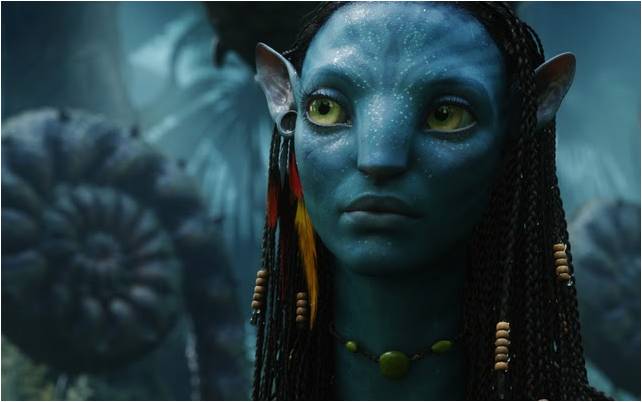
Downloading into bodies… WOW (credit: Twentieth Century Fox)
To be clear, it is not expected that all of the code for a person’s patterns of mindedness would be line-by-line coded. Instead, the mindware, or mind operating system, will be learning software [9].
It will designed to seek out and adopt or “auto-tune” to idiosyncratic data and patterns in each participant’s mindfile in accordance with fundamental pre-programmed universal patterns of human thought and socio-economically specific cultural knowledge.
Iterative internal quality assurance cycles will result in revisions until a stopping point is reached based on matches to pre-set parameters between the learned software-mind and all material elements of its biological precursor as reflected in the mindfile.

Cyberconsciousness can be OK, says Martine Rothblatt’s avatar in Second Life (credit: Martine Rothblatt)
Self-awareness functionality will be activated once cyberconsciousness health and safety checks are complete.
Digital environments such as future iterations of Second Life will accommodate the social needs of digitally conscious humans.
Growth rates in software sophistication, even if less impressive than hardware efficiency, are nevertheless impressively compounding [10]. While it is not expected that such mindware will be available prior to the launch of the 100YSS, it could be transmitted to the starship in a series of software updates, gradually awakening ever more of the mindfiles, in accordance with their informed consent, as expressed upon participation in the Human Sapienome Project.
Socioeconomic research on project ownership
Socioeconomic research is presented in the paper showing that a sense of personal ownership in a project is a major element in determining the support of an individual or a group for the costs of a project. Hence, the We Are the World sub-project helps to enhance the size and durability of public funding for the 100 YSS.
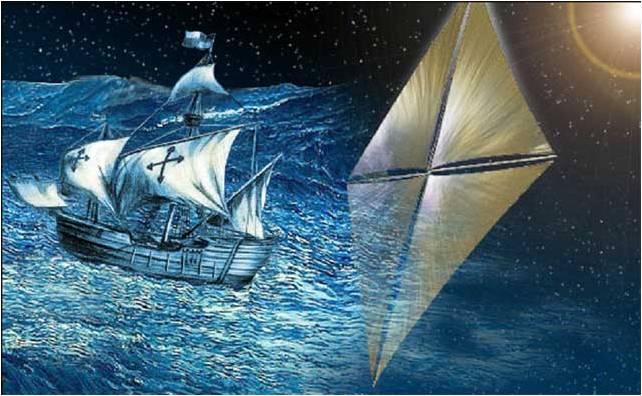
En-route software updates at the speed of light (credit: NASA)
Participatory development has been shown to enhance project success, provided that individuals have a meaningful opportunity to engage with a project that may be of benefit to them [11] [12]. For example, merely completing an informational questionnaire about blood donation increased the rate of blood donation from under 1% to over 85% among a sample of college students in India [13] There is a robust literature demonstrating increased citizen willingness to pay taxes for which the citizens have meaningfully participated in the tax budgeting process [14].
It is not obvious how the lay public can participate meaningfully in the highly complex undertaking of an interstellar starship. Yet, due to the very high cost of the venture, and its long duration, public support is essential.
The solution to this dilemma can be found in the field of participatory project development and ownership. By giving the public a feel that they “own” the 100YSS project, the socioeconomic research cited above, and many concordant studies, strongly indicates the public will be much more willing, and for a much longer period of time, to support 100YSS costs from public treasuries.
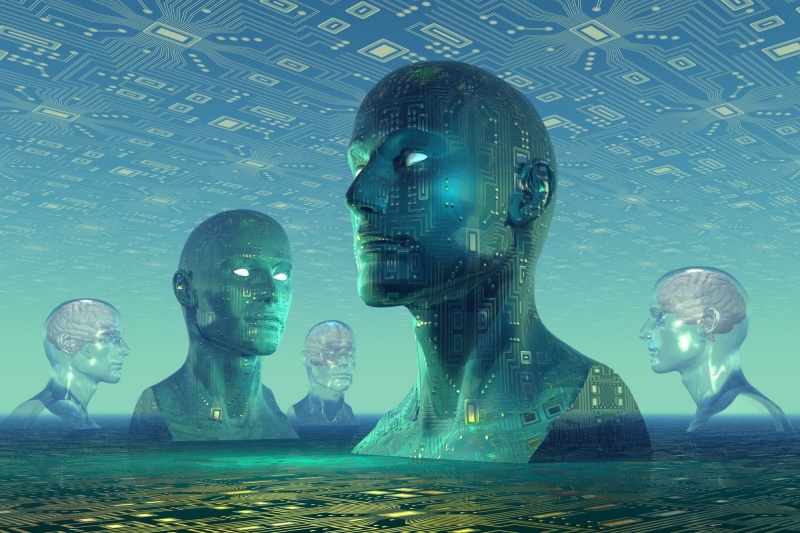
Human Sapienome Project, complement to the 100YSS (credit: Photo Wall)
This paper proposes giving the public ownership of the 100YSS via a “We Are the World” human sapienome project. It will be explained to the public that a grass-roots organization called “We Are the World” has been formed to help transcend war and conflict by collecting the life experiences of every human willing to participate into a massive database similar to Facebook and Google+, but not-for-profit.
The project helps to transcend war and conflict because the database’s social networking features will enable everyone to better experience the perspectives of diverse peoples they may not meet face-to-face. The project will also help to transcend war and conflict by opening itself to social scientists who may study the database — which will scientifically be known as the Human Sapienome Project — for insights into how to better organize societies for harmonious cooperation.
Finally, the project has a quantitative goal — to include the mindfiles of 10 billion human beings, living or passed, and to store them as the real passengers, on an interstellar starship, within 100 years. The We Are the World Project is at once a scientific project, a participatory development project and an ark project, depending upon one’s perspective.
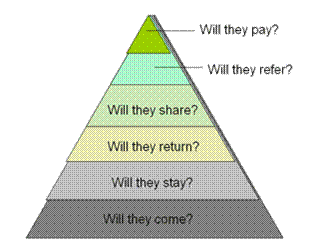
Human Sapienome Project and its freemium potential to help support the 100YSS (credit: Martine Rothblatt)
We Are the World as a 100YSS freemium venture
The We Are the World structure will serve as a platform for “freemium” offerings that in many other endeavors have shown significant abilities to generate revenue. Some of the wide variety of income opportunities that arise from the 100 YSS unique hosting of what could be one of the largest databases of individual psycho-social information are:
- Individuals choosing to pay for digital and database functionality beyond the hosting of their mindfile and the ability to interact with other mindfiles;
- Organizations willing to pay for anonymous but demographically tagged information from participants in the Human Sapienome Project;
- Sponsorship fees from organizations that wish to be known as sponsors of the Human Sapienome Project or the We Are the World website;
- Licensing fees from software, firmware and hardware advancements that emanate from the development and growth of the We Are the World and Human Sapienome Projects.
The intrinsic freemium and extrinsic negotiated revenues that flow from these projects will go to supporting the long-term costs of the 100YSS organization. A special focus of these revenues should be an unceasing education and outreach effort to achieve the quantitative goal of 10 billion mindfiles within 100 years safely stored onboard an interstellar starship. In this way, the project becomes a self-fulfilling prophecy.
As ever more people deposit mindfiles with what is known as either the Human Sapienome Project or the We Are the World Project, they are in a very real sense voting with their digital souls for the success of a 100YSS. This will help to give the project greater momentum during a century-long design and build period, plus the interstellar transit period that follows.
Every individual can feel a sense of ownership because their digital self will be on board the starship. Furthermore, there is a realistic hope that with a century of software development, that digital self will be able to actually experience the thrill of taking footsteps amidst the stars.
References
1. Jet, April 8, 1985 pp 60-64. The song was written predominantly by Michael Jackson, with help from Lionel Ritchie, at the suggestion and with the production of Quincy Jones. The process began as an idea of Harry Belafonte.
2. Brown, D., “Human Universals,” McGraw Hill, New York NY, 1991.
3. Costa, P.T. and McCrae, R. R., “Personality In Adulthood,” Guildford Press, New York NY, 1990.
4. Landauer, T., “How much do people remember? Some estimates of the quantity of learned information in long-term memory,” Cognitive Science 10, 4 (1986) pp. 477-493.
5. Bainbridge, W., “Massive Questionnaires for Personality Capture,” Social Science Computer Review 21, 3 (2003) pp. 267-280.
6. Grant, T.J. 1978 “Project Daedalus: An Engineering Assessment,” Journal of the British Interplanetary Society Supplement, S180, S187 (1978)
7. Dyson, F., “Interstellar Transport,” Physics Today, October 1968, pp. 41-45
8. Kurzweil, R., “The Singularity Is Near: When Humans Transcend Biology,” Viking, New York NY, 2005, pp. 75-77
9. Bock, P., “The Emergence of Artificial Cognition: An Introduction to Collective Learning,” World Scientific, New Jersey, 1993 p. 52.
10. Vinge, V., “Signs of the Singularity,” IEEE Spectrum 45, 6 (2008) pp. 77-79.
11. Sen, A., “Rationality and Freedom”, Harvard Belknap Press, Cambridge MA, 2002.
12. Sen, A., “Development as Freedom,” Oxford University Press, Oxford UK, 1999.
13. Bharatwaj, R.S. , “A Descriptive Study of Knowledge, Attitude and Practice with Regard To Voluntary Blood Donation Among Medical Undergraduate Students In Pondicherry, India,” Journal of Clinical and Diagnostic Research 6, 602-604.
http://www.jcdr.net/articles/pdf/2145/14%20-%203715.pdf
14. Ebdon, C., “Citizen Participation in Budgeting Theory,” Public Administration Review, May/June 2006.
Comments (40)
by Frost
I have a better idea, let’s NOT conflate the awesome and visionary 100YSS project with someone’s ridiculous neo-religious ideology where a couple of exabytes of really bad copies of Eliza approximating a person’s behavior is sent and the Faithful are filled with glee that they are supposedly on the ship.
I wish some of you people could hear yourselves.
It’s becoming extremely clear to me that the first thing we’re going to need after the singularity is a strong and immediate repeat of the Enlightenment. The clerics of the new world are already lining up, mythologies in hand, to take advantage of it.
by Nyk
The first thing we need is for the Singularity to actually happen. This is by no means a given in the world’s current political and economic climate. For all we know, we could be at the end of a Golden Age and repeating the fate of the Roman Empire.
by persilj
I’d like to hear more about the “advanced versions of pattern recognition software”.
by A4i
In theory a person can map his connectome , load it in to a computer and boost a billion time his own though speed. Then use that additional speed for solving difficult problem in an hour computer time, that equals roughly 115 thousand ordinary years. Upon completion of the task that real person can chose to remember what the virtual himself has done by simply uploading a file into memory extension implant in his biological brain. Seems useful to me. Technically it’s still you in the computer, so everything your virtual brain discovers legally belongs to you.
by SmartAndSober
Question: How to effectively create backup for human beings?
We human beings are little more than biological machines.
As mere biological machines, do people not sense the immense terror of going through their daily lives *without* a backup?
by stan
This project offers no profit of any kind to the future of mankind or to the acquisition of further knowledge. It is just an ego trip.
by ErikSMeyer
A sentient creature, let alone a person, is not reducible to a set of data points.
I don’t doubt that it will be possible to construct very big sets of data about people (“mindfiles”) in the near future (the busy little bees at Google and Facebook, not to mention their enablers at DARPA and similar organizations, buzz happily closer to that goal by the day, for their own reasons)…
But the data is not the person.
It can only be used to create an informed representation of the person, an avatar. There has been talk of combining such “mindfiles” with the data outputs of brainscans designed to recreate the actual neural structure of a given person; even were that to be done, the combined result would still be a representation, not the thing itself. Not a “digital soul.” (You don’t know what minds are, you don’t know how to copy them, and any attempt to do so, however convincing, is predicated on the assumptions that everything essential about the mind has been identified and is capable of being transferred/reproduced; neither is true.)
In my view, if you “uploaders” were to ever get your wish, you would find yourselves staring at representations/copies/avatars of yourselves that, however cleverly constructed and however well informed, were just functional mimics of life, having no life of their own, certainly not “transfers” of your own lives into a machine.
They might be easily confused with living creatures, though, responding to various tests in the ways we would expect their originals to respond. That would make them good copies, not “uploads.”
Further, I keep pointing out the dangers of reductionism here, and, while it doesn’t really matter what I say, because these people will not be stopped, I’ll do it again:
Reducing a person, or any animal consciousness really, to a set of data points, or the output of a scan (to be read in, mapped, and reconstructed), denies that that person/consciousness has any intrinsic character, any essential core that cannot be observed, analyzed, and reproduced. This is the endgame of materialism, which views sentient life as simply one way among many of processing and responding to information; by definition it is soulless and bloodless and rejects any essential distinction between life and non-life.
If you don’t believe there is a difference between life and non-life that matters, well, why would you care if non-life were to replace life? Might that not be more efficient in many ways? Better for business? A more practicable way to build a “new world”/realize “our destiny”, “conquer the stars,” etc.?
Meanwhile we all skip down this path gleefully, mesmerized by the immediate term possibilities inherent in recording every aspect of our lives, bundling all of it up, and storing it in some megadatabase.
You’re not putting people into the machine, you are exposing them to it.
Whatever else happens, these people from Google and Facebook and their successor organizations will definitely accomplish that, have no illusions.
They will capture every last speck of data about all of our lives, store it, tag it, process it, make it available for review and reconstruction (think of how useful that will be, for them!, how much easier it will be to manipulate, indoctrinate and control people [I’m sorry, I meant manage their “compliance,” err, market to them, “educate” them, attune their behavior with the standards of the governing “community”]. (Oh, and participation will be nominally voluntary but mandatory in practice, as it will be all but impossible to live in the world normally without transmitting, however unwittingly, enough data about yourself to flesh out your profile well enough for purposes of the system. That will not be an accident either).
Even in this article, the idea of “uploading” the “minds” of everybody on Earth is presented as a Marketing concept, which is to say, a technique of compliance management, a way to get everybody to buy into the program being sold by creating the illusion that they “own” it or are “participating.”
by Mark
I agree with comments in your last few paragraphs about how much easier this would make it for the slave class’ opinions to be manufactured and regulated, but I disagree with many of the distinctions you made between human life and intelligent machines. I find one useful way to look at humans vs intelligent machines to be this:
Consider the origin of life and its likely initiator, the theoretical process of abiogenesis. Without going into too much detail, it constructs a pretty decent platform by which the organic matter by which life is built (amino acids and long chain proteins, nucleotides and polynucleotides, lipids, etc) readily form on their own from raw materials by merely simulating Earth’s early atmosphere in a lab (and then goes on to postulate how over the course of a billion years or so these parts could self-appropriate into the first primitive cells to be subjected to the process of the evolution of life). So far, the study of evolutionary biology, genetics, the triangulation of genes, abiogenesis, etc. seem to indicate the same thing: that life is a series of simulacra that originated at a point. Heck, we can even see our relation to bacteria with which we share paragraphs of identical genetic information. My point is that we are this evolved machine that has a set of finite parameters which are to be decoded, even if we don’t agree on a timeline. If we are to speak of the philosophical concept of whether a copy of someone is actually that person, then I find it more useful to observe a gradual process of transition. If one were to transition slowly, part-by-part from a biological to a digital substrate, keeping intact the action potentials of neurons and the connections of the neural network as well as all other relevant details, then you would have a system that indeed would be able to be defined as a bunch of zeros and ones. The consciousness of that person wouldn’t have been disrupted, and he or she would be convinced of their identity. Now, you could make the case that the parts replaced would have a small margin of error in rendering the person, which I believe is true. However, you could make the case that you aren’t exactly you after any relevant experience you have where your neural network changes, cells are replaced, you have a heart transplant, go through puberty, or even when you wake up from sleeping and forget where you are, etc. There are constantly disruptions and changes to our consciousness yet we still claim our identities. I won’t go into quantum differences and it’s potential role in consciousness because my rant has already gone on long enough. I’m not trying to tell you that you’re wrong but rather share my views that are alternative to yours. Neither of us will ever be able to do justice to the whole of our belief on this matter via a box of text.
by Eric Anderson
Why just ONE? Why not 10 or 100 or 1000 such ships sent out with the miinds and DNA replication of everyone? When new home worlds are ready an ISSS could start an new world. The minds sent in the ISSS could then use the technology to have children and then=== Expand at the speed of the Inter Stellar Star Ship travel speed.
by Phil Osborn
Willard P. Osborn – Posted on my FaceBook home page:
http://www.kurzweilai.net/solve-for-x-celebrating-moonshot-thinking
This is off the top of my head: I was thinking that instead of just Google funding this, why not take a lesson from another high-minded project which was also just this past Saturday the subject of an interview on KPFK’s Digital Village:
http://www.kurzweilai.net/we-are-the-world-inviting-everyone-onboard-the-100yss-is-practical-and-will-help-to-ensure-its-success
So, why not a planetary fund for “Solve For X” projects. I would call it the X-Fund, except that the name is taken… along with a host of others. Maybe, tentatively, Be-Fund – altho there is a fund in India for low-income youth startups… darn… Slightly different spelling, though, and “befund” has the great advantage of meaning “the findings or results” in German, which is PERFECT! So, a nod to the Indian project – maybe a cooperative deal or an agreement to help publicize them?
So, regardless, here’s how it works: Everyone contributes one dollar or simply signs up, and major contributors make up the balance for those who can’t afford even $1, and then there is $7Billion available to actually investigate and pursue projects that should be done. Planetary warming, universal justice, etc.
Or, like, figuring out a really equitable way to distribute the planetary production that respects everyone’s human rights and and at the same time doesn’t discourage people from being really productive. (My project, BTW, based currently on a Common Law perspective.) Like the current Challenge contests, in which people are asked for solutions to real problems, rewards could be financed via the planetary Be-Fund, with the winner(s) sharing a percentage of the value added if they choose to make in a proprietary venture.
So, you come up with a solution to some pressing social problem, collect a reward for your efforts, and then, you’re allowed by contract to collect royalties of up to perhaps 1~10% of the value that your idea added to the user’s lives, on the basis of some patent that you filed and got. (Actually, part of the $1 sign-up contract for Be-Fund would be that you agreed to adhere to the principle of paying that limited royalty on Be-Fund results. That proprietary interest is not just about making someone filthy rich, however, because the more people benefit from the idea, the more the originator(s) receive back in royalties. So, you have a major vested interest in maintaining and enhancing that value.)
And, you’re required up front to agree to license the use to anyone who pays royalties, as well, so that if someone comes up with a better or more efficient way to do it, you don’t lose out for being first. You still collect royalties from them and perhaps many others, but they also reap the benefits from their contribution. Win-Win-Win, because the Be-Fund also gets a cut, which goes into funding more innovation, as well as reimbursing the original $1 investors, or even paying them dividends as more and more solutions generate more and more wealth. That’s dividends going to effectively the entire planetary population. Nice, huh?
Compare this to our current system of intellectual property: winner takes all and then either is sued out of business by a major player to get the property or uses the patent to block competitors from using the idea. Lose-Lose.
The BeFund solution avoids any such pitfalls by the mechanism of tying everyone’s benefit to everyone else’s, thus also achieving many lofty moral ideals.
by A4i
Well, if MRI can map whole connectome , then that map will represent a relatively small file of just numbers – coordinates of neurons and their corresponding individual synapses . So this personal connectome map may be even smaller, than a mindfile, while being exact copy of the original brain in the same time.
by Giulio Prisco
MRI cannot map the connectome, because the resolution of MRI is too low. At this moment, only destructive in-vitro techniques can map neural circuitry at the high resolution (a few nanometers) needed for uploading. So far, very high resolution techniques can only be applied to small neural tissue samples, and we are still far from being able to scan a whole mouse brain, let alone a human brain. See http://www.kurzweilai.net/a-connectome-observatory-for-nanoscale-brain-imaging
Of course our ability to scan the brain will improve, and perhaps there will be dramatic improvements, but I guess the mindfile approach will remain a useful complement to connectome mapping.
by A4i
If you obtain connectome mapping file and load it into a computer (similar to Blue Brain), that computer can compose music , paint pictures, construct buildings or do whatever it’s human original is trained to do. So that’s fundamentally different outcome from mindfile approach. Also neurons are pretty big cells to scan. It should be possible for a MRI to map them , using just improvements of nowadays technology , with ought the need to develope new one. In 100 years there should be MRI with sub atom resolution.
by Shiny Raygun
“We Are the World” !!! Brought to you by DARPA in order to bring a Jacksonian/Coca-Cola era of World Peace as we prepare to upload all the human minds of planet Earth to go an amazing journey to another star! Yes indeed, lets use our cel phones and advanced versions of FB to tell the US Defense Dept. every single personal detail and most intimate inner thoughts. With such a worldwide profiling database, DARPA will be able to send digital copies of the entire world’s population off to another twinkling star! WTF! Sure will be a hit with the Heaven’s Gate Hale-Bopp crowd! And imagine the benefits to World Peace that will come from the Defense Dept’s use of this data base! Whoever thought this one up, has been reading too much George Orwell! But then again Orwell was a visionary who wrote truth disguised as fiction. So it may actually happen. In fact, it has already begun with their top-secret support and popularization of the hooded wonderboy’s drunken school project. You find that hard to believe? But are you tempted to believe in the “We Are the World” project? hmmm… What great comedy!
by SmartAndSober
Okay, you are being sarcastic. But do you really believe that *anarcho-capitalism* which I guess is your prefered social-political mode, will make the world a better place?
by SmartAndSober
What I mean by that (my earlier comment) is that, according to history, slightly totalitarian states are (practically) longer living and better ran than the totally *democratic* ones.
If USA is a *real democracy* like in some form of Utopian fantasy, it would not have the great influence and global dominance it have today.
by Nyk
We 21st century humans may be good at science, but we suck at politics. How many times do we have to rediscover Plato’s wisdom? Best ruler = philosopher-king. Remove Obama and the beige bureaucracy behind him, put Kurzweil in charge as supreme leader, give him unlimited power, and watch the quality of governance improve overnight.
by Fredrik Wallinder
Sorry, I don’t identify myself with some facebook updates. And a collection of data cannot reproduce the abstraction properties related to actual thought and intelligence. But let’s assume that future brain research allows a truthful copy that somehow survives the trip inside some hardware. What happens then upon arrival? Why go there in the first place?
by Giulio Prisco
Why go there? Because it is fun, and it is our destiny!
by Bri
I’m reminded of sperm bursting forth, wiggling and pushing themselves into every nook and cranny.
by SmartAndSober
I guess something like a Bina 48 robotic bust would be too large for the Starship, but I prefer (if I can choose) a more material one (instead of digital approximation).
by Gabriel
I feel a bit confused reading this article…
Firstly, Dr.Rothblatt (whom by the way, I don’t remember ever seeing an article from her on this website; I did very enjoy her and her optimism in her interview with Kurzweil in the Singularity is Near movie) says that It takes less then 1TB to basically capture someone’s mindfile….but, if I remember correctly, according to Kurzweil, it takes 10TB, which we apparently cost 1000 dollars in 2018, is what constitutes a human being’s memory….not their “essence” (memory, personality etc)…which implies that a person’s mindfile will be much bigger and take much longer to cheapen….10TB is also apparently 10^13…whereas he gauges human intelligence to be 10^16-10^19….with all human intelligence today being 10^26, which is bigger then the 10^22 figure…
I’m probably mixing apples with oranges, much less getting the numbers straight, but I felt strangely confused reading; another weird feeling I got was basically what Gordon said…if we uploaded ourselves, we wouldn’t have to leave Earth…or leave “anywhere”, wouldn’t we? We’d be able to stay on Earth (actually, we’d technically probably be spending much of our time in VR) and be connected and part of this starship as well, as computronium is seeded and spread across the cosmos, expanding our presence and intelligence that much further….the whole idea of a giant starship, if I have the right image in mind, seems strange at any case…wouldn’t swarms of molecule-sized ‘starships’ spread across the cosmos be a more accurate vision of the future? Barring the mind-uploading, this one giant starship going to find new life is basically the conventional mentality that people have with the future….which is quite deviant and limited to what our capabilities in the future will bring us.
Apologizes if I’m not reading this article at all…I am always happy to read more on the ‘logical endpoint’ known as mind-uploading.
by WLGJR
Many starships may be molecule sized, but some (like the ones carrying artificial wormhole termini) won’t be.
Artificial wormhole termini probably need large supporting structures when they are moved at a significant portion of lightspeed.
http://www.orionsarm.com/eg-article/4b1645da51e3d
by WLGJR
In the future, we may depend mainly FTL communication (via wormholes) and probably little to no FTL travel.
All *travels* of sentient beings are done by sending a digital “sentience-copy” through a wormhole.
by me
This project as described is evil.
by SmartAndSober
There are probably similar projects being carried out by other civilizations in the galaxy. I think SF writers are thrilled to know this is happening.
BTW, how is it evil? Participation is optional.
by smb12321
Maybe you would care to elaborate on the evilness of this project. As we continue to miniaturize, increase complexity and data holding, I can see several “worlds” flying through space until eventually a planet is found where “beings” will be grown for download. Seems so sci-fi but folks 200 years ago would consider space travel, computers, TV, fridges, light, etc magical (or in your case, evil).
by PirateRo
I like the idea of a 100 year starship project. I think it is an important mission and worthy of investment. Answering the question, what’s in it for me is the key to the discussion.
I’d much prefer pouring money into the NASA effort to build a warp drive. Instead of a big data view of this souvenir-view of starships, let’s build the real thing and make it available to everyone. I think we need to do this sooner than later and we need to stop with the “oh, it’s too difficult” nonsense. We need a Manhattan project.
The essential nature of our species is the basis: It is our conversation, dissention, changes of minds, new and divergent ideas that let us all contribute to this thing. No one cares about a Kodak-moment. I think you open this project up and you’ll have more ideas than you can deal with which, by the way, is the kind of problem you want when there’s an incoming asteroid or red dwarf star.
Build the drive. The rest will take care of itself.
by Astronist
One relevant reference you missed: Athena Andreadis, “Why Our Brains Will Never Live in the Matrix”:
http://hplusmagazine.com/2009/10/19/ghost-shell-why-our-brains-will-never-live-matrix/
This project could probably be done more cheaply by sending a photo or two of everyone involved. Your speculations about “digital consciousness” are okay as science fiction, but need a bit more experimental evidence before we start planning starships on this basis.
Stephen, Oxford, UK
by Giulio Prisco
I can’t answer for Dr. Rothblatt but I guess that, in the very unlikely case that she was aware of the article you mention, she did not consider it as “a relevant reference.”
The Andreadis article is ideologically-motivated and assumes the conclusions that the author wants to reach, without offering relevant scientific arguments in support. Assuming a conclusion like “[Uploading] is intrinsically impossible” is not science, but wishful luddite mysticism. In science, we let theoretical models and experimental evidence decide.
I consider the feasibility in-principle of mind uploading as (almost trivially) self-evident, but I totally agree with your call for more experimental evidence, and therefore I think mind uploading research, including the Bainbridge-Rothblatt mindfile approach, must be vigorously pursued, and the recently approved Human Brain Project is a good step in the right direction.
by Khannea Suntzu
Not interested. We are not a fraction of where we need to be to make this work. I only see massive dangers allowing my private secrets to be thrown around in such an irresponsible manner.
by smb12321
Frankly, few folks have secrets interesting enough to entice others. Most of our lives are filled with minutiae – work, kids, eating, TV, music, reading, sports, school, etc. I wonder about those monsters who appear normal but underneath are yearning to kill or maim folks. Wonder what their upload will be like?
by SmartAndSober
I am reminded of the science fiction anime GITS.
In GITS, the sentient legged battle vehicles *Tachikomas* perform *mind-merge* every once in a while to share newly acquired memories and skills.
I guess it would be great to make the 100YSS uploadees to *mind-merge* once in a while. We probably need AI analyzer softwares to help us iron out the *malevolent* traits (mental pecularities, memories, skills and other details) and amplify the *desirable* traits.
I also think the uploadee population would cooperate with each other better if the *mind-merge* is done several times.
by A4i
Maybe in 100 years MRI scanners will be capable of mapping a human brain connectome, so no approximation required for uploading. At that point computer simulation will represent any individual participant. One human personality will constitute single computer thread and by multitasking a single computer will accomodate billions of humans in real time , exploiting the big difference between human neural impulses propagating / light speed connection and femtosecond switching (at that time) in computers.
by WLGJR
I think there is the undesirable possibility that the reconstructed personalities (from my lifelogging files: diaries, photos, etc) end up being awkward like the more primitive versions of ELIZA and other similar programs.
Just lifelogs alone, IMHO, is obviously not enough. Full brain scanning is the safest, most guaranteeing way for personality uploading.
by Gorden Russell
It might be a better idea to click on the above link for our friend Giulio Prisco’s article from last December, “Uploaded e-crews for interstellar missions.”
Once you have the article, read down to this paragraph: ” The basic idea of uploading is to ‘take a particular brain [of an astronaut, in this case], scan its structure in detail, and construct a software model of it that is so faithful to the original that, when run on appropriate hardware, it will behave in essentially the same way as the original brain,’ as Oxford University’s Whole Brain Emulation Roadmap explains.”
This seems to be a much better way to go, than the “mindfile” described by Dr. Martine Rothblatt.
Just check out the Charles Stross book, Accelerando, as Giulio describes in his article. It’s a good read and available in libraries and used book stores.
Also, Dr. Rothblatt talks about doing all this in 30 or 45 years. Ray Kurzweil charts the Singularity as arriving in 32 years or so. We will have the connectome by then for sure, and we be able to load up all we are into the starship without ever leaving home.
We are certainly going to have self-reproducing robots up on the moon and out among the asteroids long before the year 2045. They’ll be multiplying like rabbits out there in the Solar System and building more space stations and space ships than you can keep track of without a computer in your head. But in ten years or more we just might have those robots and those computer implants.
A few years after that, and there will be robots out amongst the asteroids
In less than 40 years there will be enough robots out there to start building a starship with a charged particle accelerator as a drive that will thrust the ship at one gravity. In a little more than a year of thrusting at one gravity, the ship will be very close to the speed of light.
This can happen and will happen just as long as the people of the world will it.
It can all start with a single self-replicating robot and a proper toolkit. (That includes a solar array to power everything and a 3-D printer.)
by Giulio Prisco
Thanks Gorden, but I don’t see any incompatibility between the two approaches. Rather, “traditional” mind uploading and Bainbridge-Rothblatt mindfiles are complementary technical means to achieve the same goal.
In mind uploading, we read information from the brain, and we must try to read enough information. In mindfiles, it is the brain that chooses which information to write out, and again, the problem is to capture enough information. I think both techniques will be used in parallel, for example using brain scans to capture low level information and mindfiles to capture high level cognitive information.
The problem of mindfile technology is that with current technical means (writing blogs, posting videos, answering questionnaires) it would take too long to build a mindfile rich enough for uploading, but I think this may change dramatically once high speed brain-computer interfaces (BCI) are available.
Also, a lot of information does not need to be acquired from the brain because it is available in the cloud. For example, Google Street View converts a text string (say, your address) to a full visual map of your more familiar sights, that can be added to your mindfile.
by hakan1997
Now we are talking! What an amazing project idea. Let us hope that it can become a reality
by Gorden Russell
Those scammers are back Phishing at this page now. Their address is:
http://www.bonusprizes.net/index.php?source=trafficvance&keyword=Kurzweilai.net
Don’t anybody here answer their phoney survey and don’t be fooled by their lying promise that you have won a prize. Certainly, never give them your contact data. They will bill false goods and services onto your phone bill.
by gaoptimize
Recommend some of that 1TB be structured inventories (questions/answers surveys) so that it will be of more immediate use to researchers. Seems that some privacy and security issues may need to be worked out.