What happens during the brain’s ‘resting state’?
September 20, 2012
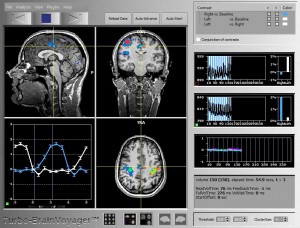
Over the past few years, some researchers have been adding a bit of down time to their study protocols, Nature News reports. While subjects are still lying in the functional magnetic resonance imaging (fMRI) scanners, the researchers ask them to try to empty their minds. The aim is to find out what happens when the brain simply idles. And the answer is: quite a lot.
Some circuits must remain active; they control automatic functions such as breathing and heart rate. But much of the rest of the brain continues to chug away as the mind naturally wanders through grocery lists, rehashes conversations and just generally daydreams. This activity has been dubbed the resting state. And neuroscientists have seen evidence that the networks it engages look a lot like those that are active during tasks.
Resting-state activity is important, if the amount of energy devoted to it is any indication. Blood flow to the brain during rest is typically just 5–10% lower than during task-based experiments. And studying the brain at rest should help to show how the active brain works. Research on resting-state networks is helping to map the brain’s intrinsic connections by showing, for example, which areas of the brain prefer to talk to which other areas, and how those patterns might differ in disease.
But what is all this activity for? Ask neuroscientists — even those who study the resting state — and many will sigh or shrug. “We’re really at the very beginning. It’s mostly hypotheses,” says Amir Shmuel, a brain-imaging specialist at McGill University in Montreal, Canada. Resting activity might be keeping the brain’s connections running when they are not in use. Or it could be helping to prime the brain to respond to future stimuli, or to maintain relationships between areas that often work together to perform tasks. It may even consolidate memories or information absorbed during normal activity.
(more)

Comments (20)
by DrDubious
It would be interesting to compare the “resting state” of an average person to that of someone trained in meditation. Such training typically begins with the instruction to quiet the “internal dialog”, which is much easier said than done.
by Chris P. Kareem
According to some people like Zen Buddhists and Eckhart Tolle, the majority of our thinking is unnecessary. So perhaps it doesn’t serve any useful function.
by Marcos Marin
From the original article:
“I strongly believe that there is a neurophysiological mechanism that underlies the entire thing that we call resting-state networks,”
Can you imagine a better way of sounding smart while saying nothing at all?!
by Mr.X
Yes.
George Orwell on talent, paraphrasing the bible:
“Objective considerations of contemporary phenomena compel the conclusion that success or failure in competitive activities exhibits no tendency to be commensurate with innate capacity, but that a considerable element of the unpredictable must invariably be taken into account. “
by Mr.X
My brain’s always at rest, my comments can prove that.
by Marcos Marin
hehehe indeed! They MORE than prove that :-D :-d
by GatorALLin
….maybe one theory is that the brain has to be on to keep basic functions going (breathing/heart beats, etc) and so it does not take much more to do some basic house keeping like tasks for the brain. Maybe it is like sharks swimming that they need to keep water moving through their gills to stay alive… maybe neurons need activity to stay active and die off without enough activity… Maybe like a wired system that adjusts with use (like a muscle with use/non-use). I like to think of the sleeping brain just like my computer with the Defrag mode to clean up space and fix errors, or just compact and repair where memories considered non important get cleaned out to make room for new ones….? Interesting how short term vs. long term memories work…. what it takes to get a short term memory into long term, etc… interesting comparisons from computer to brain sometimes…. is that just a good idea and both the brain and the computer need to clean/repair?
by Marcos Marin
what doesn’t?!
by Mr.X
Re:”what doesn’t?!”
Art.E.g just let something rot away and call it art.I have seen things like that, or planned doing it (jk, I don’t want to starve, better stay away from the commercial aspects of art).
“These wonderful pieces of art are here to expand our awareness of the unity of all things, through showcasting the fate of all things material: Decay.
Ps: Watch your children, parents! Eating that sandwhich on the left is both illegal and unhealty.”
by Antikytherapy
I’m not sure just how restful you could get when lying in an fMRI, when a researcher asks you to “empty your mind”. I certainly wouldn’t be relaxed and empty-minded.
by GatorALLin
….darn good point…… I think it would be cool to get some monks in that could fully control their mind… I bet you would see more of a difference then….
or would be fun to watch the sleeping brain vs. the quiet brain when your awake. Then you should also see some interesting differences. I would guess that there is still a lot of things going on in the REM cycles with active dreamers.
by Marcos Marin
Exactly. Humans beings have a very odd definition of “resting-state”.
by Chrispium
Actually Jon Kabat-Zinn has been scanning Tibetan master monks to see what happens in their brains.
by John
Right, it’s still active, just active less.
by Marcos Marin
You’d be dismayed if you knew what kind of “healthy” cognition passes for normal in psychological “science”.
Antikytherapy’s skepticism is the correct approach.
by Nick
Is there any science behind polyphasic sleep, i.e. is it dangerous or harmless?
Does the brain, get enough rest in this form of sleep?
Does it shorten the life span?
Are there any animal studies regarding polyphasic sleep?
by Marcos Marin
Yes.
Yes.
No.
Yes.
Yes.
Furthermore it makes you even dumber.
by Marcos Marin
Page not found (error 404)
Are you sure the URL contain so many white space, dear?
by Giulio Prisco
Thanks Marcos. Fixed.
by Marcos Marin
Thank you ;-)