What our civilization needs is a billion-year plan
September 23, 2012 by Peter A. Garretson
Lt Col Garretson — one of the USAF’s most farsighted and original thinkers — has been at the forefront of USAF strategy on the long-term future in projects such as Blue Horizons (on KurzweilAI — see video), Energy Horizons, Space Solar Power, the AF Futures Game, the USAF Strategic Environmental Assessment, and the USAF RPA Flight Plan. Now in this exclusive to KurzweilAI, he pushes the boundary of long-term thinking about humanity’s survival out to the edge … and beyond. — Ed.
The views expressed are those of the author and do not necessarily reflect the official policy or position of the Department of the Air Force or the U.S. government.
It isn’t enough just to plan for two or 20, or even the fabled Chinese 100 year periods. We need to be thinking and planning on the order of billions of years. Our civilization needs inter-generational plans and goals that span as far out as we can forecast significant events.
For this discussion, I define a “significant event” as an event about which we have foreknowledge and which will fundamentally change our planning assumptions.
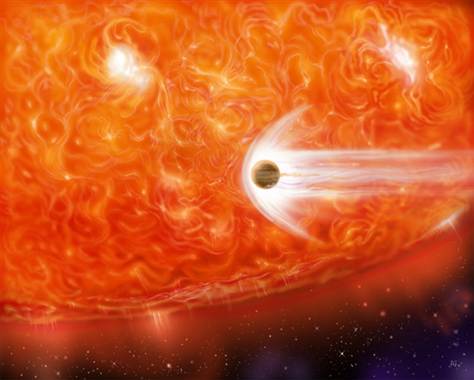
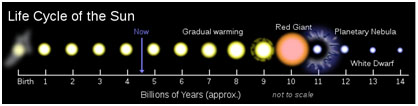
For instance, the most significant near-term external problem we can forecast is that we have only about one billion years before the Earth becomes uninhabitable. Somewhere around that time, our Sun will have expanded and start boiling away our oceans. Truly, as the great space visionary Konstantin Tsiolkovsky foresaw, “Unless mankind leaves the Earth, it will surely die there.”
It is a nasty reality that sometimes the solutions to significant problems take time, and last-minute crash programs can fail. It would be a darn shame to end life’s two billion year run (and humanity’s eight million year run) prematurely because of a lack of planning.
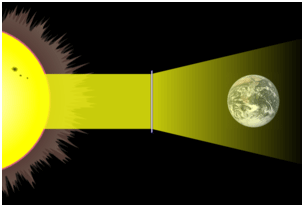
Moving everyone and everything we value off Earth is likely to take some time. The same is likely to be true for any of the alternatives: uploading most of us to exist “in-silico,” putting a sunshade between Earth and the Sun, moving the Earth, or attempting to control the Sun.
It is often a good idea to have at least a cadre of people thinking well in advance about the problem, and designing solutions.
Space colonies and space solar power
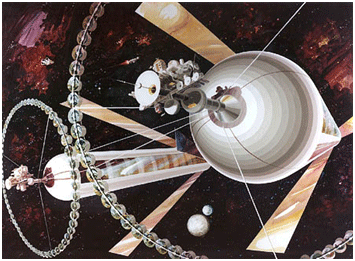
The obvious solution available to us today to cope with Earth’s eventual non-inhabitability is to build O’Neill style space colonies from material in the Asteroid belt, which is estimated to have a carrying capacity of 10–100 trillion people (1,000 to 10,000 times our current population on Earth).
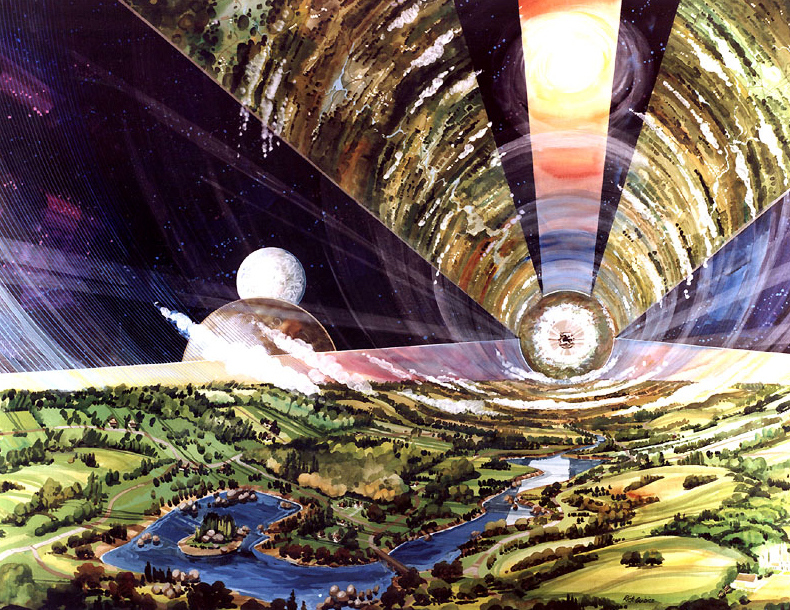
Of course, to be able to exercise that option, we would need a space policy that recognized survival as the fundamental reason for the space program, with articulated goals of space development and space settlement explicitly stated, and a space program pushing the technology and logistical capabilities to be able to attain those goals.
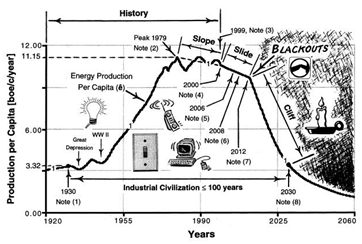
Energy production history and forecast (credit: Richard C. Duncan, The Peak Of World Oil Production And The Road To The Olduvai Gorge)
Energy availability is a key constraint to human progress and mobility. Spacefaring and space settlement capabilities would need to be developed before some other crisis (such as peak oil) caused a new and likely irrecoverable dark ages, which would reduce the energy capital available to develop the pre-cursor technologies. Nature has provided humanity a bounty of easy energy in the form of fossil fuels, a sort of ”baby fat” for the Earth to grow to adolescence. Use it well to reach new energy sources and we transcend; use it poorly (use it up) and we collapse.
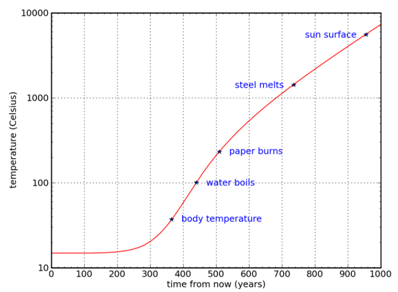
Earth surface temperature given steady 2.3% energy growth, assuming some source other than sunlight is employed to provide our energy needs and that its use transpires on the surface of the planet. (Credit: Tom Murphy)
The case where we transcend a fossil fuel crisis is just as compelling. If we succeed in continuing our population and development growth and find new energy sources, and assuming energy use (including all sources: fossil, nuclear, fusion, etc.) grows at annual rate of 2.3% (reduced from the current 2.9% to be more realistic), we’d only be able to continue growth on Earth for another 420 years before we could not maintain the heat balance of the planet, and started boiling the oceans ourselves.
Of course, a good plan seeks to avoid such extremes, and with a little planning and ambition, we can make the best of those billion years, and both expand our population to “islands in the sky” and take good care of our home planet.
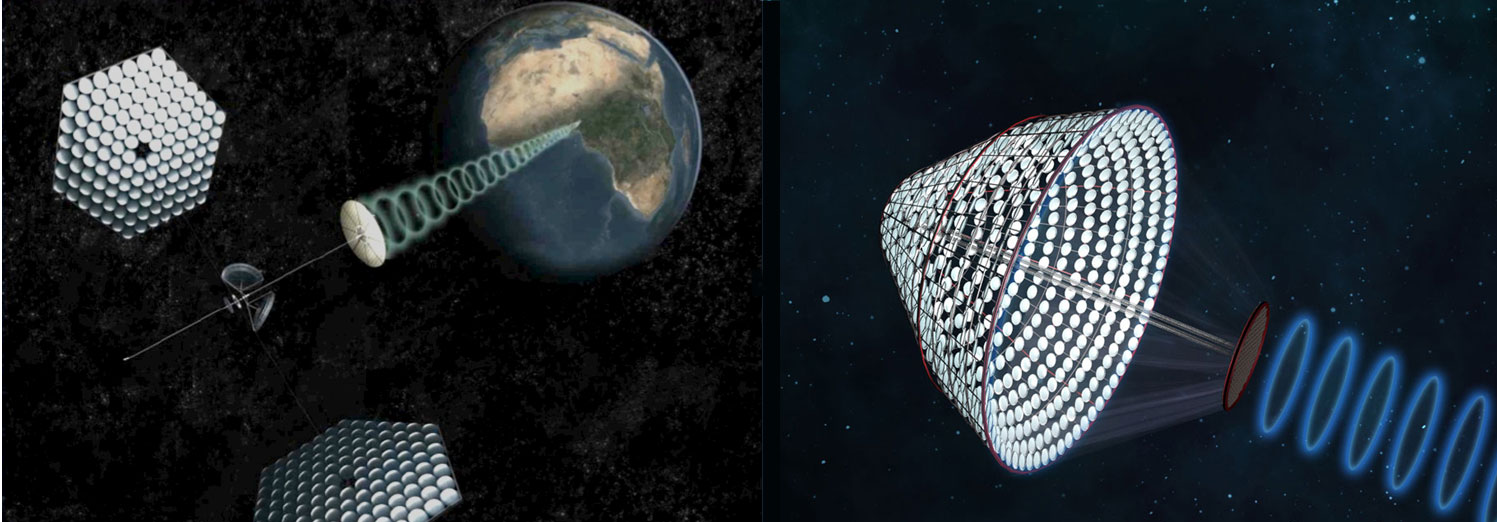
Space solar power satellite, artist’s impression (credit: SpaceWorks Engineering Inc. and Spaceworks Commercial)
With just a little care and proactive maintenance of the biosphere (climate control and some impact sensors), Earth should be good for at least another billion years. It could be a lush, green tourist location with a modest population of 10 billion, all living in relative energy wealth, if it built a ring of solar power satellites in geostationary orbit. (A fully developed civilization living at a U.S. or European equivalent lifestyle would only require on the order of 40–50TW of total electrical energy, and a ring of powersats in geostationary orbit could supply as much as 330 TW).
Sure, Earth might end up being a minor player and backwater tourist location in a solar-system-spacefaring civilization 1,000–10,000 times more populous and better connected, but a planet is a terrible thing to waste, especially when a little maintenance can get you another billion trips around the Sun.
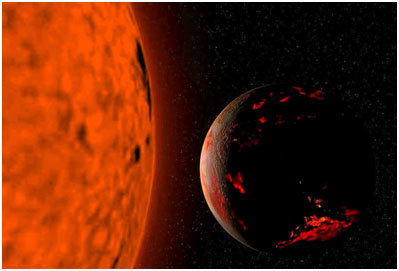
But even the O’Neill solution is temporary, because within only about 5 billion years, our Sun will have first swallowed most of the space in which those colonies had been built on its way to becoming a red giant. Shortly thereafter, the Sun would collapse to a dim white dwarf incapable of supplying the passive solar energy upon which such colonies would depend.
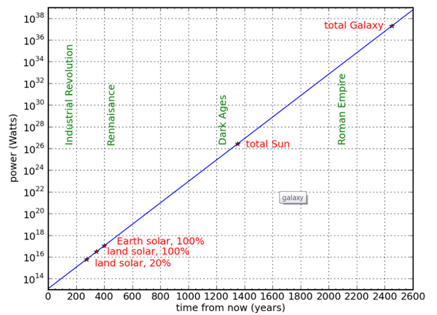
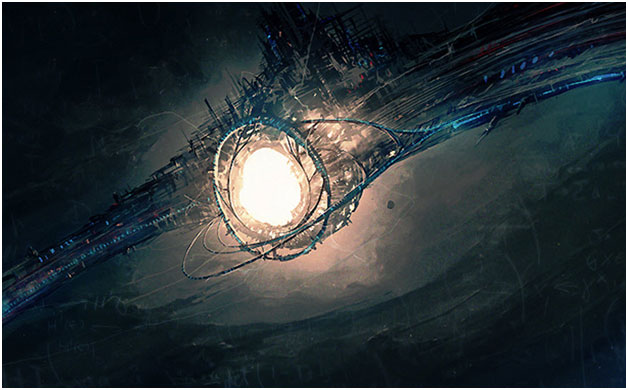
Of course, colonies can be moved, and it’s possible we will have developed more impressive technology by then. As long as the Sun shines, there is energy available, and we can have an ambition to become a Kardashev Type 2 civilization — where we first surround and ultimately encase our Sun to use all of its energy.
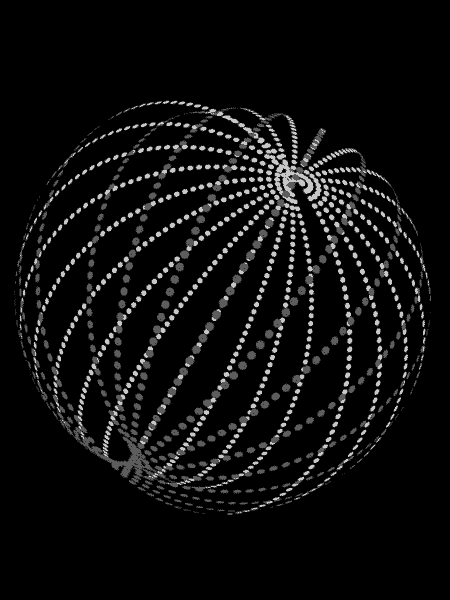
A “Dyson swarm” version of a Dyson sphere, consisting of solar power satellites and space habitats orbiting in a dense formation around a star (credit: Wikimedia Commons)
But once our Sun started to dim, even encasing the Sun in a Dyson sphere of solar arrays to capture all the Sun’s energy would not be a sufficient solution.
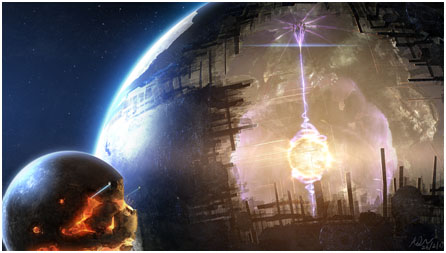
Artists conception of completion of a Dyson Sphere under construction and a moon being harvested for resources (credit: Adam Burn)
However, the knowledge that the utility and growth horizon of our home star is limited should not lead us to be resigned or pessimistic about our future. Human beings have done fine in the past when the environment constrained growth. Even with constrained growth, there is plenty of Sun to support a space colony-based population of billions to potentially trillions at current energy requirements … for a good 5 billion years.
Beyond the solar system
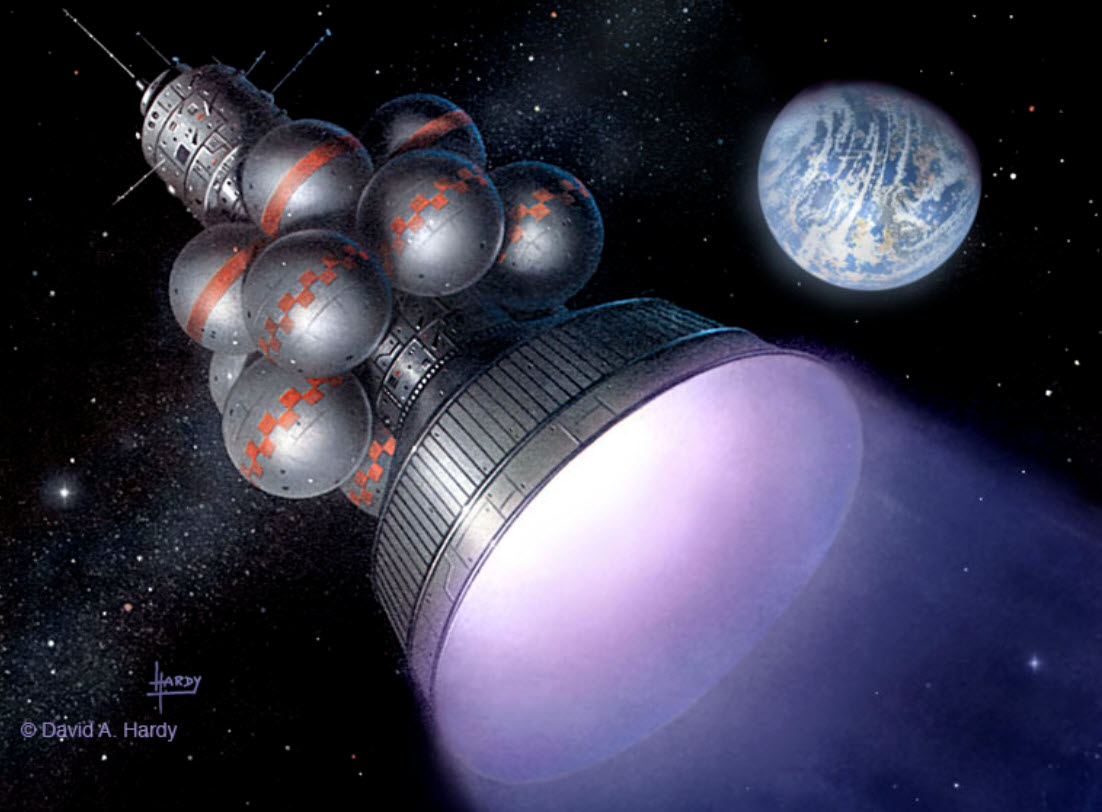
But as we get close to the 4 billion mark, it would be good to have figured out a non-solar solution to our energy problem or figured out interstellar travel to move to new younger suns. Fortunately, there are already serious efforts to conquer interstellar travel and faster-than-light (FTL) propulsion. (The definitive work on approaches to FTL travel and space-time engineering is Frontiers of Propulsion Science by Marc Millis, founder of NASA’s Breakthrough Propulsion, and Dr. Eric Davis.)
The latest effort is the 100 Year Starship Project (100YSS), begun by the Defense Advanced Projects Agency (DARPA) — the people who brought you the Internet — and NASA, which previously led an effort in the 1990’s called the Breakthrough Propulsion Physics (BPP). The 100YSS is managed by a team of non-profits led by former Astronaut Mae Jemison.
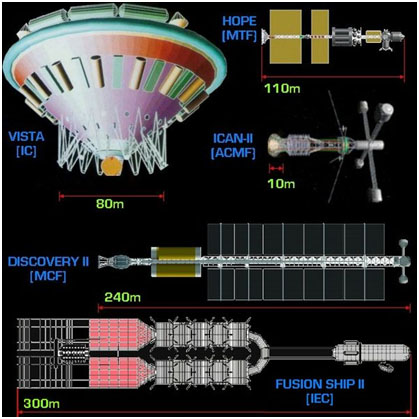
100YSS is not alone. Marc Millis, former head of NASA’s Breakthrough Propulsion Physics program, heads another organization, the Tau Zero Foundation, a volunteer group of scientists, engineers, entrepreneurs, and writers who have agreed to work together toward practical interstellar flight.
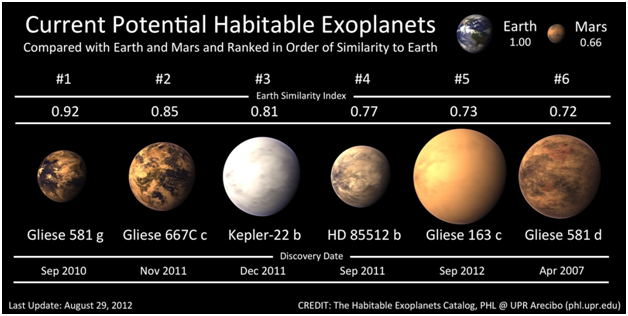
In advance of achieving interstellar flight, we can begin to map out where we intend to go. Fortunately our science presently has this capability. There is already a significant amount of activity in the astronomical community looking at potentially habitable systems.
Each day seems to bring stories of new discoveries of ever more Earth-like planets circling distant stars. Our capabilities to detect exoplanets (planets orbiting another star) are getting better every day, and will receive a major upgrade in 2018, when we launch the James Webb Telescope (JWST).
Our criteria for new suns certainly will include that they have at least have the energy and material we need. While by then we will certainly be at home in space colonies and worlds of our own making, we may still desire systems that have habitable planets where we could recreate much of our entire biosphere or daughter ecosystems.
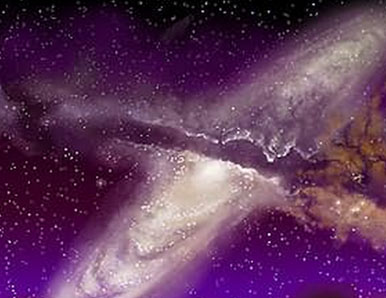
Artist’s impression of the collision between our Milky Way galaxy and the Andromeda galaxy, as viewed from Earth (credit: James Gitlin/Space Telescope Science Institute)
But as we approach the four billion year point, we need to plan to be a multi-stellar/multi-exo-planetary civilization, as there are other neighborhood events to consider. Around the same time our mother star is going through significant changes, we’ll have another problem we need to plan for. Our galaxy will be colliding with another galaxy, Andromeda.
How exactly that will affect us will become clearer as we get closer; it may present both threats and opportunities. The mix-up may move other stars into proximity with our own, perhaps making it easier to leap to attractive new stellar habitats, but perhaps also disturbing our own system and endangering our civilization.
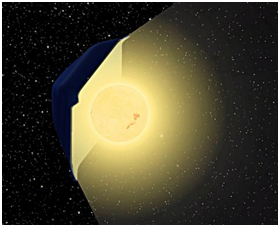
In case something nasty was heading our way, it is not too early to think about how we might sidestep a potential collision. There are already ideas for moving entire stars. An example is the Shkadov Thruster, which uses gravity to balance light pressure on a reflector (“statite”), resulting in a net force that moves a star slowly through space.
Spreading out as wide as possible within our galaxy or other galaxies is highly desirable, because there are largely unpredictable events like supernovas and gamma-ray bursts that are like a grenade going off in a crowd, killing any solar systems in their proximity. The farther we spread, the more we spread our risk.
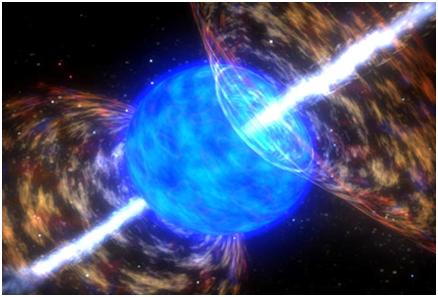
But the remote possibility that we could be a victim of a gamma ray burst is no reason for defeatism. If we can figure out a way to do interstellar travel, we should have a nice long run as a multi-star civilization.
However, if we forecast out a little more, we see that again, our planning assumptions to start to change. Even as a long-living civilization capable of interstellar travel, we face limits. The stars themselves are limited resources.
But even here, there are ideas of fundamentally re-engineering space-time to literally give us a “new lease on life,” perhaps deliberately engineered black holes or wormholes that allow for the creation of entirely new baby universes — possibly even “intelligent black holes” — and restarting the entire process of creation.
Even the galaxies are moving farther and farther away. Eventually, as the Stelliferous Era comes to an end, it will be “slim pickins” as new stars form less and less. Still, our civilization could enjoy a nice life to a ripe old age of one trillion to one quadrillion years before things really got bad.
That is a lot of time for creation of poetry, literature, art and science! We should not let a few small obstacles a mere 1–5 billion years in our future slow us down, and deprive us of the chance to spread life, intelligence and art farther in the universe.
Further in the future, in the Degenerate Era (1014 to 1040 years) we will need to have figured out some serious magic to perpetuate life and intelligence, or we will have to make our peace with entropy as we approach the Heat Death of the Universe.
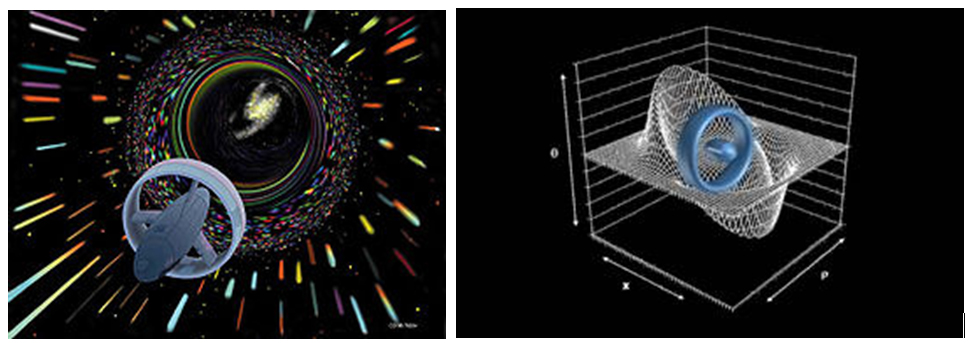
But even here, there are ideas of fundamentally re-engineering space-time to literally give us a “new lease on life,” perhaps deliberately creating black holes or wormholes that allow for the creation of entirely new baby universes, and restarting the entire process of creation. The exploration of fundamental engineering of spacetime itself is being pursued by the same community seeking to make interstellar travel a reality.
Near-term threats
Of course, even before 1 billion years, we’ve also got some near-term “bad weather” to plan for. Before the Sun starts boiling us, we’ll have major dust storms as the Sun’s 250-million-year-orbit around the center of the galaxy pushes us through cosmic clouds of dust as we climb and descend through the galactic disk, say astronomers.
That dust could penetrate our heliosphere as early as 2,500 years from now, possibly even reaching Earth to deplete our atmosphere of vital gases and strip away protection from cosmic rays (as may have happened in previous mass extinctions).
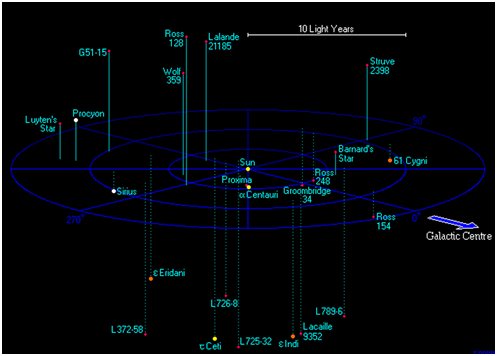
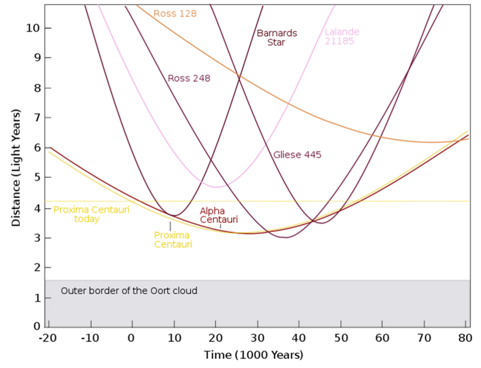
In only 10,000 to 35,000 years, four stars (Proxima and Alpha Centauri, Barnards, and Ross 248) will be close enough to disturb the Oort cloud and send giant comets our way, such as those that killed the dinosaurs (only 65 million years ago).
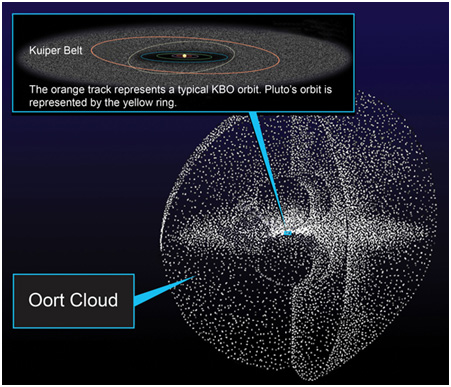
An illustration of the Kuiper Belt orbit (KBO) and Oort Cloud in relation to our solar system (credit:NASA)
And in less than 1 million years, the star Gliese 710 is going to race past our solar system and come within just three quarters of a light year from our Sun, well inside the Oort cloud.
In that same time period, we can count on more than a few asteroid strikes, which luckily will be completely preventable. According to NASA, more than a million near-Earth objects are larger than 40 m in diameter (the approximate threshold for penetration through the Earth’s atmosphere).
Asteroids as big as 2 kilometers can discharge an impact energy of a million megatons and create an effect similar to a nuclear winter, with loss of crops worldwide and subsequent starvation and disease. Still larger impacts can cause mass extinctions, like the one that ended the age of the dinosaurs 65 million years ago (15 km diameter and about 100 million megatons).
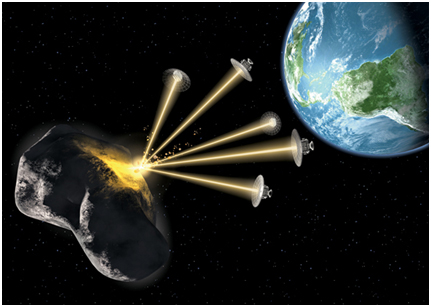
Artist’s concept of Laser Bees spacecraft swarming around a dangerous asteroid to move it into a safe orbit (credit: Planetary Society )
So to reach our billion year plan goals, we will need a planetary-defense asteroid detection system and a deflection system up and running “lickedly split,” or we forfeit a lot of good years! Fortunately that is a comparatively easy problem to solve, and the same suite of competencies that allow us to divert an asteroid enable us to capture and mine it.
Creating the plan
But any plan about the future is really about how we intend to allocate resources today. Our first priority needs to be planetary defense and space-solar power so we can lock in the full billion years of value Earth can provide.
The next priority is developing the competencies to make use of space resources to enable closed-cycle life support for the free-flying space settlements that will allow us to extend our civilization to the full five billion years warranty on the Sun. All the while, we need to be trying to find a way to build starships before this Sun goes bust.
Some people think a billion years is too far out to plan for. If it isn’t in their or their children’s lifetime they don’t care. Or it is so far away that they think no one will be around, or if there are, then it will be “their problem.”
That’s silly. It is good not to allow really big looming problems. And, planning for a long-term problem does not mean you need to ignore near-term problems. It is possible both to put money away in an IRA while you maintain your car. Planning for events like your children’s college or retirement might seem a long way away, and that there is plenty of time ahead to get busy, but the same factors apply — a little bit of early investment compounds over time and is worth a LOT of investment later on.
Of course, any person alive today should realize that “objects in the future may be closer then they appear.” Proximity is based on perception. Our perception of the distant future is measured against our own individual life span — and that is undergoing change as well.

Our billion-year plan needs to consider the likely and predictable problem of time-contraction: 1,000 years is just not what it used to be! If thinkers like Aubrey de Grey and Ray Kurzweil are right, our civilization is on an exponential technology curve that will eventually result in “longevity escape velocity,” meaning that for every year a person lives, medical science advances to allow them to live one additional year. Already, there may be people alive today that may have indefinite life spans.
The idea that a post-Singularity world might allow us to exist “in-silico” as uploaded simulations and control our own “clock speed” poses even more radical time contraction. Even if we only succeed in extending human life a mere tenfold to 1,000 years, or an unrealistically low doubling to 200 years, every number discussed above is twice or ten times closer in terms of individual “care factor” and potentially much closer to home.

But even if human life span remained constant, it is a responsibility of life to plan for its offspring, and civilization to seek to continue itself. At least the part of civilization I live in has this essential mission enshrined as the most basic task in our U.S. Constitution: “Secure the blessings of liberty to us and our posterity.” To do that requires planning. Planning allows time itself to be our resource and acts as our lever to do great things.
Many look at the significant events discussed above as “doomsday scenarios,” but to me, they are just eventualities to be planned for, and chance favors the prepared mind. It’s also a happy consequence that the farther out you look for problems, and the bigger problems you try to tackle, the more likely you are to perceive and be able to bring ambitious thinking to more proximate problems.
If we had not been building instruments in space to look far out into space, we would not even know about the threats of asteroids, comets, gamma-ray-bursts or galactic collisions. We also would not have the space-based surveillance to know about the hurricane or tsunami on its way. Lifting our eyes to the horizon pays.
Of course, there are more proximate threats, and several of our own creation. But personally, I bet on humanity, not against humanity. We are the life carriers, the intelligence, and the gametes of Gaia. It is our destiny to spread not just human life, but the entire clan of life, and intelligence, first to the Solar System, and then to the stars.
The great strategist John Boyd told us that it is the nature of all organisms to seek to “Survive, survive on their own terms, and improve their capacity for independent action.” Ultimately, the space program is about survival, growth, and flourishing. Not just of ourselves, but all life.
And for at least a billion years, the plan needs to be (as beautifully stated by Lee Valentine of Space Studies Institute): “Mine the sky, defend the Earth, settle the Universe.”
Peter Garretson is a transformational strategist at Headquarters U.S. Air Force.
The views expressed are those of the author and do not necessarily reflect the official policy or position of the Department of the Air Force or the U.S.government.


Comments (105)
by rightway4500
world NOT ENDING on December 21,2012
by Alpha
I like to live in the moment. But this is freaking awesome!
by freshideas
The invention of writting is only 5000 years old
by GatorALLin
Its always that first million years that is the hardest to plan for inside a billion year plan…. (grin).
by Craig
This whole idea is representative of the 19th century mind. Plan plan plan, top down command and control. So 2 cneturies ago. Complexity theory explodes this Neanderthals thinking. We would be on mars today colonizing it if poltics hadnt stopped us and stood in our way! (Nixon burn in hell!)
by SmartAndSober
I don’t believe a total lack of plan will be optimal.
I guess humanity need a meta-plan (very complex plans only comprehensible and will only be followed by cyborgs and super-AI) that takes “complexity theory” into consideration.
by GAUSS
The crazy thing is, I totally agree.
I’ve long had this idea/intuition that a viable path toward peace between major superpowers would be to unite them under a common project, namely that of building an interstellar spacecraft. In truth, the Russians do many things better than us Americans, and vice versa. The Chinese have a lot to weigh in as well. Instead of being in competition and war, a common project of this kind would make each civilization’s abilities complementary to one another, speeding progress and hopefully avoiding conflicts.
Many (if not arguably all) of our conflicts are over resources. Working together to reach the realm of infinite resources – space – can only be a good thing, in my opinion. It’s not to say that people will lose national pride – Russians will still be Russians, Americans their usual selves, and so on. I imagine the Russians building the engines, America building the communications & computers and such, and the Chinese building the hull and other pieces. Just a vague vision, really.
by SmartAndSober
This idea of planning ahead for very long term sounds great to me, too.
Can human diplomats (possibly cyborgized ones) proven useful in pacifying and unifying the world?
by alliwant
Excellent commentary that echoes much of my thinking on the distant future. If the next billion years is to be the gestation period for humanity to seed a galactic or universe wide civilization, it will be because ideas such as those herein are taken seriously. A vastly different perspective from the next news cycle or quarterly revenue targets. Think big, and long. It’s a vast future (if we manage to see it).
by Bri
I’ll tell you what. In one million years, I’ll check on how things are going on this plan. Then every million years after, or another thousand times!
by robert
brilliant article, amazing to be able to speculate and try to plan to survive all of our current human made disasters waiting to happen and come out the other side to a world we would like to live in. I hope people learn to be more understanding and kind to one another as well otherwise kaboom is coming with or without the singularity.
by Mark
I have to admit I did not read the whole article as most of which was way over my head, but what I did read was excellent. After all “It’s what Dreams are made of”. There are some really fine Dreamers out there as the comments express. I for one would not hesitate to step through, The “Stargate” and step into a world void of insanity where beings work for the common good of all. Where poverty, death and disease are things left in a long ago distant past. A place where enslavement, wars and mutually assured destruction will never happen. If only Dreams could come true. I dream of such a place where I will go after this old clay jar I call a body is worn out, where “I can live long and prosper” and I only need is faith to get there. This is my Dream and I feel many others share the same Dream. I have the faith and I have the dream and no man can take them away.
by tj
Your so right,your dream is my dream. The greatest adventure of all begins when we leave this body within which we live for a short while. Live long and prosper buddy.
by Bri
Although I like your sentiment and both of the posts here, you may find that the ” other side” as I call it, is a little bit different from what you are expecting. Everything is there, and I do mean ” everything”.
by GatorALLin
I like the idea of planning ahead….. but have to agree that any plan past about 30 years seems needing major (unforeseen) overhauls if you believe the singularity is on the horizon. Still I think it is important to start thinking or planning for the what ifs….. that could be planet killers, or singularity stoppers. Of all the obvious ones listed like meteors hitting the earth, or the sun heating up, or just trying not to blow ourselves up… the one that was left off the list is the Super Volcano threat….. I hope by then we just turn it into an energy source…but still that threat would put a dent in lots of things, so I think it should make the list of What if..and how would we fix it.
by Ken
Wonderful article!
Ques: If information can be self organizing (which it can)
and form can maintain it’s internal relationship within a dissipative system (which it can)
then, I suspect, thought can exist dependent only upon ‘intent’.
I’m not certain
that there need be
a future nor a past
nor a purpose nor a task.
by John Bonomolo
My issue is that if Einstein’s proposition that its physically impossible to travel faster than the speed of light winds up remaining a fundamental law of physics billions of years into the future, and factoring in that the closest planet with the possibility of being a habitable planet is 100,000 light years away, one suddenly realizes the need to act now.
by Peter the printer
Seems my realist posts are too much for fantasists and censors. Dream on as our planet dies from our ignorance.
by Peter the printer
We will be lucky to survive the next fifty years. Man has always dreamed way beyond his capabilities, women tend to be more grounded and centred on the real. How can we do anything about the distant future when we can’t even agree to what to do to avoid total collapse from climate change? Droughts in some places and floods in others as the climate goes chaotic are not good signs for a highly complex global society surviving. Current response is ‘we can drill for oil in the arctic now’, which is about as crazed as it gets. Like putting more fuel into the furnaces of the Titanic.
by Shadow
Great read. Loved the visuals.
by Jonathan Gibson
I’m just saying… that nobody here is talking about the looming Y3K bug
by Editor
OH SNAP We’ll get right on that!
by Mark
If We Do Nothing – America In 2050
http://rense.com/general95/2050.html
http://www.youtube.com/watch?v=LPjzfGChGlE&feature=player_embedded
by Sally Morem
A billion-year plan? Considering the impact of the doubling effect of accelerating tech, I wouldn’t even trust the projections of a 30-year plan. What will happen will be unimaginable to us today.
by Jared
Agreed, what tools are we to prepare with for the extinction of our sun? Lets let the generations 3 billion years smarter deal with that. We still have people rioting and killing over 15 minute videos on youtube.
by zEke
and people believing media-created and government-created propaganda. What oh dear! would happen if people actually realised demonstrations againsts americans had more to do with their killings than an insult to a prophet. CIA is seen in the woodworks, you probably haven’t read the article but some of the protesters were /paid/. And if youve ever picked up a non-government-sponsored-white-wash book on the CIA youd know that the CIA also has a long history of riling up people to do whatever bidding they choose. Master propagandists they are, indeed half their organization is dedicated to it!
by Alexandre
Thank you Lt Col Garretson. Your article made me dream farther than ever, and it’s always better to dream than to have nightmares like the ones we live today.
by John Kennard
We need to worry about quite a bit quite a bit sooner and quite a bit more than we need to worry about the Sun’s going red giant or white dwarf on us.
But when it comes to it, and presumably well before it becomes necessary, move the the whole planet, man, including the moon, to a nice safe globular cluster well outside the galaxy, far away from all the nasty things that go on in galaxies.
How? I haven’t the foggiest.
But then I’m not a galaxy-spanning transportation engineer of, say, 500K AD, either.
by Paul Werbos
What is a “plan?” I agree 100% with Peter that humanity really ought to support serious thinking about the long-term future, including at least a few of us who do think a billion years or more ahead. Yet see http://www.stateofthefuture.org; even just 100-1000 years ahead, rational thinking really has to account for UNCERTAINTIES. We need strategic thinking, more in the spirit of Raiffa than in the spirit of Soviet 5-year plans. For starships, especially, we need to buy information, per the strategic analyses I have posted in places like vixra.org, and in some papers in press or recently out. But yes, if we don’t think long and hard about possible futures, premature extinction is more than likely.
by Editor
Hi, Paul. Thanks for joining the discussion! By way of introduction, Dr. Werbos is a Program Director at the National Science Foundation, responsible for Adaptive and Intelligent Systems (AIS), Quantum systems and device modeling (QMHP), and systems-level power grids (GRID). He also handles the EFRI 2008 topic in Cognitive Optimization and Prediction (engineering-neuroscience collaboration to reverse engineer intelligence). He is especially famous for the backpropagation concept in neural networks. More: werbos.com.
by Gophernevich
I think the author has clearly lost his mind. A “billion year plan” for the human species? How nutty can you get. I say start with a 100 year plan, work your way up to a 1000 year plan that might involve space colonization and then go from there. Does any rational thinker envision “human beings” or “human civilization” existing one billion years in the future? I’m sure something will exist, but it won’t be pot bellied Homonids.
by Editor
This is a standard forecasting exercise. Having the big picture in mind helps in near-term planning and cuts down on short-term miasma. It’s a given that a Type II civ would not resemble our current one. I don’t think the author puts many constraints on the scenarios. This is a useful exercise.
by Chuck
Not sure how you plan for a billion years in the future when we don’t even know what technology we will be working with in a billion years. New technology opens up new ideas. Whatever ideas we come up with now will be obsolete based on technologies we haven’t even dreamed of, yet. Hell, we may not even be human in a billion years!
by Cromic
Reading the replies and comments is proof to me that the average person who fancies themselves an intellectual is consumed with the twin blights of our current civilization….Nihilism and Relativism.
Really people?
Everyone is waiting for the ‘Singularity’? Talk about nihilistic laziness. Here, let me sit here and do nothing while the singularity comes.
Humanity has too many problems now to look to the future? Really? Humanity has always had these problems. It – Will – Not – Change. What? You think that everyone will obtain a hive mind and have the same belief systems? And this must be done before we can go to space?
by Sally Morem
A large number of engineers, scientists and visionaries are doing things right now that will lead directly to the Singularity. They aren’t sitting, twiddling thumbs. The point is, with acceleration, a billion years from now is literally inconceivable. We can’t do any sort of planning for it at all.
by Editor
Well, then you probably won’t like my follow-up post, “A trillion year plan.” :)
by alliwant
Nice riposte. It’s sometimes hard to convey that for actions like planning to move an entire civilization, the timescale involved will be far beyond anything we have experienced to present. Yes, civilization and technology will be vastly different, but it’s all going down the drain if we don’t move before the sun goes dark.
by Bri
I’m thinking that for the next article, we should plan for a universe going out of business sale.
by Robisapiens
We will need geopolitical socioeconomic singularity very soon if we want to get meaningful traction on this.
by Mr.X
Why?
by z
abolish religion first
by smb12321
Will mankind suddenly become kind and understanding? I’ve argued with fellow atheists that morality does not depend on religion OR non-belief. Before organized religion, society was brutal. Nations that banned religion also treated their citizens horrifically. Humanity has a dark side and getting rid of religion will not cure that.
by Mr.X
@smb: I hate religious people who try to fake being atheist.
Please stop that, or learn to actually do it the right way.
I really hate that.
And your claims are typical bs.Sry.
Do you want me to impose sme who is religious?
by alliwant
No need for an overt act on that count. Take a good look at past religious practice; Thor and Zeus have few followers these days. The rest will slowly slip away as it becomes obvious that we don’t need those myths any more. Won’t be fast to our perspective, but on the scale of this article it won’t take long at all. Science and other facets of the rational mind will slowly take over, and will themselves evolve over time.
by Robert Schryvers C.Ht
We will need a socioeconomic and political singularity as a first basis.
by Tony Longworth
we need to evolve beyond the need for religion and trust in ourselves as competent individuals and as a worthwhile species…
by Zakir Hussain, India
I must say awesome!
A man prepares the world for billion years prgramme that is marvelous but I want to live, feel and enjoy the success of the homo sapiens
by Grant Lenaarts
Our moral development seems the most pressing issue.We cannot even agree goals unless there is a baseline moral framework model against which to set the goals.I personally think dropping the price of energy radically will give us the resource boost we need to get a larger solar presence.The apollo program cost 4% of USA GDP for over 10 years.
by Dan Robinson
I’d go for a logarithmic scale of concern, with the constantly changing mean being equal to maybe the time since we discovered we live on a planet. That’s at least better than most concern being for the next election.
Gorden Russell, what do you mean by “we” if you’re talking about the singularity?
by Dallan Lax
Why not just build a planet? Within the asteroid belt are the materials we need to do such a thing. Build the planet with the capability to move itself through the solar system and maybe even beyond.
by jmldavis
Yeah, like the Death Star ;-) Only we’d call it the “Life Star” …kidding aside that may be one plausible future.
by Bob Blum
Hi Lt. Col. Pete,
Entertaining post.
BUT, many readers of KurzweilAI including me believe that
the main intelligence carriers within a couple of centuries
will not be human beings, but rather will be our “Mind Children”
- electronic entities that stand in relation to us as we do to
bacteria.
Our main goal right now should be protecting the biosphere
and humanity from near-term hazards, so that the phase change
to machine intelligence will not be stunted. Those hazards are well known
to all of us: poor control of and rogue use of WMDs (especially nuclear and biologic),
accidental war, chaos and failed states, environmental deterioration.
While I share your enthusiasm for space exploration, I view manned missions
at present as being huge and expensive diversions of resources away from
science-based robotic probes (MSL/Curiosity, Kepler, JWST, eg) that have far
more bang for the buck.
Our Mind Children will not require food, water, shielding or medical supplies.
They wil be as light as the luminiferous ether and have god-like intelligence
to cope with the long-term hazards you described.
But – we must survive long enough to build them. That’s our real job now.
by GAUSS
Agreed. Robotic probes are the way to go. Especially as we’re digging deeper into nanotech, more can be done with less, which culminates to allow lighter, smaller craft. Put some chips and an AI on it, and you’re good to go.
My money’s on the Gliese system, at least for an outpost if not an all-out colony. We could learn almost everything we need to know about it via a fleet of lightweight robotic probes, grandchildren of Curiosity if you will. Even at subluminal speeds, Gliese 581g is reachable.
by Fresh Breeze
And for what purpose do we do this, to propagate and elevate our sense of self-worth? Humans are nothing more than an insignificant ant colony in the eons of time struggling to survive. No matter what grandiose things we do, we will still be putting on our pants, or space suits, one leg at a time in a futile effort against nature’s laws which don’t give a damn about us or our existence. Quite frankly, before we worry about asteroids we might try to figure out how not to blow ourselves up. Judging by the current state of affairs it doesn’t appear to me like the countries of the world getting their shit together has much of a chance of happening. A well placed asteroid would at least rid the survivors, if any, of who to blame.
by John
I don’t give a dxmn about your luddite antiprogress sentiment.
by Steven
I agree.
Asteroid, epidemic, neutron bomb – all would be traumatic, but the survivors of the European Black Death of the Fourteenth Century did just fine.
Whatever would reduce the human population to 500 million would e wonderful for the planet and the other animals and plants. I’d take my chances. We are too many.
by Conrad Green
Are you signing up to off yourself and your family otherwise don’t speak.
by Mr.X
I always wondered why everyone who holds these theories exempts themselves.
Maybe because they are enlightened enough to see the need, and therefore more worthy than us others.
But it’s not his families fault, he should only be able to sign up himself.
by Jack
Perhaps they already know themselves exempt, yes.
by Bri
Too many! I agree, but if you think it’s bad now, wait till sentient robots come along. They will be able to argue successfully that they deserve rights. One of those rights will be to reproduce. That will consume resources and energy. Even without being granted rights, those people with power and money will be able to produce as many as they wish.
by alliwant
Maybe as we merge with the machines we will take a more sober and responsible view of reproducing. Maybe we can even reduce our numbers to a sustainable size gracefully, just be being less prolific. Beats most other solutions.
by Logic
Anyone who looks into the infinite universe and still concludes that there are “too many” people, has a real problem with both scale and imagination.
by Bri
@Logic: your name is ironic when you consider the multitude of problems that our huge population is creating. Sure there are solutions and I feel the problems can be resolved, but I think you are using your imagination too much, and are ignoring how perilous our present circumstances are.
by Jack
Unless your eugenic ¨ disaster¨ did not do the math like you have, and the whole of humanity were wiped out. This is as has been foreseen by more than one. Go ahead, take your chances.
by Mr.X
Could you be more specific? I think trends indicate the opposite.
And emotional language (insignificant ant colony) clouds our judgement.
Anyway, there is no meaning without someone who perceives it, without sentient beings.Why then, are we insignificant?
Thanks in advance, and have a nice day :)
by Logic
@Fresh, it seems you think today’s challenges are insurmountable. This disregards the whole of life’s evolution. Not just humans, but all of life. Life adapts and evolves to solve its problems. You worry that the scale of problems grows larger, but ignore that the increase in challenges itself is the very catalyst that spawns our continual evolution.
by Sally Morem
When somebody says “nothing but” I grab my anti-reductionist word processor.
by egore
I would think there have been colonizations in our Solar system for millions of years. Some, probably from our own planet over a long period of time. After all, we see only a tiny speck of reality at a time.{At least speaking for my self.}
by Marcos Marin
Except that humans are not capable of reliably planning even their next meal.
by Mr.X
@ Marcos: Then I must be a true transhuman.
by de Broglie
If transhumanism does not pan out, the dysgenic trend of society may halt our progress. The less intelligent tend to produce more offspring than the intelligent. Thus the average IQ declines each generation. However, thinkers like Charles Murray seem to think the widening of the standard deviation is the most significant aspect.
by Mr.X
How do you account for all these statistics showing that IQ actually increases?
Anyway, IQ itself is a not-so-smart- concept.
by de Broglie
The “Flynn Effect” is true for countries that used to have low nutrition. In the developed world especially the United States we see that IQ’s are not rising.
by Bri
It’s worse than that. Ancient man had a larger brain case, especially in northwest Africa.
by Mr.X
@Bri: I guess you are kidding ^^ Einstein’s brain was smaller than the average male brain.The brain of males is generally heavier and bigger, as is the brain of bigger people (due to motorics, senses [skin], etc).
@De broglie:
I think IQ is a missguided concept because it only refers to your ability to complete tasks like working out puzzles and seeing -mostly visual/spatial and mathematical- patterns -which may be the same, depending on the way you do your math-.
These things improve with training and are often not needed the way they are presented in such a test.It certainly doesn’t test general aptitude.Of course, vice versa- someone who is generally good at things will tend to be better at IQ tests.
The things traditionally tested are faily “westcentric” and IQ tests focuse on what you may need if you are a lower-order worker in an industrialized society, something at which you are generally better if you have at least a middle class background.
Notice that making people fit for an industrial society is one of the main reasons for state-schools to exist, and that IQ tests are much better at predicting success in school than elsewhere.
IQ tests also involuntarily test your “test taking” skills and I don’t think these have any importance outside the fact that our societies often rely on such tests to weed out the truly not-so-smart.
I think we like these tests because they give us the feeling of quantifiyng -and thereby controlling- something important.Notice the time period in which Binet et al (for example Terman) came up and iterated upon the concept.Notice also that Terman’s famous experiment failed to find those whose perfomance (!) deviated to such an extent from others that they were extraordinarely good at something, just on the basis of IQ.Background was much more important.
Another thing that has not been sufficently taken into account by him is the nature-nurture debate.All of Terman’s kids came from better-off backgrounds, with habits and environments that are favorable to the development of higher intelligence, according to those who think that nurture matters much.His was a time in which almost everything was assumed to be genetic, while genetics itself was just starting out.It was also a time of belief in science and industrialization, of quantifying and scientific determinism.
These things lost some of their clout because they were used in both world wars.
And don’t get me started on neuro-plasticity and fluid/cristalyzed intelligence.
Ps: Charles Murray is a political scientist.I think he clearly intends to influence politics, which of course is nothing bad per se.
Pps: We shouldn’t support the ugly measures, like forced sterilazation, that early proponents of IQ tests have favored.IQ also has been used to defend unequality of all kinds, some of which may be truly unfair.
by de Broglie
If people are actually unequal so be it. IQ attempts to measure general intelligence. It does this with the visuospatial tests and verbal reasoning tests. IQ test are correlated to the theoretical general intelligence. Of course it is not a full proof theory, but it is way more convincing than man made climate change and many take global warming as a dogma. Most people on this sight must believe in IQ. If not, how are the machines going to improve our brains?
by Mr.X
People are certainly unequal.Did I say otherwise?
To your question: They endow us with powers of memory, and speed of calculation formaly only in the domain of computers.They help us use algorithms, think some things in a mechanical way.
This does not change the fact that I don’t believe in “general intelligence” quite the way you do.
by Mr.X
* formerly.
by Peter the printer
Stats lie according to what they are required to ‘prove’. Looks to me like IQ is diminishing generation on generation.
by pt
Fortunately, intelligence is bounded by far more than birth genetics. Neuroplasticity in light of novel stimuli can take substandard starting genes and produce above average intelligence. This is why education is so critical, and why, at least in the US, the state of education funding is so depressing.
by Peter the printer
Well the state of education in the US is dire
by Jack
There are those, capable of planning over the course of hundreds and thousands of years quite effectively, the results permeate almost every aspect of our lives.
Indeed, everyone is capable of planning of this sort and much more, merely not quite aware of their own possibilities.
Finally, not all aspects of ones life or actions need be planned out meticulously of course, those men and women that have acted toward goals for centuries also understand and enjoy the fact that reality can never be totally planned merely ¨nudged¨ into a direction or another, and use this to their enjoyment and advantage.
The grander the goals the grander the costs.
by Bri
I like all the comments, as diverse as they are. Trying to figure out the next twenty years is hard enough. I think AI will deffinately be handy for figuring out the next million or so. This guy would be great fun at a party or a bar, but all of this is in the realm of science fiction. They have been toting with this stuff for years. The only other thing this would be good for is a Steven Hawkings Higgs boson type bet, but I don’t know who or what might collect on that bet, or if our currency would have any relevance.
by Mr.X
Some thougths on long-term existence in a changing, habitated universe:
I think we need to get AI in order to accelerate our technological progess, which would allow us to expand as fast as possible, filling the universe with “us”.Something like Neumann probes comes to mind.
And we need to begin as early as possible, because other species might do what I just wrote.Or already began.Due to the enormous distances we wouldn’t notice this right away.
If there are other species, and they start colonizing in this manner earlier than we do, it is most likely this headstart would make them stronger than us.
If we want to obliviate this existential risk we need to colonize the whole universe -or most of it- and manage other species we may meet. Else we’d be at the mercy those beings that were better colonizers than we.
by Fresh Breeze
Your comment assumes all other forms of “intelligent” life think like humans, that we must be strong and control or be controlled. That sums up the human race. It may be wishful thinking, but it would be nice to think some other intelligent form of life in the universe has matured beyond that. I don’t foresee that happening with humans – ever, but then again, forever is a long time..
by Mr.X
My comment makes this assumption for a reason: Physics and Evolutionary theory make it likely that higher lifeforms are very similiar to us, due to the evolutionary advantages traits like agressivity bring with it.
And physic kinda constraints the way lifeforms look and where they dwell, meaning that life probably endures similiar conditions elsewhere.
by Mr.X
@ myself.Of course, indicate that this is likely.Theories don’t do that, they predict things.
by Jack
Violence does appear to have played a significant role in the development of the human race. However, if an alien life form were, for example, asexual, then aggression and violence may not have been necessary for reproduction and may not have played a significant role in their development. In addition humanity is by and large a race of followers. Consider a race consisting of mostly creative thinkers as opposed to followers. A race not able to adopt structures of possession or dominance over each other due to their intrinsic asexual nature. A race capable of sharing to the degree that their ¨brains¨ adapted to run concurrent hive-mind and individual thought processes maintaining both separate. Capable then of instant communication with no need for the semantic disasters that the spoken or written word brings with it. Just a possibility.
by Jim Muccio
@ Pete
Very nice survey and summary of material to really get us thinking about where we are ultimately headed…none of the long term prospects look very good…it’s either a hot death or a very cold one. I agree that if we wait a billion years to begin working on how to solve the problems we will face it a billion years it will be too late. However I can’t help fighting the feeling that the solutions will be more than achievable and perhaps even self-evident, once we advance another million or so. I think Freeman Dyson’s point has always been that we should solve the most pressing problems first and then we can get at the lesser threats. So it appears that planetary protection against an asteroid is perhaps our most pressing problem, at least outside the planet, and even more so in 10,000 years. So we just have to make sure, as we advance to the Moon and Mars, that we consider the technology necessary for planetary defense at the same time. I submit that we will learn enough during the next several decades, even if we are not dedicated to planetary defense, to post a reasonable response if threatened and then even if threatened ahead of the 10,000 disturbance to the Oort cloud.
by Mr.X
@ Jim: Cold death? If we reengineer ourselves we may be able to cope with extreme temperatures.
by Bri
We might look forward to the material from the Oort cloud being snt our way!
by Nick Eftimiades
Best response on the thread.
by Aaron
In a billion years, will we still be us? Living things evolve over time, and even if we extend our lifetimes indefinitely, we ourselves will change beyond recognition given enough time. What if modern civilization changes the evolutionary pressures that affect us to the point that intelligence is no longer selected for? (Some might argue we are already seeing the effects of such a change.) How do we ensure we won’t simply fade into the background and become nothing more than the weird cousin in the animal kingdom? Any plan that spans a billion years is going to have to account for the possibility that without self-intervention, we may not be capable of planning (or even consciousness) when that span is up.
by Mr.X
Without self-intervention we won’t be able to have these lifespans.A big part of aging is change, so I think it is almost given -if we have indefinite lifespans- that we won’t evolve without wanting to,
Almost, since I don’t know which agents are out there and what they might do to us.
by Gabriel
I agree with Mr.X — there are two quotes from the Singularity is Near, that I feel go into this discussion:
1) Homo sapiens, the first truly free species, is about to decommission natural selection, the force that made us….[S]oon we must look deep within ourselves and decide what we wish to become.
2)A mind that stays at the same capacity cannot live forever; after a few thousand years it would look more like a repeating tape loop than a person. To live indefinitely long, the mind itself must grow, … and when it becomes great enough, and looks back … what fellow feeling can it have with the soul that it was originally? The later being would be everything the original was, but vastly more.
The consequences of the Singularity are important because we will be in control of the change that follows the indefinite life-spans we have — it’s true that growth is an unavoidable (good thing)…however, again, what seperates the difference between technological and biological evolution is that this isn’t the latter anymore….this isn’t the next step in a long line of blind biological evolution in which we can’t predict what will happen or we may end up fading away throughout the course of time…
The Singularity means power – it means having Death at your fingertips and living for as long as you want indefinitely…which also means, you will be able to decide what you will become in the future, over the blind beyond-your-control biological evolutionary controls of the past in which you were short-lived and incapable of taking the reins of nature like that. Technological evolution is a sort we will be in control of, so aside from living as long as we want, we will be able to control what we will become in the future as we will be around indefinitely to see it.
And of course we will still be “Us” Gordon….we will always be “Us”…an ever-increasingly capable “Us”, but “Us” nonetheless….what else would we be?
by Peter the printer
‘about to decommission natural selection’ hardly. We are about to go extinct through natural selection and can’t adapt or evolve fast enough to survive on a planet we have radically altered in ignorance and greed.
by Gorden Russell
Hey Aaron, by 2050, will we still be us? Well…we’ll be somebody. After the Singularity, we can select ourselves for intelligence. After we homestead the deserts with desalinated water, poor people who flee to these new settlements will have all the carbon nanocells they need to live a life of abundance. They will have the same nanocomputers inside them that everybody else has. They will go WiFi broadband with their minds and know everything that everybody else knows. This will be the end of ignorance, maybe even the end of science-denying.
by Gorden Russell
Thinking about all this, we could start even before 2046. It wouldn’t take that much fuel, or even a solar sail, to get a cube sat out to a carbonaceous asteroid. A 3D printer could use the carbon there to print out robots to mine the asteroid and make carbon fiber rocket engines and hydrolyzing plants to make fuel. Surrounding the asteroid with engines it could be piloted to capture a nickel-iron asteroid and haul it back to Lagrange Point Five.
by John North
Having one of them friendly general artificial intelligences with an iq of a million or so would surely makes things easier and safer.
by Gorden Russell
After 2046, we will have AI all over our bodies. We won’t have to worry about them being friendly, they will be part of us. We will have nanocomputers in the nucleus of every cell, even toenails and hair follicles. You won’t even need to trim your nails or hair anymore, just grow them out to the length you want and repair them as needed.
by Fresh Breeze
And since only one tenth of one percent of the current human race are even on the same level and sheet of music at the select few reading this article it reduces the amount of people that will need all the technology you speak of because the rest of the human race will be considered not useful and expendable. The vast majority of humans will continue in their ignorant bliss and parish in what is currently normal human life cycles and let the planners and dreamers work to conquer the stars.
by Mr.X
I don’t think that is true. In the 80ies people like me (If I had been born) could not afford those gigantic mobile phones, and today even Africans use them.Despite the fact that they are still poor.
If something geds produced for enough selected few, it’s production tends to become more efficient: More efficient to a point that it becomes cheap on larger scale.
If new technologies like nanotechnology give us wealth beyond measure, we all move up Maslow’s pyramid of need, and these secondary humanistic values become more important.
We westerners already have, albeit often self-servingly, helping organizations in many parts of the world.
by Logic
@Fresh, your nickname is surely ironic, considering your deeply pessimistic ideas about humanity and its future, no?
Here you’re making the classic mistake of confusing early adopters with elitists. Early adopters help bring a new technology into existence, but as it grows, its cost and accessibility drop, bringing it to the masses. Expendability has nothing to do with it. Every conscious being has the capacity to control their world, and as we continue to evolve, the world around us changes. The “rest” of humanity will evolve naturally, without any prompting, of their own free will and choice.
by Gorden Russell
If we just plan to get to the year AD 2046, we will be doing fine. After the singularity comes, we can make plans for all the other things that are going to happen. We will be mining thousands of asteroids to make millions of robots to build thousands of inner-system ships…and that’s just from the near Earth asteroids. Once we have all those small ships and robots we will move out to the main asteroid belt and start building starships.
by Sally Morem
It could be even more advanced than this. IF we choose uploading into an incredibly rich VR world(s), we might also choose to replicate this noopshere an endless number of times, upload the copies into tiny space probes, and launch them in all directions. Perhaps our duplicates will choose to do the same from the many star systems they get to. A slow, but sure and intense way of exploring the galaxy and later (much later) the entire universe.