What zebrafish can teach us about healing brain damage
November 11, 2012
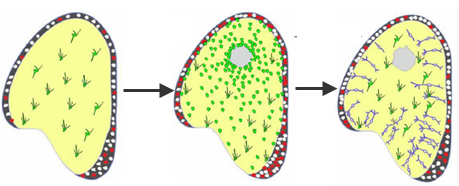
Zebrafish neurogenesis (nerve-cell creation): Left: zebrafish brain showing microglia cells. Center: lesion (damage) results in microglia activation and leukocyte invasion (green cells), which generates inflammation, causing proliferation of radial glia cells (red). Right: resulting generation of newborn neurons (blue). (Credit: Nikos Kyritsis et al./Science)
The zebrafish regenerates its brain after injury, unlike mammals. Is there something we can learn about the process that might help with traumatic brain injury and neurodegenerative disorders?
A research team at the Center for Regenerative Therapies Dresden (CRTD), Germany decided to investigate.
They found that that in zebrafish — in contrast to mammals — inflammation is a positive regulator of neuronal regeneration in the central nervous system, and in fact, is required.
“Our results suggest that acute inflammation can promote central nervous system regeneration, because it provides cues necessary for the initiation of the reactive proliferation and regenerative neurogenesis in adult zebrafish brain,” the researchers say in a Science paper. “Our findings reveal a signaling pathway in zebrafish that couples the inflammatory response to efficient enhancement of stem cell activity and initiation of neural regeneration.”
It it hoped that the research will lead to therapeutic applications in the future.
Comments (14)
by CK
As being one of the authors of this paper, a clarification. The programs (in terms of genes) are all present in humans, but are not activated similarly as in the fish brain after injuries. if such programs can be activated by any means in humans, the regenerative capacity could hypothetically be unlocked. sometimes slight differences could make big changes.
by Sea Bass
Interesting thoughts. I think we already have the components of this system in place, just not in the right order. For the most part (excluding HGT), novel genes and functions don’t necessarily appear out of thin air. They arise from the interaction and evolution of pre-existing domains and scaffolds.
Once we learn how nature did it, we can do it. It is time we start to tinker with our own genetic toolkit!
by asiwel
I wonder whether we can argue that it is the “same” zebrafish after brain regeneration … or learn by experiment whether it has the same “memories” and “skills” – or at least the same stimulus-response patterns that it had leaerned before brain regeneration (maybe these are somehow “weakened” but can be reinforced again). It would be even neater if such “brain patterns” could be stored externally, then the fish brain regenerates, and then the patterns reintroduced successsfully. That would be a primitive form of “fish-brain up- and downloading.”
by alliwant
Inflammation is one of those phenomena that seems to fit my pet peeve about biology, that “survival of the dog with the fewest fleas” is commonplace. I am given to speculate that this ability arose recently in evolutionary terms, and agree that it would be particularly good to target as an augmentation.
by Kat
Neurogenesis (or the birth of new brain cells) occurs when we exercise. I sure prefer that method over messing with my genetics. The misspelling in Bri’s comment above did not go by unnoticed by me.
by MikeB
Fascinating. Equally fascinating: wondering what led them to look at zebrafish in the first place?
by Gorden Russell
Mike B, this fish has been used for a lot of experiments. I first used it in an closed ecology experiment in 1963 when I was 12 years old.
by Editor
Yes, mainly because it’s transparent
by Sea Bass
It was the first complete fish genome sequenced.
by Beatriz Valdes
These abilities seem to reside in animals we left behind in our Evolution voyage. Will there be a way back to recover some of the lost and useful functions?
by Charlie
Reexamine the animals. Recover the lost and useful functions?
by Charlie
Why not create a program of all the functions of a human and cross reference them with the nearest genetic mammals first. Start there? And while you’re at it. Why not genetically determine the beginning of modern mankind if it is possible by metadata and cross-reference of surname. You could also do an evolutionary iq while your at it. Get the drift. Find what is the undertow. Find what is the wave. Understand the function. ???
by Bri
In a nutshell, the zebrafish has evolved a system of biochemical communication that let’s damaged brain tissue direct regenerative stem cell activity. A system that other animals don’t possess. This sounds like a good candidate for genetic augmentation. One can invasion every human having such a system inserted into thier genome.
by Charlie
Twould be interesting to see a human evolve such a mechanism. Why is zebra fish oil and small (>.7ml) regulated doses of sodium oxybate so important? I don’t have a clue. Twould.