Why 3D printing will go the way of virtual reality
January 26, 2012
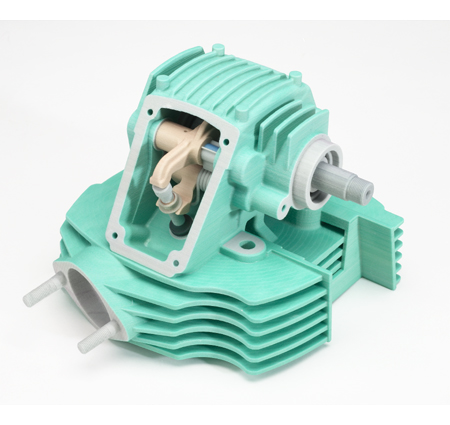
The notion that 3D printing will on any reasonable time scale become a “mature” technology that can reproduce all the goods on which we rely is to engage in a complete denial of the complexities of modern manufacturing, unless you’d like everything made out of plastic, says Technology Review | Mim’s Bits blog.

Comments (13)
by chris Norman
There is no need for shapeways or Kraftwurx.com or anyone else to open shops across the globe. There are already hundreds of bureaus and thousands of small printer shops worldwide and every one of them can print right now. How? Kraftwurx is already tied into nearly 150 discreet locations producing 3D prints for customers worldwide. We make everything as local as we can and as we grow, we are getting closer and closer to being local…right now.
by Steve D
This is wildly incorrect. It’s written from the point of view that technology stands still. It doesn’t. In ten years there will we 3D assembly line factories all over the world working in materials and densities not yet imagined. A wager would be in order.
by Alex
“Experts from the University of Hasselt in Belgium have helped build a 3D printed lower jaw bone for replacement surgery in an 83-year-old woman”
http://www.ibtimes.com/articles/292856/20120203/experts-build-printed-3-d-jaw-implant.htm
This is Why 3D printing will NOT go the way of virtual reality
by Chris Norman
3D Printers will displace a portion of traditional manufacturing of products. It will not fundamentally undermine manufacturing in any foreseeable future. That said, in the next 50 years, what advances in 3D printing will be made?
It is already possible to 3D print Titanium, Inconel, Cobalt Chrome, Stainless Steel, Maraging Steel and even aluminum. The parts are fully dense or very close.
Everyone having a 3D printer at home: Think of them as Betty Crocker ovens. Some kids will have them, others wont. More likely they will go to school classrooms for education. Some kid will grow up thinking about 3D printing and invent the next generation of these things…the Replicator from Star Trek.
In the mean time…and in the foreseeable future of REAL REVENUE, 3D printers will be relegated to exploratory use, small production runs and SOME limited full production runs. In certain markets.
Its all about exploiting the tech for a market that wants or needs it. thus far, its all hype and tinkering inventors that want them, not the kid down the street.
NO, I see the future like this:
Engineers Engineer, Designers Design, Manufacturers Manufacture and Consumers Consume….Its not going to change. What will change is the supply change, and the variety of what can be purchased. Nothing more.
by Michael
For any number of reasons the horse is more practical than the auto-mobile, and will never be replaced by it.
Wannabe futurists should remember how many of their number have failed to consider ALL aspects of change, including the fact that the people who are working on new things are not stupid, also realize their present shortcomings and are constantly attempting to get beyond them..
by {i}Pan~
Here’s a great rebuttal:
http://www.technologyreview.com/blog/guest/27533/?p1=blogs
Why 3-D Printing Isn’t Like Virtual Reality
Before you dismiss it as a fad, consider the evolution of 2-D printing.
TIM MALY 01/27/2012
by Editor
Ray Kurzweil comments:
“This person is imagining that 3D printing will never move beyond the materials that are currently used. The scope of materials is expanding and will include electronics in a number of years. Within 20 years they will be moving molecules around and will use machinery modified from biological assemblers such as the ribosome and chaperone molecules (which fold up amino acid sequences into proteins). This article is typical myopic thinking that assumes not much will change with the current state of the technology. There is never a shortage of articles such as this about every emerging technology.”
by Cybernettr
Even more interesting than this article was the one by Mims on virtual reality (linked to in the same article). Computers are thousands of times faster than they were in the ’90s — so how come widespread VR still isn’t here? As for 3-D printing, I think one of the commentators to Mim’s post hit the nail on the head — 3-D printing will be like robots, which are heavily used in industry, but are nearly absent from the home, except for toys and the occasional Roomba. 3-D printing will likely be the same way. Creating usable 3-D objects will remain too complex for most people.
by Matthew Crenshaw
The title is kind of silly. A lot of things are plastic parts. So 3d printing doesn’t need to take over everything else to be a mature technology. Maybe by going the way of virtual reality he means it will be a huge success, as measured by the revenue of Blizzard and its World of Warcraft?
by star0
Absolutely correct that 3D printers in the home will not replace all the traditional manufacturing processes we now have ANYTIME SOON; and absolutely correct that we will not be able to just print out any item we please using home 3D printers ANYTIME SOON.
What is much more likely to happen in the near future is that there will be operations like shapeways that open up 3D printing centers in cities across the country (US), which can print using a wide variety of materials, using high-end 3D printers. In many ways, such centers will be like Kinkos — Kinkos for the 3D printing crowd.
On the other hand, I wouldn’t count on 3D printers being unable to replace your local Wal-Mart, say. It will happen eventually, if amazon.com and similar websites don’t do it first (online shopping). It will one day be possible to even print out wood furniture using 3D printers — in fact, they can already print using wood powder and sawdust. And a day will come when bioprinters will not only be able to print human organs, but also wood planks by gluing together plant cells. When will that be? Can’t say for sure… but I would bet this decade we will see prototypes that can do it.
by Your Mobile Site
I’ve read the article and also some of the pages it links to.
The problem with Mims’ argument is that he simply compares 3D printers to VR just like that. As if it is obvious that these two are perfect parallels of each other.
VR is like jetpacks: feasible, but impractical.
3D printers are feasible, but certainly not impractical. Mims himself concludes this in his ending paragraph, where he provides evidence that 3D printers are already having a huge impact in traditional manufacturing.
Just because of that fact, there is no way that 3D printers could ever ‘go the same way as VR’.
3D printing in traditional manufacturing will lower the costs of products, which leads to decreased prices.
Decreased prices lead to an improvement in spending power. An improvement in spending power leads to a higher quality of life.
3D printers are in no way like VR, which was all eye candy whose time simply hasn’t come yet. VR might follow Gartner’s Hype Cycle, but that doesn’t mean 3D printers will do as well.
I’ve seen a usable wrench come out of a 3D printer.
http://www.youtube.com/watch?v=pQHnMj6dxj4
Cheap plastic my hiney. And who knows what more materials science can come up with in the next few years.
In recent times, I see more and more news articles on circuitry integrated in materials.
Once 3D printers will be able to print materials with integrated circuitry, the proverbial sh#t will have hit the fan!
You can expect a global surge in broken piggy banks around the time that happens.
While we’re comparing 3D printers to other technologies… why not compare them to computers?
There was a time when people thought ‘there is a global market for maybe 5 computers’ and that ’1 kilobyte of ram should be enough for everybody’, wasn’t there?
We all know how that turned out.
by {i}Pan~
Christopher Mims is a moron.
by Dizzle
If it becomes a battle casualty it will be able to repair itself. I hope we will have the same capabilties when we go to war with it.
Read my .99cent ebook. It’s 2048 and It Happened at Nextfest.
http://www.amazon.com/dp/B004RD9EEY/