Wind power not enough to affect global climate
September 11, 2012
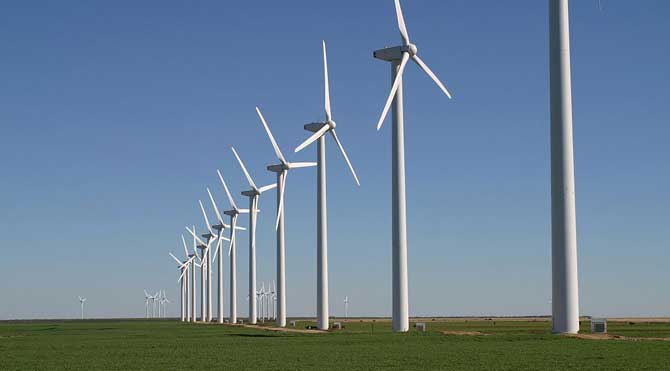
Wind farm (credit: Wikimedia Commons)
There is enough power in the Earth’s winds to be a primary source of near-zero emission electric power for the entire world, but some scientists have been concerned they would substantially affect climate.
In related news today, Stanford University and University of Delaware researchers found that there’s plenty of wind over land and near to shore, using 4 million turbines, to supply 7.5 terawatts of power without significant negative affect on the climate.
A 2004 Stanford University study (open access) of general circulation found that “large-scale use of wind power can alter local and global climate by extracting kinetic energy and altering turbulent transport in the atmospheric boundary layer.”
But a Lawrence Livermore National Laboratory climate scientist and collaborators who studied the geophysical limits to global wind power has now challenged its validity for current power demand levels.
“The future of wind energy is likely to be determined by economic, political and technical constraints rather than geophysical limits,” said Kate Marvel, lead author of the paper and a scientist in the Laboratory’s Program for Climate Model Diagnosis and Intercomparison.
Wind generators could power the world 100 times over
Current total global power demand is about 18 terawatts. Using a climate model, Marvel, along with Ben Kravitz and Ken Caldeira of the Carnegie Institution Department of Global Ecology, estimated the amount of power than can be produced from both near-surface and high-altitude winds. They found that wind turbines placed on the earth’s surface could extract kinetic energy at a rate of at least 400 terawatts,
However, airborne turbines that convert steadier and faster high-altitude winds into energy could generate even more power: more than 1800 terawatts.
These geophysical limits on airborne wind power exceed the present global primary energy demand of 18TW by factors greater than 20 and 100, respectively.
Effects on climate negligible at current demand
The study examined the limits of the amount of power that could be harvested from winds, as well as the effects high-altitude wind power could have on the climate as a whole.
Turbines create drag, or resistance, which removes momentum from the winds and tends to slow them. As the number of wind turbines increases, the amount of energy that is generated increases. But at some point, the winds would be slowed so much that adding more turbines will not generate more electricity. This study focused on finding the point at which energy generation is highest.
At maximum levels of power generation, there would be substantial climate effects from wind harvesting. But the study found that the climate effects of extracting wind energy at the level of current global demand (about 18 terawatts) would be small, as long as the turbines were spread out and not clustered in just a few regions. At the level of global energy demand, wind turbines might affect surface temperatures by about 0.2 degrees Fahrenheit and affect precipitation by about 1 percent. Overall, the environmental impacts would not be substantial.
It is likely that wind power growth will be limited by economic or environmental factors, not global geophysical limits, they concluded.
.